
Central Africa 1837 CE




What is happening in Central Africa in 1837CE
Slavery
Despite the prohibition of the Atlantic slave trade by Britain and other European countries in the early 19th century, the export of captives for sale has continued from Angola. The captives are now mostly destined for Brazil, and the trade is largely in the hands of Brazilian merchants and shippers.
Slavery has also increased within Central Africa itself. As in West Africa, this is the result of more intensive local production, especially of export crops. There is also a growing demand for slaves as porters along the trade routes, caused by a rise in the export of ivory.
East Africa
Also, the number of slaves being exported from East Africa is growing. This is because Brazilian traders have not been getting enough slaves for purchase on the Angolan coast, and have therefore expanded their activities into the Indian Ocean. At this time most of these slaves are purchased from the Portuguese-controlled coast of Mozambique.
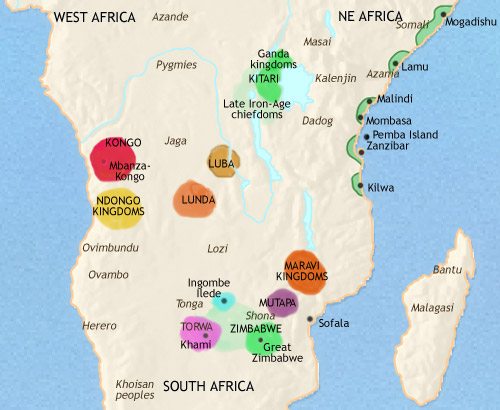
In the 1830s, societies over a large area of East-Central Africa have been disrupted by invasions by the Ngoni people, escaping the turmoil affecting much of southern Africa at this time.
The Ngoni introduce into the region an entirely new style of military organization. This is based on age-regiments, recruited from different tribes and states without regard for traditional loyalties. This made it easy for these Ngoni groups to absorb conquered peoples into their societies, whilst creating highly disciplined bodies of troops.
The Ngoni diaspora has created brand new states, such as the Kololo kingdom, which occupies the southern territory of the former Lozi kingdoms, and the Ndebele kingdom in the area of present-day Zimbabwe.
Dig Deeper
Sources:
What is happening in Central Africa in 750CE
Bantu farmers had spread through the Congo forests, and then into southern and eastern Africa, at start of the Christian era; they had settled in small, scattered villages on lake shores and in river valleys, moist areas suited to their early iron-age farming technologies. Stone-age hunter-gatherer populations were still sizeable in central Africa in the first millennium CE.
Cattle herding was uncommon in most of central Africa. Due to tsetse fly (fatal to cattle) it was limited to areas of open grasslands, such as those in the Great Rift Valley and the Serengeti plains. In the southern areas, however, the dry, open grasslands were ideal for cattle. From 650 CE onwards a cattle herding culture, the Toutswe, has spread over a broad area.
By this date, communities located along the shores of the Indian Ocean had long been in trade contact with the Middle East and India. Some important towns, such as Lamu and Rhapta, had grown up here.
Next map, Central Africa in 979 CE
Dig Deeper
Premium Units
World Trade Routes : The Medieval World 750 CE
Sources:
What is happening in Central Africa in 979CE
In east Africa, the clearing of forests by generations of farmers had by this date created more open landscapes, favouring a cattle herding lifestyle. Pastoral peoples came in from southern Sudan and settled, probably as a ruling class, amongst Bantu farming populations in the Lake Victoria/Tanganyika region. The mixing of the two populations seems to have stimulated marked advances in technological development. At the same time, more, and larger, towns became established along the Indian Ocean coast. These towns became home to a mixed Arab-African culture, later called “Swahili”. From them, trade routes spread further and further inland, bringing with them new ideas and techniques.
Rippling out from the Lakes region, there are signs of late Iron-age culture, with new farming techniques (for example, terracing), more effective weapons for fishing, hunting and war, more sophisticated textiles and pottery, increased trade and greater class differentiation. Politically, this period sees the start of the formation of powerful chiefdoms, to be followed shortly by full-blown kingdoms.
Next map, Central Africa in 1215 CE
Dig Deeper
Premium Units
World Trade Routes : The Medieval World 979 CE
Sources:
What is happening in Central Africa in 1215CE
The trade routes radiating out from the coastal cities of east Africa have continued to thrive and spread. Inland, the past centuries have seen farming and fishing, and mining and craft, techniques improving all over central Africa. Communities were specializing more, in such activities as mining, metalwork and hunting, a development closely linked to the expansion of trade. Late Iron Age populations grew, and the remnants of hunter-gatherer peoples were squeezed more and more into deep forests (pygmies) or dry deserts (San). In the Lakes region, small chiefdoms have been emerging. In grassland areas, cattle herding has become ever more important, particularly in the south; this too has favoured the formation of chiefdoms. The Leopard’s Kopje culture is the product of warlike and chiefly pastoralists, with strong trade links with the Swahili cities of the Indian Ocean coast. Its final flourish comes, at about this date, with the transition to the Great Zimbabwe culture, with its large, stone-built settlements anchoring a sophisticated, hierarchical society.
Dig Deeper
Premium Units
World Trade Routes : The Medieval World 1215 CE
Sources:
What is happening in Central Africa in 1453CE
This period has seen kingdoms appearing in different parts of central Africa. Some of these are linked to the continued expansion of the trade routes from the Indian Ocean. Most notably, the inhabitants of Great Zimbabwe have benefited greatly from their control of the gold trade down the Zambezi Valley to the coast. After flourishing for several centuries, however, Great Zimbabwe is abandoned at around this time. New centres of trade and power are coming to the fore, centred on the town of Ingome Ilede and the Mutapa kingdom.
The Luba people of the Congo forest fringes have organized an important kingdom (c. 1400), and other kingdoms have emerged elsewhere – Kongo, the Ngondi states, Kitari and the small Ganda kingdoms.
At this time, the pastoral Maasai people are beginning to migrate southwards from their homeland in present-day northern Kenya, and on the Atlantic coast, the Herero have adopted the cattle-keeping economy and are moving into the dry grasslands of Namibia.
Dig Deeper
Premium Units
World Trade Routes : The Medieval World 1453 CE
Sources:
What is happening in Central Africa in 1648CE
The spread of American maize and cassava is leading to population growth, and has boosted the process to state formation in central Africa. Kingdoms modelled on the Luba state (and in some cases offshoots of it) have appeared amongst the Lunda and the Maravi, the Imbangala (Kasanje) and the Lozi. Other kingdoms – Loango, Tio and Kuba – have been formed in areas of dense population within the vast Congo forests. Tutsi pastoralists have established their rule over states in the Lakes region, in the area of modern-day Rwanda and Burundi.
The Slave Trade
On the Atlantic coast, a new factor in central African history has been increasingly felt since the late-15th century: European demand for African slaves. The kingdom of Kongo was the first to feel its impact – the kingdom now survives in name, but central royal authority has declined in the face of rival warlords competing for war captives to sell to the Europeans.
In Cantral Africa the Slave Trade is dominated by the Portuguese, who have set up two bases on the Atlantic coast, at Luanda and Benguela. From these, the slave trading routes are gradually extending inland, destabilising kingdoms and spreading anarchy and violence.
East Africa
The Portuguese have also made their presence felt on the Indian Ocean coast, where they have attacked the Swahili states and occupied some. Inland, in the lower Zambezi valley, Portuguese settlers called prazeros have carved out large landed estates, They have set themselves up as a local aristocracy there, forcing the local population to work for them.
The kingdom of Matupa has grown powerful in the past century or so, and now blocks Portuguese penetration into the interior.
In what is now Kenya, groups of Maasai pastoralists are arriving in their modern homeland from the north, while Kikuyu farmers have begun moving into theirs from the north eahttps://timemaps.com/history/africa-1789ad/st.
Dig Deeper
Premium Units
World Trade in the Early Modern Period – 1648
Sources:
What is happening in Central Africa in 1789CE
Western Central Africa
The Angolan interior is a regular source of captives for the Atlantic trade for most of 17th and 18th centuries. These are supplied by the conflicts that are now endemic in this region. The warfare is fed by cheap European guns.
The Lunda kingdom has put out several offshoots, most notably Kazemba’s Lunda. Along with Kasanje, these form the heart of the trading network which by now covers much of Central and East Africa.
It is not only captives that move along the routes: ivory, beeswax, salt and copper are also important commodities. These are exchanged for European and Indian textiles, shells, beads, metal goods from Europe – and of course guns. The Bisa people supply many of the professional merchants who operate the long-distance trading caravans along these routes.
In East Africa, the Bisa traders deal with the Yao, who have also developed into long distance traders. They have pioneered trade links with the Portuguese in Mozambique and the Swahili in Kilwa.
East Africa
In the region of modern Tanzania, long-distance trade is in the hands of the Nyamwezi, who operate regular caravans between their capital Tabora and Zanzibar.
In the second half of the 18th century, the trade in captives for sale becomes increasingly important in East Africa. This is mainly due to the expanding demand for slaves to work the sugar plantations on the French islands of Mauritius and Reunion.
The Maravi kingdoms (which took up parts of what are now Malawi, Mozambique, Zambia and eastern Zimbabwe) disintegrated in the 18th century, as local chiefdoms asserted their independence. In their place, a new power has emerged. This was founded by a warlord called Changamire, who in the later 17th century built up a much-feared army known as the Rosvi (“the destroyers”). This state is therefore known as the Rosvi empire.
The Great Lakes Region
On the northwest shores ion Lake Victoria Nyanza, in what is now Uganda, the kingdom of Buganda has risen to dominance. This is the most centralised and best-organised state that has appeared in the region.
To the east of Lake Victoria, the expansion of the Maasai is now moving down the Rift Valley into northern Tanzania. The Maasai bands are organized for war, and though not united, are more than a match for the other peoples in the region. They are able to seize by force the grazing lands of other pastoralists they encounter along their way.
On the shores of Lake Tanganyika, the kingdoms of Rwands and Burundi have emerged, both under the control of the Tutsi people.
The Omani empire
At the end of the 17th century the Portuguese were expelled from the Mombasa area by Arab and Swahili forces under the control of the Sultan of Oman (on the Arabian peninsula). From Mombasa, the Omanis have extended their rule over other Swahili city-states along the coast.
Dig Deeper
Premium Units
World Trade in the Early Modern Period – 1789
Sources:
What is happening in Central Africa in 1871CE
The expansion of trading and raiding
The expansion of the slave trade in East Africa in the late 18th and early 19th centuries has already been noted. In the mid-19th century the trade received another boost. This occurred in 1840, when the sultan of Oman, whose empire stretched down from the Arabian peninsula to take in an increasing number of Swahili city-states, moved his capital to the island of Zanzibar. This coincided with a rise in the number of clove plantations on the island, which increased the demand for slaves. Zanzibar soon became the largest slave market along the East African coast. In the 1860s it was exporting 70,000 slaves a year to the Middle East.
At the same time as the slave trade expands, so too does the ivory trade. The new wealth being created by industrialisation in Europe has created a huge demand for ivory for such baubles as billiard balls, piano keys (nicknamed “ivories”) and handles of cutlery. Ivory hunting is a peculiarly violent activity, second only to slave raiding itself. The heavily armed hunting gangs, largely made up of brutalised young men, spread anarchy wherever they operate.
During these decades the demand for ivory and slaves pushes this trading and raiding far into interior of Central Africa. Often the two activities could barely be distinguished from each other. This is clearly illustrated in the rise of a new power in Central Africa, the Chokwe kingdom. Its power is based on armies composed of both professional slave raiders and ivory hunters.
The pioneering work of opening up new trade routes is usually done by Nyamwezi and Yao traders. They are creating a trade network covering all regions of central and eastern Africa.
Once established, most of the trade is carried on in huge caravans of donkeys and camels under leaders form the coastal city-states, most of whom are probably of mixed Arab and Swahili race. The caravans are often composed of hundreds of men – well-armed hunters and raiders, and of course porters.
Traders-turned-rulers
Some enterprising traders set up bases in the deep interior of Africa which acted as notes in the trade network. In the 1850s a Nyamwezi trader called Mrir created a base which took over from the Kazembe kingdom as a major pivot in the coast-to-coast trading system. He in effect created a state, and his people called themselves the ‘Yeke’.
An even more successful trader-turned-ruler was Tippu Tip. He was an Arab/Swahili trader who gained control over based in the upper Congo river. From these, hunting and raiding expeditions set out, and villages over a wide area were brought into Tippu Tip’s tribute (or “protection”) system.
Region-wide horror
Large swathes of Central Africa have sunk into generalised bloodshed and chaos, and many small farming communities in the region have taken to surrounding their settlements with high stockades for protection. European Christian missionaries working in these regions – most notably, the Scottish missionary-explorer David Livingstone, react with horror at the conditions they encounter. They soon conclude that only the intervention of European governments could rescue the peoples of this huge region from their sufferings.
Dig Deeper
Sources:
What is happening in Central Africa in 1914CE
The Congo Free State
In 1874-77 Henry Morton Stanley completed Livingstone’s work of exploration by sailing down the River Congo from an upper tributary to its mouth. He did so at the head of a heavily armed expedition, against fierce opposition from the local peoples he encountered.
Stanley was then recruited by King Leopold of the Belgians to make treaties with local rulers in the Congo region. These laid the foundations for King Leopold’s ‘Congo Free State’. This was in fact Leopold’s personal empire, not subject to any governmental control from Europe.
To clear the way for Leopold’s control to extend over the whole Congo basin (apart from the north, see below), two powerful local rulers had to be dealt with, Tippu Tip and Msiri. Tippu Tip was at first persuaded to become governor of the Free State’s eastern provinces, but soon retired to Zanzibar. Eighteen months of savage war followed before his kingdom’s territory was able to be incorporated fully into the Free State.
Msiri’s Yeke kingdom, on the other hand, offered little effective resistance after a Belgian army officer shot Msiri dead. By the time of his death Msiri’s tyrannical rule had undermined support for him, and his death went unavenged.
The Congo Free State soon became an extraordinarily oppressive colony, with millions of local people forced into working for the Belgians under the harshest conditions. Gradually African residence mounted, and by the mid-1900s the authority of the Belgians was under serious threat. This, combined with an international outcry at the cruelty shown to the local peoples, led to Leopold having to hand over his personal control to the Belgian parliament. This soon resulted in the worst abuses of the system coming to an end.
French Central Africa
In the early 1880s, the French had been working to secure treaty relations with local rulers north of the River Congo. In 1884-5 they used these treaties to claim rulership over this region, and by the early 1890s had established the colonies of Gabon, Moyen Congo (Middle Congo), and Ubangui-Chari (the territory of the Central African Rep).
The treatment of the local people by the French colonists was not as terrible as in the Congo Free State, but it was still appalling.
The Portuguese Central and East Africa
South of the Congo Basin, the Portuguese had dominated the coast of modern day Angola for centuries. With other European nations now laying claim to large chunks of Africa, however, they now started making good their claims to hinterland.
Not being able to field a large army, the Portuguese adopted the traditional policy of exploiting rivalries amongst local rulers. Nevertheless, Portuguese rule took a long time to be established: many local peoples continued to defy their authority until well into 20th century.
The Portuguese had also been involved in the territory of modern Mozambique for several centuries. Here, resistance to Portugal expansion was widespread, including from prazeros, whose ancestors had originally come from Portugal. Portuguese forces were eventually able to overcome, aided by traditional rivalry between local peoples.
The Germans in Central and East Africa
In the territory of modern Namibia, the Germans proclaimed a protectorate over the coastal region in 1884. In 1890 they expanded into the interior, where they exploited the age-old rivalries between the Nama and Herero peoples to gain control. In the early years of the 20th century the region saw the rapid spread of German settlement.
In East Africa, the German government declared a protectorate over the Tanganyika mainland in 1885. A private merchant company was granted the right to exploit the region, and its harsh treatment of local peoples soon led to an uprising within the territory. It was only in 1889, when the German government had taken full control and called in reinforcements, that the rising was defeated.
The brutality of German rule led to rebellion breaking out near the coast in 1905. Fighters sprinkled themselves with magic water known as maji-maji, and tried to storm German machine guns. They were mowed down in their thousands. In 1906 gradually brought back central highlands under their control, laying waste to vast stretches of land.
In the immediately aftermath, the Germans authorities reduced their use of violence in enforcing their authority, for fear of provoking another rising.
The British in East Africa: Uganda and Kenya
An Anglo-German treaty of 1890 confirmed the territories of modern Kenya and Uganda as falling within the British sphere.
In Uganda the British benefitted from rivalries between the local states to establish a protectorate in 1894. In Kenya, the British established a protectorate in 1895. There was some initial resistance at the coast, but this was soon overcome. Like the Germans, the British granted to a private merchant company rights to exploit its East African territories.
In 1900 British authorities agreed with local Ugandan chiefs not to take land for white settlement, and local chiefs and peasant farmers benefitted from the demand for cotton that the new Uganda railway stimulated.
The Kenyan highlands of the interior were practically untouched by these early developments, but this changed with the completion of the Uganda Railway from Mombasa to Kisumu, on the shores of Lake Victoria, in 1901. This connected the highlands to the coast, and made it an attractive region for European-style agriculture. The British colonial authorities pursued a policy of turning the entire area over to white farmers, with the local African population reduced to subordinate workers. This policy inevitably led to conflict (1901-8), but British military superiority eventually prevailed.
The British in East Africa: Rhodesia and Nyasaland
In the 1870s, in the area of modern Malawi, attempts to establish “Christianity and Commerce” as an alternative to continuing slave trade failed. In the 1880s missionaries appealed of the British government to intervene to suppress the slave trade. This led eventually to the establishment of the Central African Protectorate in 1889. A few years later this was renamed Nyasaland.
From this base, the British expanded into the region of modern Zambia. A major coup came in 1889 when the king of Lozi sought British protection from Ndebele raiding. This was granted in 1890 as the Protectorate of Barotseland, in exchange for British control of mineral rights.
Meanwhile Cecil Rhodes and others had come to believe that the territory of modern Zimbabwe was rich in gold. This was land occupied by the Ndebele, and their King was tricked into signing over commercial rights to one of Rhodes’ agents. The British government then backed the occupation of the region by Rhodes’ newly-formed British South Africa Company. It soon became clear that there was little gold to be had, but the country was carved up into white-owned farms. In 1896-7 the Ndebele and Shona rose against their conquerors, but Rhodes’ company was able to call on British forces from the Cape and overcame it.
Next map, Central and East Africa 1960
Dig Deeper
Sources:

Subscribe for more great content – and remove ads