
West Africa in 1837



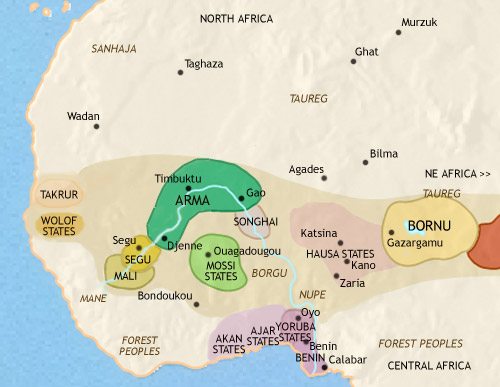


What is happening in West Africa in 1837CE
The slave trade was banned by most European countries in the early 19th century. Although very little changed for some time – the British warships sent to stop the trade were too few and slow to make much difference – during the years since then the slave trading networks have become increasingly disrupted.
The decline of the Slave Trade, and its effects
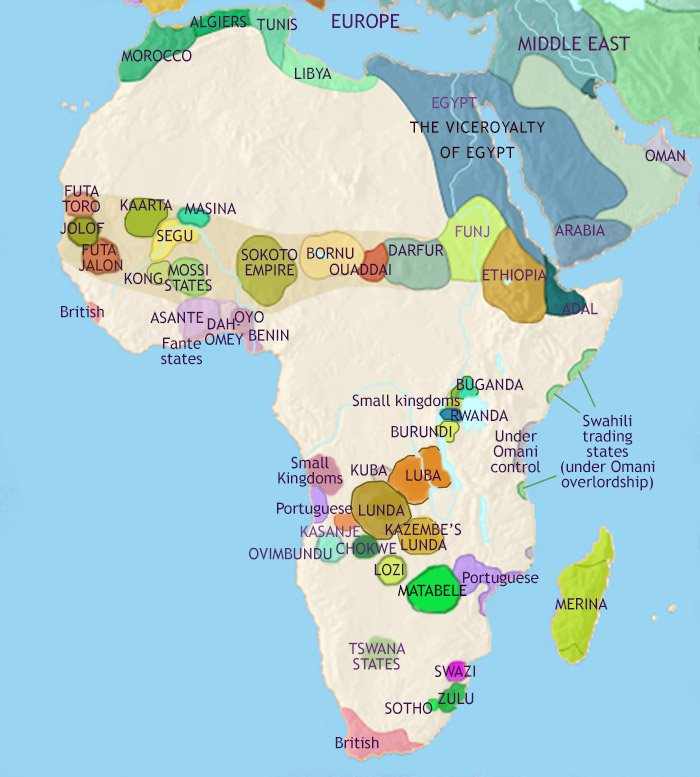
In some places, the ban on the Atlantic slave trade has led to politic upheaval. Dahomey has been badly weakened with the decline of the trade routes through its territory, and the power of Oyo collapsed in 1817 in the face of internal rebellion.
Many African chiefs on the coast have resisted the ban on the slave trade, the source of their wealth and power for so long. The British have responded by modifying their traditional policy of non-interference in the affairs of African chiefdoms, and in some places have imposed anti-slavery treaties on them. They have also taken steps to enforce these treaties. In this way the control of the Gold Coast, in modern-day Ghana, has passed from the Asante to the British (1817); and British influence over the hinterland has expanded step-by-step since then.
The growth of legitimate trade
The British and other Europeans have made efforts to replace the trade in captives with more acceptable commerce (called “legitimate” trade by the British). Palm oil in particular is growing in importance. This commodity is proving very useful in keeping the machines running in the new European factories.
Legitimate trade is proving so successful that the overall value of the commerce between West Africa and Britain has in fact overtaken that of the slave trade at its height.
Colonial settlements
In 1808 the British gained a foothold on the West African coast when they established Freetown, in modern day Sierra Leone. This was a settlement for African captives freed from slaving ships by the Royal Navy. The colony soon become a centre of Western education in West Africa, and in 1827 the first European-style higher education institute in Africa, Fourah Bay College, was founded.
Another outpost for freed slaves of African descent was established in 1822 when a group of Americans founded the colony of Liberia. These settlers were Afro-American ex-slaves from the United States. Like Freetown, it also soon became a centre of Western education in the region.
Jihads on the Savannah
In the interior, on the savannah, a major development has occurred with the rise of a huge new state, the Sultanate of Sokoto. This has come about by another Islamic jihad (Holy War), this time against the rulers of the Hausa city-states.
This mostly took place between the years 1805-9, and in fact took the form of a number of local jihads. These were only loosely co-ordinated under the supreme leadership of an Islamic Fulani scholar called Usman dan Fodio. His aim was to purify Muslim worship and practice within the Hausa area. He and his (mostly) Fulani followers, with the backing of many Hausa peasants, drove out the Hausa ruling families of thirty Hausa city-states, and installed themselves as a new ruling class. Dan Fodio’s son, Muhammed Bello, has founded a new city, from which he takes the title Sultan of Sokoto. Usman dan Fodio died in 1828, and was succeeded as sultan by Bello, who has put the state on a stable basis.
A separate jihad, also Fulani led, has created the Empire of Masina in the western Savannah (1818), with its capital at Hammdullahi. Like the Sokoto sultanate, it was founded by a Muslim cleric intent on creating an Islamic state. This state has a clearer commitment to Islamic principles than the Sokoto sultanate, with councils of Muslim clerics holding considerable power at all levels of government.
European exploration of the interior
Since the late 18th century European explorers have begun probing the interior of West Africa. Up to this time this huge region had remained largely a mystery to Europeans.
These explorers mostly travelled along the long-distance trade routes which criss-crossed the region. The Scots explorer Mungo Park made his way to the River Niger twice (1795-7 and 1805-6), and others followed. It was not until the 1830s, however, that it was discovered that the ‘Oil Rivers” on the coast of what is today south-eastern Nigeria were in fact the Niger Delta.
The high mortality rate from malaria means that these explorers have not been followed by European traders, missionaries, settlers, soldiers or government officials in any numbers.
Dig Deeper
Sources:
What is happening in West Africa in 500CE
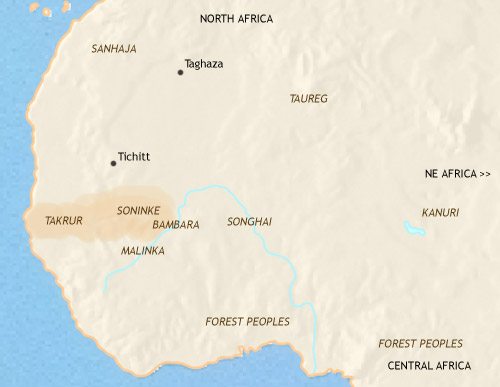
The trans-Saharan trade had become well-established by 200 BCE at the latest. However, it remained small-scale for several centuries, with goods being carried from one oasis to another by different Berber groups. All this changed when camels came into regular use on the route. These large animals are superbly adapted for desert environments, and their use enabled the trans-Saharan trade to expand enormously. This set in train a competition for control of the southern sectors of the trade routes, which in turn stimulated the emergence of large chiefdoms. Importing horses from the north, some chiefs were able to form cavalry forces and so dominate surrounding villages more easily. Kingdoms are in the process of being formed.
Next map, West Africa in 750 CE
Dig Deeper
Premium Units
World Trade in the Classical Era 500 CE
Sources:
What is happening in West Africa in 750CE
With the establishment of Muslim power in North Africa, the long-distance trade across the Sahara received a further boost. This stimulated trade within the Saharan and sub-Saharan regions. Large towns appeared, with organized networks of markets. Powerful kingdoms also became established. The most famous of these was the kingdom of Ghana. The Soninke people of Ghana acted as middlemen in the gold trade, keeping the source of gold a secret from the Berber traders. Gold was traded for salt (a highly-prized commodity in the region) at king’s capital.
Takrur was another West African kingdom of the period, controlling the southern end of the westerly trade route to Morocco.
Next map, the West Africa in 979 CE
Dig Deeper
Premium Units
World Trade Routes : The Medieval World 750 CE
Sources:
What is happening in West Africa in 979CE
The trans-Saharan trade has continued to expand. Through them, Islam has been brought to West Africa, and is spreading amongst the merchant and ruling classes.
The expansion of trade has led to several new kingdoms being established in the western savannah, including Songhai and Mali. A major new kingdom has also appeared in the central savannah lands, Kanem, on Lake Chad. This is at the southern end of an eastern trans-Saharan trade route which has recently been opened up. The Hausa trading city-states of present-day northern Nigeria are beginning to emerge, and traders based in the savannah are now penetrating the southern forests.
Next map, West Africa in 1215 CE
Dig Deeper
Premium Units
World Trade Routes : The Medieval World 979 CE
Sources:
What is happening in West Africa in 1215CE
In the mid-11th century a Muslim religious movement, the Almoravids, briefly conquered a large area of the western savannah country, giving the spread of Islam a huge boost and undermining the power of Ghana.
The long-distance trade networks are now spreading into the forest region to the south of the savannah. This is stimulating urbanisation: the Yoruba people are forming a network of towns, and the Edo have founded the city of Benin. The bronze and brass sculptures for which this region is justly famous are already being produced.
Dig Deeper
Premium Units
World Trade Routes : The Medieval World 1215 CE
Sources:
What is happening in West Africa in 1453CE
In the 14th and 15th centuries, the kingdom of Mali grew into a large empire, and then declined again. A major upheaval has affected Kanem. Faced with internal revolt and nomadic invasion from the east, a king moved south with his loyal followers and set up a new state in Bornu.
Islam has continued to spread. For example, during the 14th century the rulers of the Hausa city-states accepted Islam. The cities of the western savannah lands have become centres of Muslim scholarship.
New states have been formed amongst the Mossi people of the northern fringes of the forest region. These have become middlemen in the trade between the savannah and the forest. In the latter, Benin is now a flourishing city, and in Yorubaland, the city of Oyo was founded in 14th century, The West African trading networks have now reached the coast.
Dig Deeper
Premium Units
World Trade Routes : The Medieval World 1453 CE
Sources:
What is happening in West Africa in 1648CE
Songhai was the next West African kingdom to grow into a large empire, but in the late 16th century it was conquered by a Morrocan army from the north. Moroccan soldiers and settlers have since formed the Arma state in the western Savannah. To the east, kingdom of Bornu has gained stability and prosperity. It has reconquered its historic heartland, lost to it in the 15th century.
Since the mid-15th century European merchants and sailors have become increasingly active along the West African coast. The Atlantic Slave trade is by now in full swing, with tens of thousands of captives being taken from the region each year. In return for supplying slaves, the African kings and traders demand metalware, cloth, spirits and guns. Inland, the slave trade is entirely in the hands of local African traders, often operating large, well-organized enterprises.
Dig Deeper
Premium Units
World Trade in the Early Modern Period – 1648
Sources:
What is happening in West Africa in 1789CE
West Africa and the Atlantic slave trade
The 18th century has seen the Atlantic slave trade reach its peak.
As the slave trade has expanded, new sources of captives have been opened up. From the length and breadth of West Africa, war captives and the victims of slave raids are being sent to the coast for sale into European ships.
There seems little doubt that the impact of the Atlantic slave trade is being felt by societies throughout the entire region. The armies of the leading states are now equipped with guns. Their traditional annual sweeps for captives, long pre-dating the coming of the Atlantic trade, have become far more effective. In Senegambia, new kingdoms have arisen which are structured around armies of mounted, gun-toting slaves, organized primarily for slave raiding.
Under these circumstances, it is hardly surprising that the increase in demand for captives coincides with turmoil in this region. Quite apart form the widespread slave-raiding. several kingdoms have been expanding their borders. In today’s Ghana, the kingdom of Asante, inland from the coast, has emerged as a leading power in a bloody contest with its rivals. To the east, the West African kingdoms of Oyo and Dahomey have also been expanding in this period. These wars of conquest produce tens of thousands of captives each year, who are sent to the coast for sale as slaves.
New coastal societies
Many coastal communities have undergone a social revolution as a result of the Atlantic trade. Hybrid Afro-European societies have grown up here, under African elites whose members often have a European-style education.
In the region where the great river Niger reaches the coast in a wide delta, a brand new group of societies have appeared, created by the slave trade itself. These trading states are built around “canoe houses”. Originally family households, these have expanded to become large trading companies. They send fleets of canoes upstream into the interior, to collect slaves for sale to the Europeans on the coast.
The Savannah
In the savannah region south of the Sahara desert, Segu, Kaarta and several Mossi kingdoms have emerged as the most powerful states. Islam has continued to spread, notably amongst pastoralist groups called the Fulbe (or Fulani, as they are called in the eastern part of West Africa).
As pastoralists, the Fulbe are looked upon as outsiders by the majority of the population, who are farmers. This may have made them more open to Islam, which is still regarded by the mostly pagan peasantry as a foreign religion. In the western savannah, the Fulbe have launched two jihads (Holy War) against their farmer neighbours. The first has created the Islamic kingdom of Futa Jalon (1750), while the second created the kingdom of Futa Toro (1776).
The Fulbe, originating in the western savannah, have also spread eastwards over several centuries. Many have settled in Hausaland (where they are called the Fulani). Here, they make their home in the rural areas between the Hausa cities. More will be heard of them later.
The Hausa have come to dominate the commerce of the interior. The main commodity are captured men, women and children, Year by years, tens of thousands are sent southwards to the Atlantic coast, or northwards across the Sahara to the Middle East.
Dig Deeper
Premium Units
World Trade in the Early Modern Period – 1789
Sources:
What is happening in West Africa in 1871CE
The Atlantic slave trade has continued to decline during the 19th century. The abolition of slavery in the Americas (within the British West Indies in 1834, in the Spanish Empire and the United States in the 1860s; for now it continues in Brazil), means that the slave trade is now in terminal decline. West Africa’s exports to Europeans, however – in palm oil (for greasing machines), gum (used in textile dyes) and other products have continued to grow strongly.
Western colonies
We have already noted the establishment of the British colony of Freetown, or Sierra Leona, in 1808, as a new home for freed captives. Elsewhere, attempts to stamp out the slave trade, and then slavery itself, have led the British to imposed anti-slavery trade treaties, and this in turn has induced them to interfere more and more in the affairs of African states along the coast. Since the 1840s the British have brought the Fante chiefdoms on the Gold Coast (the coastal region of modern day Ghana) into a formal state of subjection.
In 1861, the British annexed the city-state of Lagos in order to shore up their position on the coast of what is now Nigeria. This incident reflects not only the strong desire to eradicate the slave trade, but also the growing rivalry in the region between Britain and France. The French have been expanding their power in Senegal since the 1850s from their coastal base of Gorée up the Senegal river. They have conquered the neighbouring Wolof peoples in this region. The French have also become increasingly active along the coast, especially near Lagos (hence the British action to forestall the further extension of their rivals’ influenced in this area).
In those (still small) areas brought under European control, an African Christian elite has been emerging, educated along western lines and fulfilling roles as clergy, lawyers, government officials and traders. Sierra Leone and Liberia have contributed the lion’s share of this group.
In 1847, the settlers of Liberia declared their independence from the United States. They adopted a Republican constitution modelled on that of the United States.
Slavery within West Africa
The decline of the Atlantic slave trade has led to the expansion of slavery within West Africa, as cheap surplus captives have increasingly been made available by the decline in demand from Europeans. They are mostly put to work on the growing number of plantations producing palm oil and other forest crops for export to Europe.
The expansion of slavery has led to slave revolts, followed by harsh reprisals. European commentators remark on a growing atmosphere of fear and cruelty within West African societies at this time.
The interior
The Sultanate of Sokoto continues to flourish. The governing elite of this empire – the emirs, royal families, commanders and officials – are almost all Fulani. These have more or less given up their traditional pastoral lifestyle and settled down in the Hausa cities. They have adopted the sophisticated Hausa culture and language.
The stability that this empire has provided over a huge area of West Africa means that its inhabitants experience a higher level of peace and prosperity than ever before. The empire has become a thriving centre of trade and industry. Its agriculture has become more intensive, with the strong spread of crops such as millet and sorghum for export. As is the case near the coast, these are grown on plantations worked by slaves, and Sokoto is almost certainly the most slave-based society in Africa at this time. Other trade goods are the traditional ones of gold, ivory and of course slaves. There is also a thriving textile industry, centred on the trading city of Kano. The trans-Saharan routes are as busy as they have ever been.
The Sokoto empire is composed of thirty or so emirates. They are under the suzerainty of the sultan of Sokoto, but they run their own internal affairs. The emirates even have their own armies, often composed of musketeers. These armies are used mainly in the annual slave raids against neighbouring pagan peoples.
The great jihad which brought the Sokoto empire into being at the beginning of the 19th century has inspired a similar movement. As usual, this was led by a Muslim cleric, called al-Haj Umar. His forces conquered a huge area of the western savannah to create the Tukulor empire (in 1860). This state lacks the political stability of the sultanate of Sokoto, and since its founder’s death in 1864 it has experienced a number of rebellions.
Another new West African power to emerge during this period, and one that is still expanding, is the Mandinka kingdom, just south of the Tukulor empire.
European exploration in the interior
Individual Europeans have continued the exploration of the interior of West Africa, and since the discovery of quinine as an effective anti-dote to malaria, other Europeans have been following in their footsteps. The Niger Delta was a focus of particular activity, especially for the British missionaries, who set up mission stations amongst the local population. By the end of the period, British merchants were establishing trading posts in the area, from which they would increasingly take over the trade of the area.
Dig Deeper
Sources:
What is happening in West Africa in 1914CE
French expansion
From 1879 the French began aggressively expanding their control across West Africa. In the Sahel (the region south of the Sahara Desert), the two most powerful states of the region, the Tukolor empire and Mandinka empire, were conquered during the 1880s and 90s, and the smaller states were all under firm French control by 1900. The coastal kingdom of Dahomey was subjugated in the early 1890s, and the Côte d’Ivoire (Ivory Coast) was declared a French colony in 1893 (but then took more than 20 years to completely to subdue).
Many more smaller states were also conquered, and by the early 1900s France had brought most of West Africa under its rule. Nevertheless, two large chunks of the region lay outside their boundaries, under the control of their great rivals the British.
British expansion
In the early 1870s the British bought the few remaining trading forts on the Gold Coast (the coastal region of modern-day Ghana) from the Dutch and Danes, and so established a trade monopoly in the area.They then faced a powerful challenge to their control by the warlike Asante kingdom. In response, the British brought the Gold Coast under its direct rule, declared it to be a British colony, and in 1874 defeated the Asante army.
By 1895 Asante military power had revived; furthermore, French forces moving down from the interior were seen as a growing threat to the British position on the Gold Coast. The British therefore asserted their claim to the hinterland and again invaded Asante. This time they occupied the kingdom, and a British protectorate was declared over most of the territory of modern Ghana. An Asante rebellion almost drove the British out in 1900, but forces were rushed in from elsewhere were able to put it down.
Eastwards along the West African coast, British merchants were busy extending their control over the trade of the Niger Delta and lower Niger River. In the wake of the Berlin Conference of 1884-5 the British declared a protectorate over delta.
In the following years, the British took steps to counter the expansion of French power in the interior of West Africa, Between 1892-1902 they brought almost all the territories of modern Ghana and Nigeria under their rule.
The conquest of Nigeria was mostly achieved by force, often in the face of fierce opposition. The British were aided by the traditional hostilities between the different local kingdoms, so that they were able to pick them off one by one. In this way, the Yoriba city-states of modern south-west Nigeria were conquered by 1893, Benin City was captured and sacked (and many of its famous bronze sculptures looted) in 1897, and the Sokoto empire was overcome one emirate at a time between 1900 and 1902. However, it was 1910 before all the small but fierce village states of Igboland in south-east Nigeria were finally forced to surrender.
The Germans
German involvement in West Africa began with the establishment of commercial relations with peoples in the Cameroon delta in the late 1860s. These agreements were used by the German government as a basis for the establishment of a colony over the area in 1884. In that year, German colony was also established in Togoland. From the coast the Germans pushed steadily inland in both these territories.
Economic development
Under colonial rule, West Africa, whether under the British, French or Germans, was exceptional in Africa in that the region was totally unsuited to European farming, and had no minerals to speak of (apart from gold on the Gold Coast in modern-day Ghana). As a result, no sizeable white settler population came to live there, and Africans were largely left in possession of their own land. The colonial governments did use forced labour, particularly in the construction of railways – the French built a line from the Senegal coast inland to Bamako, on the upper River Niger, while the British built a Nigerian railway system inland from Lagos to reach Kano, in northern Nigeria, in 1911.
African peasant famers were incentivised to produce cash crops for international markets, rather than food crops, by the colonial governments’ demands for taxes in cash. However, local people were mostly left to run their own farms. The new railways stimulated the demand for these cash crops, and the local people. were able to respond to the expanding market for their produce..Groundnuts and palm oil, which had been the main cash crops in pre-colonial times, continued to be the primary export crops under colonial rule, and cocoa became a major export on the Gold Coast.
Dig Deeper
Sources:

Subscribe for more great content – and remove ads