
Are you any good at arithmetic? Yes?
Can you add LIII to XLVII?
Or perhaps subtract XIV from CXX?
Or try this: multiply VII x IX?
The answers are:
C
CIV
LXIII
These sums are in Roman numerals. How long did it take you to work them out? Not so easy, eh? Thankfully, in the West we have a much more straightforward notation, and we would express the above as:
53 + 47 = 100
120 – 14 = 104
7 x 9 = 63
You can (hopefully) see that using Roman Numerals made doing arithmetic far more difficult than using our modern notation. It’s not just that you have to think a bit that X stands for 10, L stands for 50, C stands for 100 (and M stands for 1000); it’s also that the existence of that humble digit 0 (zero) gives the whole numeric system a flexibility and power that the Roman system lacked. So 250, 1200 and 4444 can be much more quickly graped than CCL, MCC and MMMMCCCCXLIV (I think I’ve got that right).
And what IS 2025 in Roman numerals?
A clumsy way of doing math
But Europeans used Roman numerals right up until the 14th century. And given that arithmetic is one of the keys to mathematics, and mathematics in turn is key to physics, which is key to chemistry, which is key to biology, which is the key to medicine, and …well, you get he point…, it’s easy to see how the whole development of science and technology in Medieval Europe was held back by having such a clumsy numeric system.
The converse of that is, of course, that once Europeans started using the number system that we use today, it liberated thinkers to think much more fruitfully about things. It made it far easier for them to work out the formulas and equations that were needed to make progress in mathematics and science.
You will have noticed above that I said, “In the West” we use this notation. In fact, as many of you will know, this arithmetical system did not originate in the West at all. This fact is betrayed by the very term we use for it: “Arabic” numerals. This is because it came to Europe as a result of contact with the Islamic world.
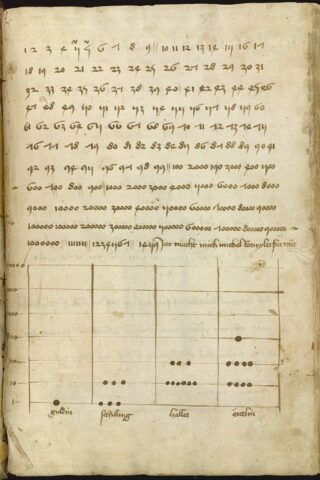
A medieval German manuscript used in learning Arabic numerals (Public Domain)
Knowledge transfer
In Medieval times, Muslim Arabs ruled the Middle East and North Africa (as they still do today), as well as parts of southern Europe, notably Sicily and much of Spain. Relations between Christian Europe (Christendom) and the Islamic world were characterised by hostility and conflict – we think of the Crusades for example. But that is not the whole story. A closer look reveals that there was also a great deal of peaceful coexistence, when interaction between the two sides took place through trade rather than war. As a result, there was a significant amount of cultural exchange. This was actually very one-sided, in that the movement of knowledge and ideas was primarily from East to West, from the Islamic World to Christian Europe. I’m not aware of any examples of cultural exchange that went in the other direction!
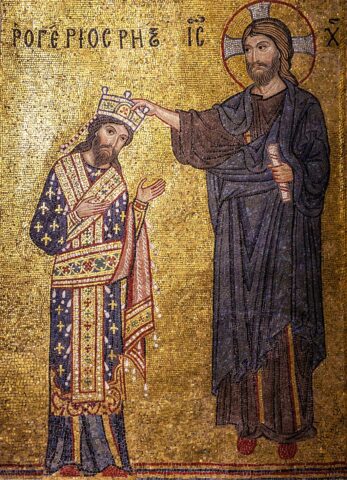
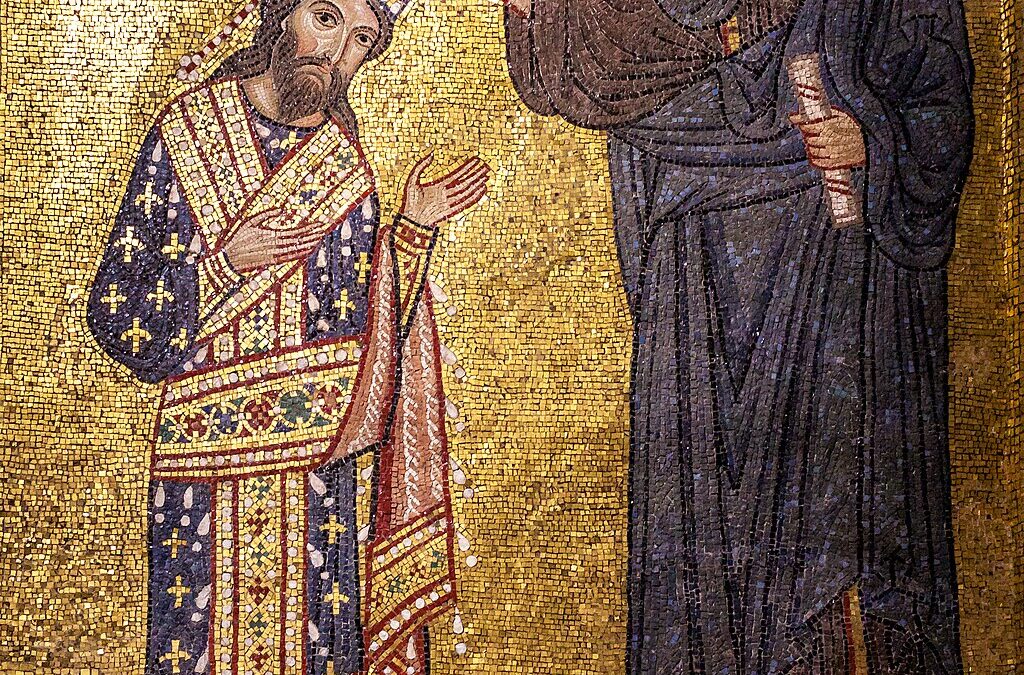
King Roger II of Sicily is crowned by Christ – but he welcomed Muslim and Jewish scholar to his court, as well as Christians (Creative Commons Licence)
The reason for this one-sidedness is that the Islamic world was far in advance of the Christian world at this time, in all sorts of measures. Literacy was much more widespread, its elites were more educated, cities were larger, commerce was more organized and so on. Why the Islamic world was so advanced, and the Christian world so backwards, are topics for another post, but one aspect of this question is well known to historians. This is that the Islamic World played a hugely significant role in transferring knowledge from Asia to Europe.
Innovations from Asia….
“Arabic” numerals are only called this because it was from the Arabs that Europeans learnt about them. However, they did not originate with the Arabs; they had come from Ancient ndia, whose forbears had invited some time. before 500 CE.
Another key technology that spread to Europe from the Muslim world at this time was paper-making – imagine a world were writing materials were costly, cumbersome and hard to come by? The art of making cheap, light and durable paper came originally from Ancient China.
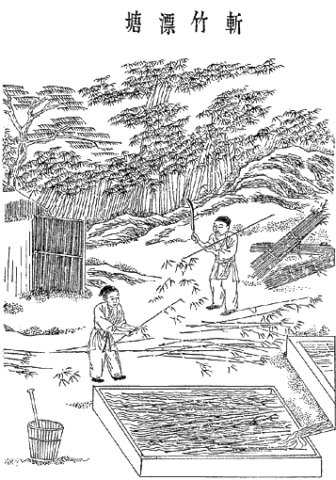
A 11th century Chinese illustration of paper-making (Public Domain)
Numerous other advances came to Europe from the Islamic world at this time, in a multitude of fields, including astronomy, medicine, textiles, geography, agriculture, music and business practices. And we should not forget Greek philosophy.
…and from Europe’s own past as well
Greek philosophy? Yes indeed. This last example gives a clue to why Europe was so backward compared to other parts of the Medieval world. The fall of the Roman Empire in the fifth century had been accompanied by a drastic decline in literacy. This resulted in a clear break with the classical culture of Greece and Rome. Ancient learning was indeed kept alive in a few monasteries, but only in a very limited fashion, given the very limited resources available to the monks and the huge effort it took to copy books by hand. A huge amount of Greek and Roman learning was lost. It was only through contacts with the Arabs that Europeans were re-connected to many of the most famous Greek philosophers, including Aristotle and Plato.
Taken together, these innovations revolutionised European cultural life and laid the foundations for the tremendous progress that was to come.
All the world’s knowledge
How did the Islamic world come to play such a vital role?
The early Islamic world was characterised by a degree of religious and intellectual freedom which encouraged centres of learning to flourish. This is most clearly seen in the establishment of the “House of Wisdom” by the Caliph Harun al-Rashid (r. 786–809 CE) in his capital, Baghdad. This was, essentially, what we today would call a research institute, which attracted scholars from all over the known world to come and study there. Learned men of all over the Islamic Caliphate, which at that time stretched from Asia Minor in the West to India in the East, came to study there. Greeks, Arabs, Persians, Indians and and many others – mingled with each other and shared their knowledge, helped by a project to translate the works of all their different cultures into Arabic. Later, as the Arab Caliphate broke up, many local Muslim courts appeared, and continued tis liberal tradition by sponsoring scholars from all over the world.
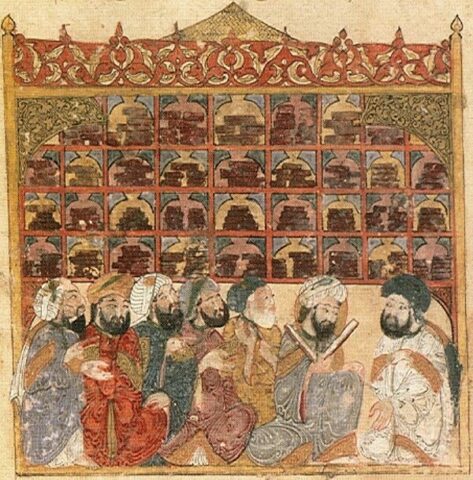
A scholarly discussion in the House of Wisdom Library (Public Domain)
And lest it be thought that the early Islamic World acted merely as a cultural go-between, it was Muslim thinkers who developed algebra and made many serious advances in a huge variety of fields such as medicine, geography and astronomy.
All in all, this was a remarkable episode in world history.