
Have you heard of Cai Lun? No, I hadn’t either, until very recently. And yet, he had a huge influence on world history.
It was he who refined the technology of paper-making to the point where it became easy to make a light, durable material on which writing was easy. He made these innovations at the imperial palace China in the first century CE, and within a short time his new technology had spread far and wide across that huge country. Within the next few hundred years it spread throughout East Asia, to India, the Middle East and Europe. Wherever it went, it made writing much easier and cheaper, and thus revolutionised communications. Furthermore, it made the invention of printing possible, as other materials (wax tablets, wooden blocks, bamboo strips, papyrus, parchment and so on) were too heavy, cumbersome and expensive.
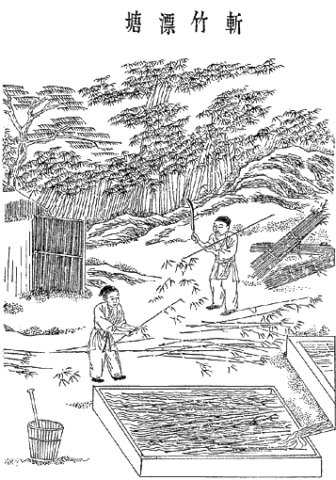
One step in the process which Cai Lun introduced in his improved paper-making process (Public Domain).
He is almost completely unknown outside China; but within China he is famous. Throughout history many Chinese have regarded him as a god, and worshipped him within temples devoted to him.
An insight into imperial Chinese politics
Before I began this post I assumed I was going to be writing about the history of paper-making, and Cai Lun’s key role in this; and perhaps also about how few people in the West know about many Chinese figures who have made a significant contribution to human advancement. However, as I started to research him, I realised that his life and career offer an extraordinarily insight into the government and politics of Ancient China under the Han dynasty – and actually to imperial China in general.
The first interesting thing to note is that Cai Lun was a eunuch.
Sexless officials
Eunuchs were held in contempt and pity by other Chinese. In a Confucian society where family ties were of prime importance, eunuchs were people who could have no family. Furthermore, in a culture in which ancestor worship played a central role, for a person to have no children was seen as, if not a disaster, then a severe misfortune. It was believed (and still is by some Chinese) that an individual’s wellbeing after death was to a large extent dependant on the reverence their soul received from their descendants.
Castration was therefore seen as a harsh punishment, next only to death. However, there was a group of eunuchs in China, right throughout the millennia of imperial rule, who could wield enormous power. These were the eunuchs of the imperial palace. Cai Lun was one of these.
These had not been castrated for committing a crime, but had generally been castrated in their childhood or youth. Sometimes this was because they had been captured in war, but probably the most common way for an individual to end up as a palace eunuch was to be sold by their family to a rich person, who sold them on to the imperial palace.
The “Inner Palace”
The palace employed hundreds, at times thousands, of eunuchs. This was because the “inner palace” – the emperor’s private living quarters – had only one “proper” male in it. This was of course the emperor himself. All other full males were kept well away from it, as this was where the emperor’s harem was kept. It was vital that any boy born in the “inner palace” was, without any question, a son of the emperor, because any of them might one day end up as emperor. If an individual came to the throne who was not the actual son of an emperor, or at least a close biological descendant, then relations between Heaven and Earth would be deeply disturbed and the whole dynasty lose the Mandate of Heaven, without which its place on the throne of China was doomed.
Most of the palace eunuchs served as menial drudges around the palace. More fortunate ones were these chosen as attendants to the ladies of the harem. More fortunate still were those who were appointed as attendants of the wive of emperors. The most fortunate of all were those who attended the emperor himself. In such a position they had intimate personal contact with the ruler, and had the opportunity to gain real power. They could come to act as confidants and advisors to the emperors, who in any case were (especially towards the end of dynasties) frequently young children.
In-built tensions
In all major dynasties, with the exception the Song dynasty (ruled 969 to 1279 CE), there was a tendency for the eunuchs and the officials of the “outer palace” (civil servants who had worked their way up the empire’s bureaucracy to become ministers and senior administrators) to regard each other with suspicion. In some dynasties, this tension got out of hand, turning into a lethal power struggle. During the Ming dynasty of the 15th to early 17th centuries, the eunuchs came to form a closed group around the emperor, standing between him and the ministers. They wielded enormous power, and essentially ruled the empire. If they came to dislike a minister, that minister would very likely end up by being hideously tortured and then put to death.
This situation was fairly exceptional, but tension between the two groups was almost inevitable. As a result, the palace eunuchs gained an evil reputation. It was the officials who were able to shape the histories of the successive dynasties, and they ensured that their own values and interests received favourable treatment in them. This meant that eunuchs almost always appeared in a bad light.
Not all bad
Some of this reputation was undoubtedly deserved, but there were palace eunuchs who were capable, honest and conscientious, and strove to serve the state as best they could. By all accounts, Cai Lun was one of these “good ones.
Cai Lun was one of the group of elite palace eunuchs during the Later (or Eastern) Han dynasty (which ruled between 25 CE and 220 CE).
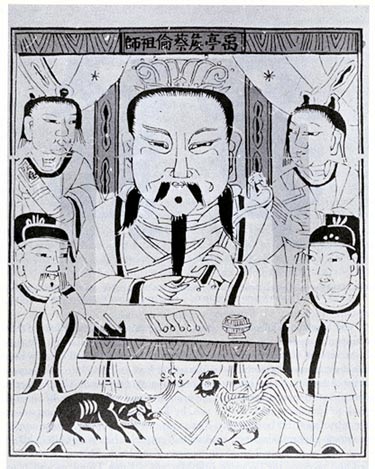
A portrait of Cai Lun as the “patron saint” of paper-making in China (Public Domain).
He was probably born between 50 and 60 CE, in southern China. His place of birth was far from the capital, and it is unclear how Cai Lun came to be a palace eunuch. Nothing is known of his early life, except that he came from a poor family, but by 75 CE at the latest, and probably well before that, he had become a palace eunuch.
Cai Lun carried out his duties diligently and intelligently, and in due course became a confident to imperial consorts and dowager empresses and emperors. As part of his duties he was given various administrative responsibilities within the palace, including over the palace workshops. Here he was responsible for the manufacture of weapons and armour for the place guards, and also of writing materials (the Chinese government was almost certainly the government most dependent on written documents in the world at that time). It was in this capacity that he oversaw the innovations in paper-making for which he would become famous.
A dangerous workplace!
Sadly, Cai Lun’s career also illustrates the lethal dangers of being so close to the seat of power in imperial China. The Later Han period was noted for the power struggles which took place at court between the ladies of the palace. The eunuchs were inevitably drawn into these, often having to do these ladies’ dirty work for them. Although Cai Lun never seems to have been at the centre of these intrigues, he was so close to these powerful women that he could not avoid being caught up in the bitter conflicts between them.
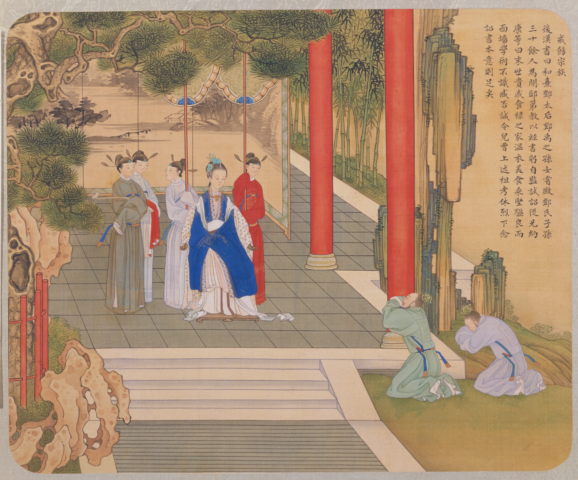
An 198th century painting of an imperial consort of the Later Han dynasty (Public Domain)
These eventually cost him his life, as they did so many others. The details of the events which brought about his death are too convoluted to go into here (we may deal with them in another post, as they shed a lot of light in the inner workings of the imperial court in China), but Cai Lun was forced to commit suicide to avoid torture and execution when the supporters of a consort who was hostile to the faction of which he had been a part gained control of the emperor.
One of the insights that Cai Lun’s career gives us is how little actual power many of the emperors personally exercised, and what miserable lives they led. Imperial China was certainly not unique in this, and it makes one wonder what shenanigans go on behind closed doors in today’s autocracies.