
Greece and Persia 321 BCE

What is happening in Greece and Persia in 321BCE
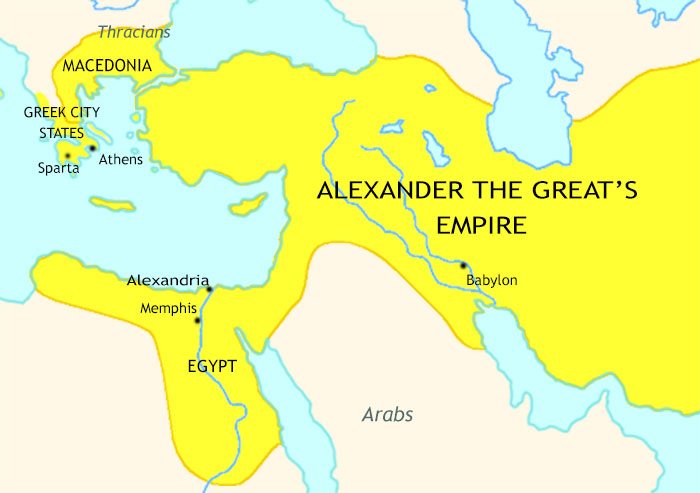
Alexander the Great
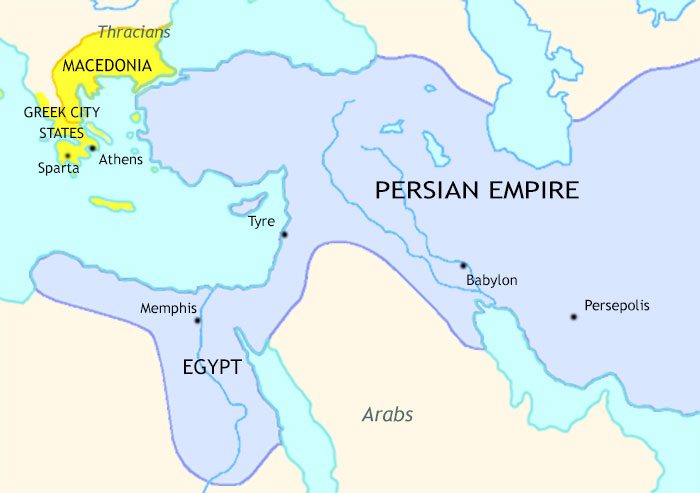
The challenge of leading the Greek war against the Persians fell to Philip’s son, Alexander III (the Great). Under him, the Greek/Macedonian force completed the conquest of the mighty empire in the space of some ten years.
Alexander’s brilliant generalship proved key to this turn of events. In a series of great battles – notably the Granicus (334 BCE), Issus (333) and Gaugamela (331) – he utterly defeated the Persian armies sent against him.
Alexander secured his conquests by planting numerous Greek-style cities across the Middle East, and in western India, settling them with Macedonian and Geek veterans.
In 323 BCE Alexander died unexpectedly in the city of Babylon.
What is happening in Greece and Persia in 585BCE
[Teachers: please click here for additional teaching resources on this topic]
The Middle East
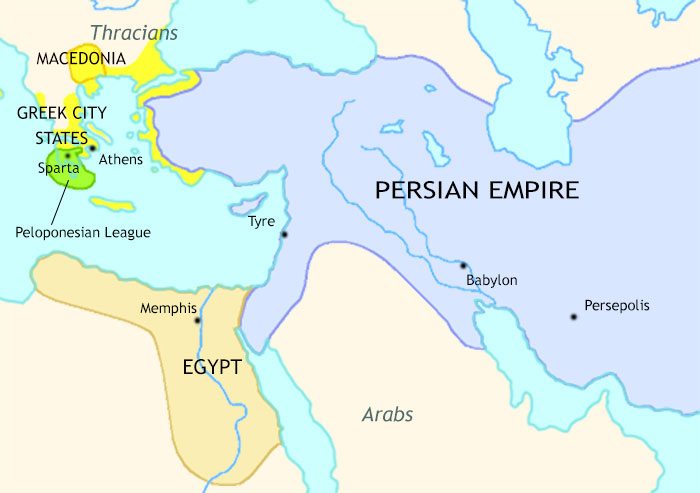
In 585 BCE the Assyrian Empire, which had dominated the region for centuries, had been replaced by three large states. These were the Babylonian Empire, ruled by the famous king Nebuchadnezzar; the empire of the Medes, an Indo-European speaking people who had come down from central Asia and settled in Iran; and a revived kingdom of Egypt.
A fourth state was Lydia, a wealthy kingdom in Asia Minor. The Lydian kings were the first to issue metal coinage, a practice which the Greeks would soon follow.
The Greeks
The Greeks lived in hundreds of small city states. Most were governed by republics, made up of councils and magistrates, not kings. In most cities, however, political office was restricted to men from the wealthiest families. Much Greek culture was borrowed from the Middle East, for example the alphabet from the Phoenicians, mathematics from the Mesopotamia, and engineering and architecture from the Egyptians.
[Click here for teachers notes and other Premium resources on this topic]
What is happening in Greece and Persia in 525BCE
The Persian Empire
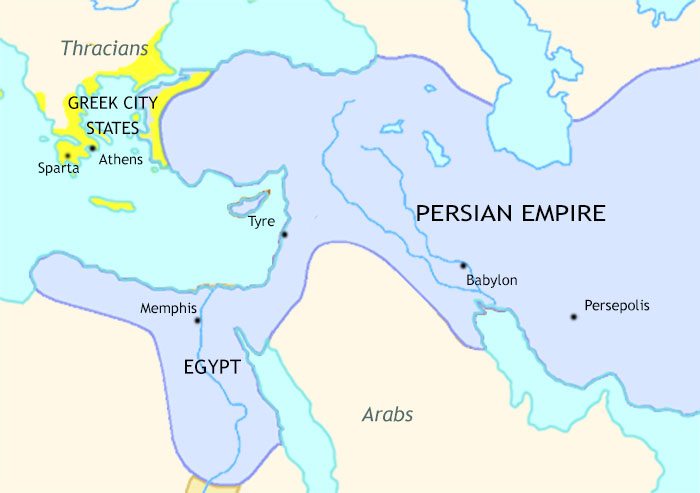
Like the Medes, the Persians were an Iranian people. They had been subjects of the Medes until their king, Cyrus the Great, rebelled against his masters and took over their empire. He then expanded its borders until, under him and his successors, the Persian Empire became the largest that the ancient world would ever see (in terms of territory, at least).
The Greeks
By this time, Greek merchants and sailors dominate the trade routes of the Mediterranean.
The expansion of commerce is increasing inequality within the Greek society, raising social and political tensions and instability within many city-states.
The economic, social and political changes experienced by the Greek city-states have created an environment where many original thinkers flourish: Pythagorus the mathematician and mystic, Xenophanes who taught that there was only one god, not many; Heraclitus, who said that all things are always changing; Anaxagorus, who pioneered the idea that the universe is made up of atoms; and others.
What is happening in Greece and Persia in 481BCE
The Greeks
In one city, the social tensions running through many Greek states has produced the first democracy in history. Athens is now ruled by all its male citizens, meeting together in a large assembly to make laws and select magistrates – most of whom are also ordinary citizens. Athens is the largest and wealthiest city of Greece.
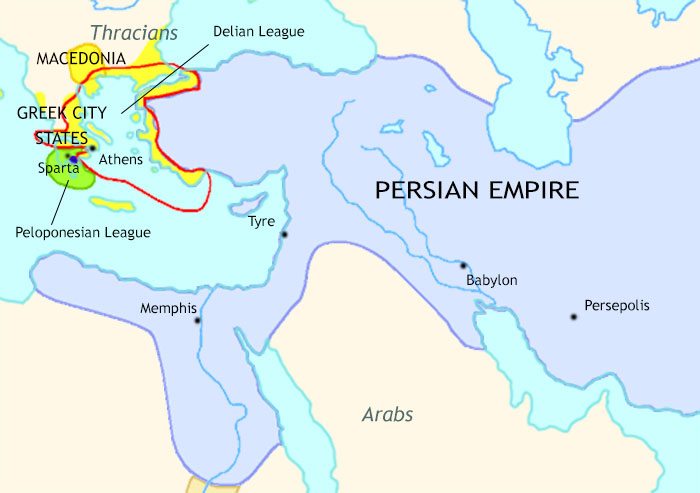
The other leading Greek city-state is Sparta. This has turned itself into the most militarized of all Greek societies. As a result, it has made itself the leader of a league of city-states in southern Greece.
At this period Greek art is undergoing a transformation. Statues of human figures, for example, become less formal and rigid, and more natural and elastic.
The start of the Persian Wars
In 499 the Greek cities in the west of Asia Minor revolted against Persian rule, and some cities on the Greek mainland, notably Athens, sent support. The Persians took several years to put the revolt down, and Darius, the king of the Persians (Darius the Great) was aware that he needed to deal with the Greeks if they were not to cause trouble on this frontier.
In 492 BCE, therefore, Darius sent a first Persian invasion and secured the subjugation of Macedonia and northern Greece. Two years later a further expedition sailed across the Aegean Sea against Athens. This ended in defeat for the Persians at the Battle of Marathon. Darius died before he could organize a more determined effort, but his son, Xerxes, is determined to complete what Darius started.
What is happening in Greece and Persia in 450BCE
The Persian Wars
The Persian king Xerxes led a second great expedition to conquer the Greeks in 480 BCE, much larger than the first. A joint military and naval force progressed around the north of the Aegean Sea, crossing from Asia Minor into Europe on a pontoon bridge, and then marched down into Greece.
Seeing the danger, the Greek city states patched up their interminable quarrels and formed an alliance against the Persians, under the joint leadership of Athens and Sparta. A tiny force of Spartans delayed the progress of the large Persian army at the pass of Thermopylae, sacrificing their lives almost to a man. Then the Persian fleet was destroyed by the Athenian navy at the Battle of Salamis.
The next year (479) this Persian force was decisively defeated at the battle of Plataea. It then retired as best it could to Asia Minor.
For the Greeks, these victories let them keep their independence and saved their civilization for greater achievements ahead.
Athens and Sparta
Athens and Sparta emerged from these critical years as the leading Greek city states.
Athens had formed a League of Maritime city states, the Delian League, to take the war to the Persians. It did so for the next 30 years, scoring some great successes, liberating the Greek cities of western Asia Minor from Persian control; but by about 450 the Persian Wars had drawn to an end.
The period between 480 and 450 was a golden age for Athens. This was the age of Pericles, an Athenian statesman who guided the city through these years. The Athenians dominated the Delian League. Commercially, it was the wealthiest Greek city, and probably the wealthiest city of the entire Mediterranean. Culturally, this was a period of astonishing achievement: artists from all over the Greek world converged on the city and reached new heights in sculpture (Myron, Phidias) and architecture (Callicrates) and drama (Aeschylus, Sophocles, Euripides).
Sparta could not match these achievements, but the Persian Wars had confirmed its position as the leader of the Peloponnesian League.
Macedonia
The kingdom of Macedonia, north of Greece proper, was regarded as semi-“barbarian” by the Greeks to the south. However, the Macedonians spoke Greek, albeit with a heavy accent, and acquired a large measure of Greek culture. Its royal family claimed descent from the royal family of the famous Greek city state of Argos.
What is happening in Greece and Persia in 400BCE
Athens against Sparta
The dominance of Athens over its allies in the Delian league aroused increasing resentment, and this fueled growing tensions between Athens and Sparta.
These led to the bitter Peloponnesian Wars between 431 and 404 BCE, which involved most of the city states of Greece. The wars ended in Spartan victory over Athens.
Greek culture
Greek civilization between 450 and 400 was characterized by further cultural achievements, despite the destructive wars of the period. At the beginning of the period, the Athenians built the Parthenon, probably the best known of all Greek structures. Sculpture continued to develop (Polyclitus, Praxiteles), and in philosophy, this is the period when Socrates challenges his countrymen to approach ideas with greater rigor.
What is happening in Greece and Persia in 338BCE
The Spartans’ high handedness, however, snatched defeat from the jaws of victory. Within a few years the Athenians were able to recover much of their power. The city of Thebes also became more powerful at this time, and was briefly the leading city state in Greece.
Macedonia
To the north, however, a much bigger power was growing. This was the kingdom of Macedonia, which, under its able king, Philip II (reigned 359-336 BCE), became a centralised and formidable state. Philip introduced an innovation to his army, by arming the phalanx (a large number of infantry soldiers fighting in one solid block) with very long spears which gave them a great advantage over their opponents.
Philip interfered increasingly in Greek affairs, until he defeated Thebes and Athens at the Battle of Chaeronea (338). He established a league of most of the Greek city states (Sparta was the outstanding exception), with himself at its head. He was preparing to lead it against the Persian empire when he was assassinated (336).
Greek culture
Greek philosophy has continued to flourish, with Plato and then Aristotle building on Socrates’ work to bring Greek philosophy to its peak.
The Persian Empire
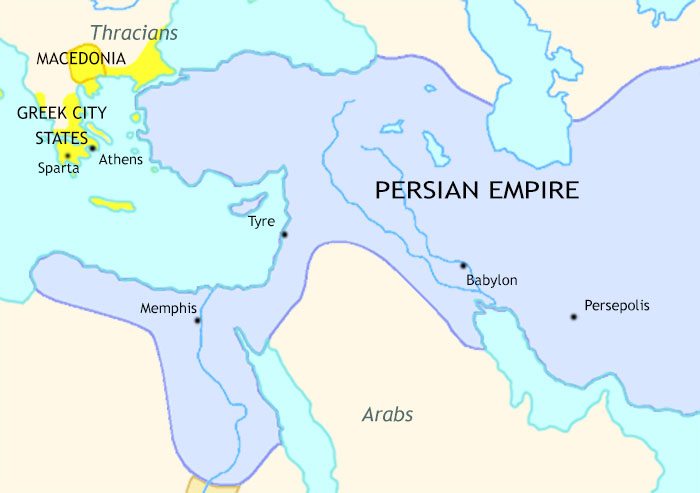
The Persian empire had, despite some rebellions and civil wars, remained powerful and largely intact. Indeed, the Greek city states took to seeking help from the Persian Great King to help patch up their quarrels. The Persians regained control of western Asia Minor, which they had lost to the Greeks during the Persian Wars.
Egypt, on the other hand, was in a state of rebellion against the Persians between 402 and 343 BCE. It was brought back under Persian control in that year. By then, though, the Persian empire had only a few short years left to it.
What is happening in Greece and Persia in 240BCE
The break-up of Alexander’s empire
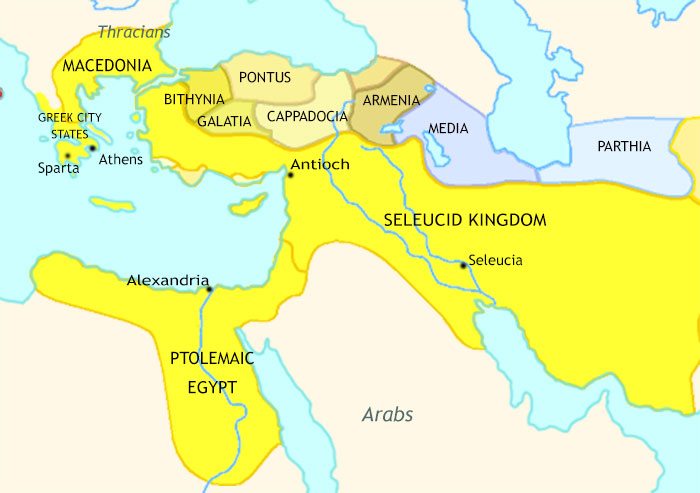
Alexander the Great’s early death in 323 BCE left his vast empire without any clear ruler. It soon began to break up as his generals fought with one another for territory. Decades of warfare led to the emergence of three leading kingdoms, each under the descendants of one of the generals: the kingdom of the Seleucids (Western Asia), the Ptolemies (Egypt) and the Antigonids (Macedonia).
The wars between Alexander’s generals and their descendants enabled smaller kingdoms in Asia Minor, northern Iran and north-west India to break away from their control.
In Greece itself, the Greek city-states survived by joining together into leagues, and by playing off one Hellenistic kingdom against another.
The Hellenistic world
Across all this vast area, however, a unified cultural sphere emerged. Alexander and his successors founded numerous cities, many of which soon became thriving centers of an expanding commercial world. Some, such as Alexandria in Egypt and Antioch in Syria, grew to become some of the largest cities in Antiquity. They acted as centers of Greek-style civilization which over time influenced, and was itself influenced by, the ancient cultures of the Middle East. A hybrid civilization emerged which, though predominantly Greek, was infused with Asian and Egyptian elements. Modern scholars call this version of Greek civilization “Hellenistic”.
A hybrid civilization
Greek-style art and architecture, now patronized by powerful kings, appeared on a much grander scale than before. Some of the best-known “Greek” works of art were produced in this period, such as the Venus de Milo and the Dying Gaul. The Hellenistic kings built huge libraries, which doubled as research institutes. Engineers, mathematicians and scientists grafted Mesopotamian and Egyptian learning onto Greek ideas to bring know-how to new levels. In religion, Greek and Middle Eastern ideas mingled as people right around the Hellenistic world took to worshipping gods and goddesses from Egypt (Isis) and Mesopotamia (Astarte).
The Gauls
One group of Celts migrated a long way from their homeland in Gaul (France) and invaded Macedonia and Greece. They then crossed from Europe into Asia Minor. Here they were eventually confined to a region which became known as Galatia. They settled down there, established a kingdom, and adopted Hellenistic culture wholesale.
What is happening in Greece and Persia in 100BCE
The wars between the Hellenistic kingdoms prevented them from mounting a united defence against enemies from east and west.
The Parthians
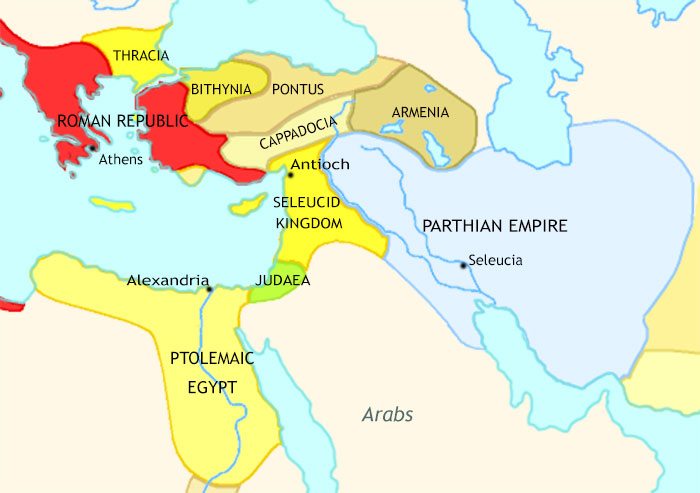
In the east, the Parthians (an Iranian people related to the Persians) had originally broken away from the Seleucid empire in the 240s. The Seleucids, whose focus was more on their rivalry with the other Hellenistic powers to the west, tried only half-heartedly to bring the Parthians to heel. When Parthian power grew, the Seleucids’ efforts to reassert control ended in disaster. By the late 2nd century BCE the Parthians had taken over the rich provinces of Iran and Mesopotamia from the Seleucids.
The Romans
Meanwhile, the power of Rome had been rising on the west. Benefitting from the rivalries between the Hellenistic states, in a series of wars the Romans annexed Macedonia, the whole of Greece and small states in western Asia Minor. The ramshackle Seleucid empire was unable to halt their advance, and the Ptolemies of Egypt either stood by or allied themselves with Rome against their traditional Seleucid rivals.
Hellenistic civilization
Despite the decline in the power and territory of the Hellenistic kingdoms, Hellenistic culture continued to flourish. Such was its attraction that Asian peoples – or at least their ruling classes – adopted it wholesale. A famous example of this was the Jews.
During this period, in Alexandria, the Hebrew Bible was translated into Greek, and many high-status Jews adopted Greek ways – even the priestly families in Jerusalem. This led to a rebellion amongst traditionalist Jews who saw this as a challenge to their religion and way of life, and a separate Jewish kingdom came into existence. Within a short time, however, its leaders too began to fall under the spell of Hellenism.
What is happening in Greece and Persia in 100CE
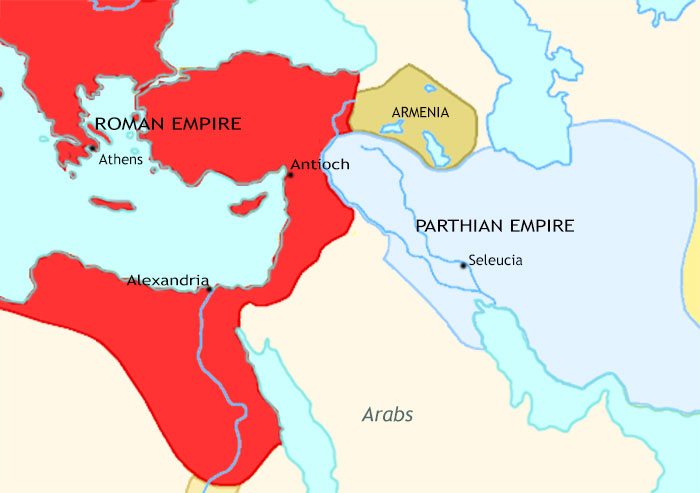
The Parthians continued their advance from the east, and the Romans from the west, until their frontiers met in around 60 BCE. The kingdom of the Seleucids was increasingly squeezed between them, until it was snuffed out of existence before 60 BCE, becoming the Roman province of Syria. The Ptolemies of Egypt continued until 30 BCE, when the last of them, the famous queen Cleopatra, poisoned herself after being defeated by the Roman leader Octavian (soon to have himself proclaimed Augustus, the first of the Roman emperors). Egypt, like Syria before it, was annexed to the Roman empire.
Despite the disappearance of the Hellenistic states, Hellenistic civilization remained intact. Greek-style cities continued to exist in both the Roman and Parthian empires. Greek remained the language of everyday life for the urban elites in both regions, and Hellenistic culture continued to develop: the famous doctor Galen and scientist Ptolemy made major advances in their fields. Leading Romans were steeped in Hellenistic culture, and continued to patronize the great centers of learning, such as the library at Alexandria. Many large new buildings were constructed in the Hellenistic style, like the theater of Hadrian in Athens.
A similar situation existed in the Parthian Empire. Parthian kings represented themselves as philhellenes, champions of Greek civilization. The Hellenistic cities prospered under their rule, and enjoyed a large degree of autonomy.
Only gradually would Hellenistic culture begin to fade. In the Parthian Empire, and then the Sasanian Empire which followed it (from 220 CE), there would be an Iranian revival which saw Greek-style elements mingling with more ancient Asiatic elements. This would give rise to the rich fusion which the mature Persian civilization represented. In the Roman Empire, meanwhile, changing political structures, much more centralized on the emperor, court and bureaucracy, undermined the autonomy of the cities, a huge departure from Classical culture. The spread of Christianity, and especially its adoption as the state religion, transformed the thought-world of the Roman Empire. Although the later Roman Empire cherished and preserved much Greek learning, in reality it evolved into something different. Modern scholars call this the Byzantine civilization.

Subscribe for more great content – and remove ads