
In the early 15th century, China sent out a series of great sea-going expeditions, which sailed further and further from the shores of China. Each one consisted of a huge fleet of warships, merchant ships and supply vessels. The first one set out in 1405, sailing across the South China Sea to the waters of South East Asia. This was followed by expeditions which reached ever further out – across the Indian Ocean to South Asia, and then even further west, to the coasts of Middle East and finally East Africa.
Grand Fleets
All the expeditions were commanded by a remarkable man, Zeng He. He was a eunuch in the service of the Ming emperor, Yongle (reigned 1403 to 1424). This emperor had a taste for grand projects (he it was who ordered the construction of the Forbidden City, still the largest palace complex ever built), and true to form, these expeditions were on a truly grand scale. Each one apparently consisted of hundreds of ships, some of them the great treasure ships which were almost certainly the largest vessels ever seen up to that date, anywhere in the world.
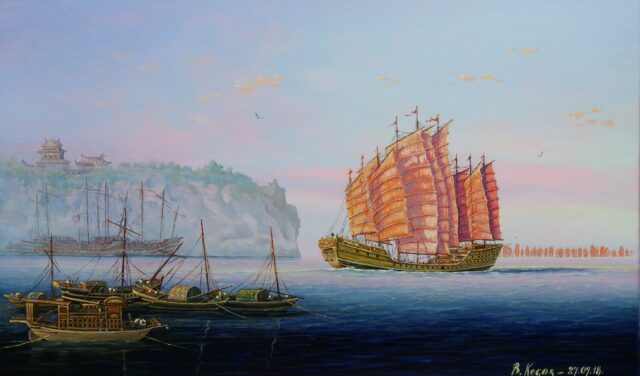
A 19th century painting of ships of the Ming treasure fleet (Public Domain)
And then, as suddenly as they had started, they stopped. Why was this?
A few decades later, the Portuguese started sending their ships down the coast of West Africa, kicking off the great age of European exploration, discovery – and conquest and colonization!
An Alternative History
It is all too easy to conjure up an alternative history of the world, a classic “What If…” scenario. In this, the Chinese – whose expeditions were on a far larger scale than the European ones (Columbus’ “fleet” which discovered the New World consisted of three ships, none more than a fraction of the size of the great Ming treasure ships) – would have continued their expeditions, perhaps sailing round the Cape of Good Hope to West Africa and then on to Europe; or maybe northwest from China, up the Siberian coast to the Aleutian Island chain to Alaska and the Americas! Or perhaps southward to Indonesia and then down to Australia?
But this never happened, became these great expeditions suddenly came to an end. Why was this?
Well, I think this question is wrongly conceived. It is looking at things from a purely Western standpoint – and with the benefit of 50/50 hindsight.
The real question is, why did they start in the first place?
Contrasted Regions
In the early 15th century, China and Europe were a study in contrasts. Compared to China – and to societies across Asia, in the East Indies, India and the Middle East – Christian Europe was poor, underdeveloped, even barbaric (a similar situation as it had been 500 years before, though perhaps not quite as extreme); and very conscious of being hemmed in. To the west was the Atlantic Ocean, to the south Muslim lands bordering the huge Sahara desert (even more impenetrable than the ocean), and to the east may more Muslim lands. As Christian merchants were, by and large, forbidden from travelling and trading within the Islamic World at this time, it is hardly surprising that they should start looking for another way to develop their international commerce.
They found this by venturing out into the vast oceans and began probing down the west coast of Africa. They soon found gold, ivory, slaves and other exotic goods to being back Europe, and this encouraged them to press on. Rounding the Cape of Good Hope at the end of the 15th century, they soon found the source of what they had been really looking for all along – spices.
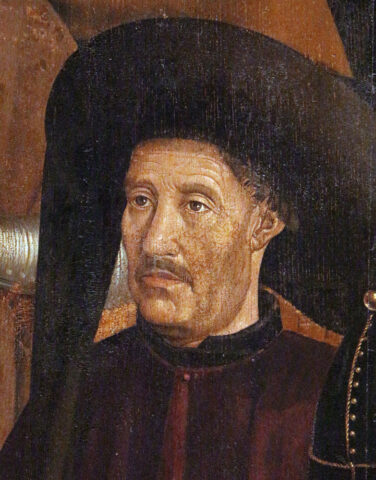
Prince Henry the Navigator of Portugal, the driving force behind early Portuguese exploration (Public Domain)
By then, there was no turning back. Other Europeans had discovered an entirely New World, and the hitherto back-water of Europe was set on the cause to world domination.
China, on the other hand, was a vast, hugely wealthy country. It was home to an extraordinarily sophisticated civilisation, which felt itself (and in many was) the “Middle Kingdom”, the centre if the world.
There were no barriers to China’s maritime trade; indeed, China lay at the heart of a great international network of countries, spread around East and Southeast Asia, which acknowledged the supremacy of China, and regarded it as a privilege to trade with it.
A Self-Contained Economy
But overseas trade represented an almost negligible fraction of the Chinese economy, which was effectively a self-contained system. The Chinese produce all the necessities of life, and most luxuries, within their own borders. In fact the internal trade of China – centred as it was on amazing the Grand Canal, which allowed goods to be transported efficiently over vast distances – almost certainly far exceeded all the overseas trade of all nations of the world at that time put together. If an alien in a spaceship had been able to measure all the trade of the whole world at this period, he/she/it would have probably found that the great majority of it would have taken place within the borders of the Ming empire.
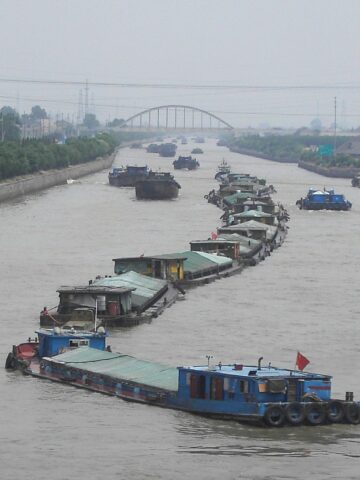
The Jaingnan sector of the Grand Canal (Creative Commons)
So why on earth did the emperor Yongle commission these great expeditions? What was he hoping to achieve?
In a nutshell, he was probably aiming to upgrade the “tributary” system which allowed trade to flow into China and Chinese prestige to spread out far and wide. He wasn’t so much interested in trade – few Chinese emperors were. What he wanted to do was spread the prestige and authority of Ming China as far as he could.
And the expeditions did indeed do this, at least while they lasted. Suddenly finding a huge fleet and large numbers of Chinese soldiers sailing into own their harbours, how could local rulers not have been ready awed by China’s power? They were quick to acknowledge the overlordship of the distant Ming emperor with acts of obeisance and the giving of pre=cuous (and to the Chinese) exotic gifts.
But as soon as the fleet had sailed away again, and was safely over the horizon, life would have returned to normal soon enough. More pressing concerns, of a much more local nature, would have soon reemerged. The local people would never forget these amazing fleets (and in case, some of them saw them several times over their lifetime), but they would certainly not have suddenly considered themselves subjects of the distant ruler, nor regarded the gifts they gave as tribute in any meaningful way.
Not Profitable for. some….
In short, spectacular as they were, these expeditions achieved nothing of any lasting advantage for China. And the senior ministers at the Ming court would have realised this very clearly. It was inevitable that this astonishing episode would come to a halt shortly after the emperor Yongle had died.
And in any case, what would further expeditions have achieved for the Chinese? They certainly had no need of overseas commodities (which they could get by normal trade), nor for land (over the next five centuries the Chinese population would grow, mostly within its own borders, to more than four times its early 15th century size), and nor for conquest (at least not overseas conquest – the next Chinese dynasty, the Qing, would annex a vast area of inner Asia in the 17th and 18th centuries).
…But Profitable for Others
For Europe, on the other hand, overseas voyages soon became profitable, as gold, ivory and slaves began coming back in the holds of the Portuguese ships. And profit was what the Portuguese – and later, all the other Europeans – were interested in. Even conquest and colonization wasn’t on their agenda at first – these came later.
But of course, from our own standpoint of several centuries after these events, we know that these European voyages were to change the world. They laid the foundations for European domination, which reached its height some centuries after the earliest voyages.
Like so much of world history, huge outcomes came from small beginnings.