

The Yongle Emperor (reigned 1402 to 1424) was the third, and most famous, ruler of the Ming dynasty. It was he who sent out the huge treasure fleets which sailed into the Indian Ocean and then onward as far as Africa. It was also he who constructed the great palace complex known as the Forbidden City, in Beijing.
Prince of Yan
He was born with the name Zhu Di, in 1360, the fourth son the Hongwu emperor, the founder of the Ming dynasty. While still a child he was given the title Prince of Yan. At the age of 20 he was sent to live in Beijing and given responsibility for the defence of the north-eastern sector of the Great Wall of China There, he gained experience in military affairs, and proved himself an able soldier and strategist.
Rebellion
When the Hongwu emperor died in 1398, the son of Zhu Di’s eldest brother came to the throne as the Jianwen emperor. Soon, the new emperor began to seek to reduce the power of his uncles, and amongst other measures summoned Zhu Di to the capital, Nanjing. Fearing that if he obeyed the summons, he would be executed, Zhu Di rebelled. In the fierce civil war that followed, Zhu Di was victorious, and succeeded in seizing the throne in 1402. He adopted the title Yongle, which means “Perpetual Happiness.”

The Yongle Emperor
A new capital
The Yongle Emperor immediately moved the capital from Nanjing (which means “Southern Capital”) to his former base, Beijing (“Northern Capital”). This made strategic sense as it enabled the emperor to have a huge body of troops under his direct command, stationed near the most threatened border of the empire. He personally led several expeditions into the steppes against the Mongols.
On the other hand, Beijing was so near the border that it was vulnerable to Mongol attack. The Mongols had, until recently, ruled China and had ambitions to do so again. As Beijing was so far from the more productive parts of the empire (to the south in the Yangtze region), keeping the capital and its large garrison provisioned was hugely expensive. This became a large burden on the Ming state, and involved the refurbishment of the Grand Canal to enable it to carry the vast number of grain transports needed to feed the capital.
The Forbidden City
The Yongle Emperor then ordered the construction of the enormous palace complex, set within its own walls and in which the emperor’s family, his harem and his personal staff (the palace eunuchs), were largely secluded from the outside world.

This palace complex became known as the Forbidden City, and was the centre of power of the Ming Dynasty and its successor, the Qing (Manchu) Dynasty. It remains an iconic structure to this day, being a UNESCO heritage site. (Creative Commons Licence)
The Treasure Fleets
Yongle is most famous for launching seven great naval expeditions “to the Western Ocean” – i.e. the Indian Ocean. He placed one his favourite palace eunuchs, Zheng He, in command of the huge fleets which sailed to Southeast Asia, India, the Persian Gulf, and the East African coast.
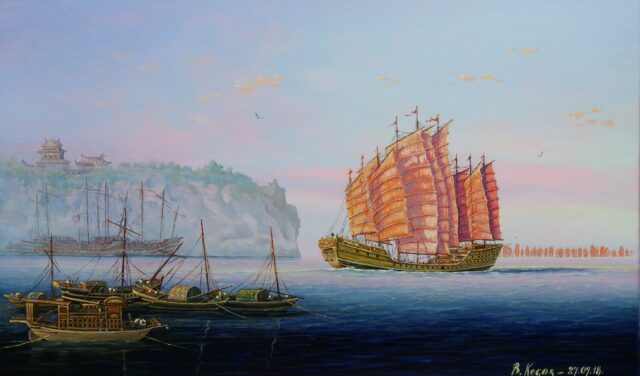
A modern illustration of the Ming treasure fleet (Creative Commons Licence)
These fleets included the treasure ships, which were probably some of the largest sailing vassals ever built. These voyages aimed to display China’s wealth and power, establish tributary relationships with far distant lands, and secure favourable trade relations, expanding China’s influence across Asia and the Indian Ocean.
The Yongle Encyclopedia
As well as his more active actions, the Yongle Emperor was also interested in promoting knowledge. He therefore commissioned the Yongle Encyclopedia. This was the largest Chinese encyclopedia to be completed in pre-modern times, and attempted to be a compilation of all Chinese knowledge.
Yongle died in 1424 while returning from a campaign against the Mongols. His achievements mark him as one of the most consequential of all Chinese emperors.