
The Roman empire was comprised of more than two thousand cities and tribes. Why was it that, out of all of them, it was the city of Rome that came to rule the rest?
One of the easiest answers to this question is that the Romans had the best army. But this begs the question, how did they come to have this?
Well, I hope to at least partially answer that question in this post, although to provide a full-length answer is the work of an expert on military matters. This is a subject I am indeed interested in, but more as a reasonably well-read amateur than an expert.
But I believe a perhaps deeper part of the answer lies elsewhere. This is that, while the Romans did win most of their wars, the thing that really marks them out from all the rest is that, in almost every case, they won the peace as well.
Winning Peace
This was down to the Romans’ generosity towards defeated enemies. And in particular, uniquely in the world of the Ancient Mediterranean, their willingness to share their citizenship with them.
This proposition requires a bit of background. “Citizenship” is something we take for granted in the modern world, but in the ancient world this was far from the case. In the Middle East, India, China – in fact everywhere apart from the Mediterranean region – the vast majority of people were subjects, not citizens. Their relationship to the state in which they lived entirely involved being obedient to the monarch and his officials.

The facade of the Great Temple of Abu Simbel, an apt image of ancient monarchy (Creative Commons)
One of the greatest contributions the Greeks made to world history was the invention of the concept of “Citizenship”.
The Greeks lived in tiny “city-states”, few of which had populations of more than a few thousand (we saw how Greece’s geography gave rise to this situation in my previous blog post, Why did Democracy first appear in Ancient Greece?). In each of these, the citizens felt themselves to be privileged members of their community. Since they lived in republics, and had a say in the decisions which affected all members of the community (for example, in most, the citizens’ assembly was consulted by the leaders of the state as to whether or not they should go to war); and since they had a say in who the officials should be who governed them; they did not feel that they were passive subjects of a king, but were active citizens of the state. They did not have a duty to obey a king, but to uphold the law; they did not have a duty to be sent to war about matters they knew nothing about, but had the responsibility to fight in their city’s wars, and had the privilege of to voting on whether they should or should not do so.
I could go on and on about the differences between being a subject and a citizen, but I hope you get the point that the concept of citizenship was a radical innovation in political history.
The Greeks spread this concept to their neighbours right round the western Mediterranean (amongst a host of other things, such as the alphabet, coinage, beautiful art, elegant architecture, tiled roofs and so on). The inhabitants of the Italian peninsula were amongst these peoples, including the Romans and their neighbours.
Sharing Citizenship
These city-states were extremely protective of who they allowed to be citizens of their communities. In Athens, for example, even people from other states who had lived there for years, decades or even generations, were not granted Athenian citizenship. This was a jealously guarded privilege. The same went for Sparta, and all the other city-states of Greece and Italy.
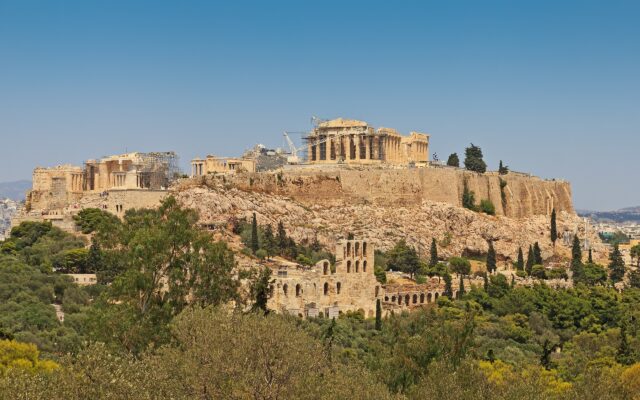
The acropolis at Athens, the moist famous of all Greek city-states. Though famous as the home of democracy, she refused to extend her citizenship to anyone not Athenian descent (Creative Commons).
Except, that is, for the Romans. For some reason they just did not have this same sense of protectiveness about their citizenship. This openness to others joining their community goes right back to the early days of the city, and was a central part of their self-identity. According to the stories that the Romans told themselves about their origins, Rome’s founder, Romulus, welcomed all comers to his new settlement – outlaws, refugees, migrants of all types. He actually needed as many men (citizens were all males in the ancient world) as he could get hold of to defend the city from the many enemies surrounding the new settlement.
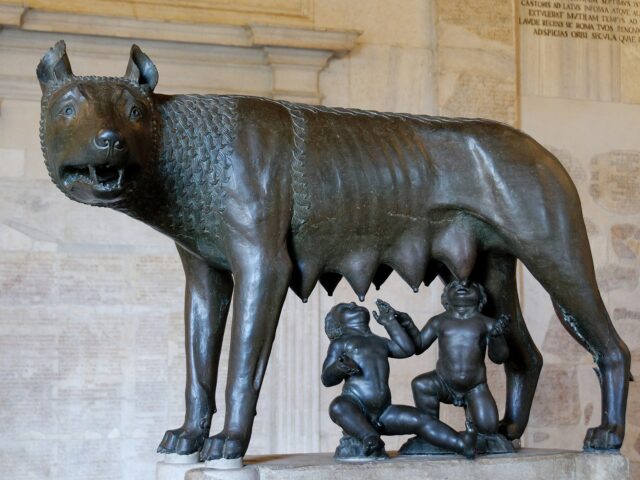
The iconic statue of a she-wolf sucking the twins Romulus and Remus. Romulus was the legendary first king of Rome, who called on brigands, misfits and other migrants to populate his new city. (Public Domain)
More prosaically, Rome was situated at the frontiers between different ethic groups – Latins to the south (where most of the original settlers were from), Etruscans to the north, and Sabines (warrior tribesmen of the hills of central Italy) to the east. This meant that it was surrounded by potential – and often actual – hostile neighbours. To survive, the new state needed to grow fast, so that it had a population big enough to fight off attackers. The early Romans were therefore willing, eager even, to welcome newcomers into their community. Groups of Latins, Sabines and Etruscans all settled in there, boosting its population and, by the 6th century BC, making it the largest city in Central Italy.
From an early date, moreover, the Romans set about expanding their boundaries. But when they conquered a neighbouring city-state, they didn’t treat its people as conquered subjects. In many cases they welcomed them as full members of their own community, which all the rights and duties of Roman citizens.
A Growing Confederation
Perhaps the most famous application of this policy was after the Latin War of 341-338 BC. Having defeated the other Latin (and Campania) cities in battle, the Romans absorbed the smaller cities into their own state, extending Roman citizenship to these defeated populations. The larger states they made allies of Rome, some with a sort of “half” Roman citizenship, which gave their people all the private rights of Roman citizens (e.g. right to intermarry with Roman citizens, to do business with them on an equal footing, to be judged fairly in Roman court of law, and so on) but not the political rights (the right to vote or be elected to public office in Rome). These allied states were obliged to furnish Rome with troops in war, but otherwise were left free to run their own affairs.
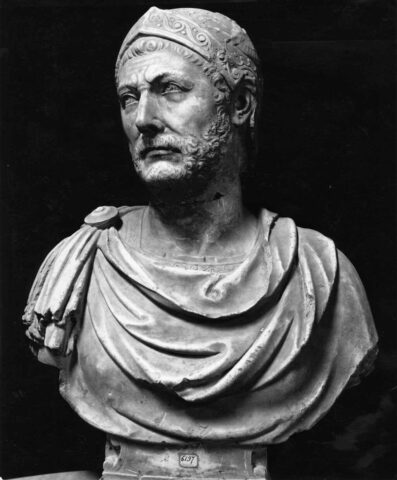
The brilliant Carthaginian general, Hannibal, who even after a string of great victories failed to prize the majority of Rome’s allies away from following her leadership (Public Domain),
By putting this policy at the heart of their dealings with defeated enemies, and pursuing it in all their later conquests in Italy, the Romans built up a growing confederation of loyal allies. These supplied Rome with more and more troops for later wars.
Rome thus gained the military manpower to conquer ever more territory, first in Italy and then around the Mediterranean. And the fact that the city won war after war, meant that her army gained an unparalleled level of experience in (to use that odd modern phrase) war-fighting. So, inevitably, she gradually acquired the very best army in the Ancient Mediterranean.