
Have you ever wondered why democracy emerged in Ancient Greece but nowhere else in the Ancient World?
I have done quite a bit of thinking about this issue over the years (I’m not sure what that says about me!) It was such a remarkable development – and seems such a …well… quintessentially Greek thing to have happened.
But was it really? And why did it happen there, but nowhere else?
The rise of democracy was certainly not due to any innate superiority on the part of the Ancient Greeks – it doesn’t take much reading of Greek history to understand that they were flawed mortal creatures, just like the rest of us.
Nor does it reflect something innately superior about early Western civilization. I personally believe that democracy IS something that the West should cherish, and has given Western nations huge benefits. I am aware that right now this notion is under pressure, and that in some ways democratic governments have been misfiring recently. This is something that anyone with any knowledge of 20th century history could have predicted, ever since the financial crisis started in 2008. After all, it was the Great Recession of the 1930s that produced Hitler and World War II!
For me, that is all the more reason that we should be very careful with this fragile thing we call democracy, and work towards making it function better rather than undermining it with apathy.
But I digress. Let’s get back to ancient Greek democracy!
It’s all about Geography
The reason why democracy first developed in ancient Greece was surely down to geography, like so much else to do with early civilizations.
Democracy was a phenomenon unique to ancient Greece because ancient Greece had a unique geography, when compared to the other great civilizations of the Ancient World. Most of those emerged on large river plains, where well-watered, uber-fertile soils (often aided by large-scale irrigations systems) enabled the rise of extensive states, such as Babylonia, the great kingdoms of northern India and the Warring States of Ancient China.
The Greek homeland (i.e. modern Greece and western Asia Minor) had a completely different geography. It had a mountainous landscape in which steep, hilly terrain was interspersed with small valleys, coastal plains, stretches of sea and numerous small islands.
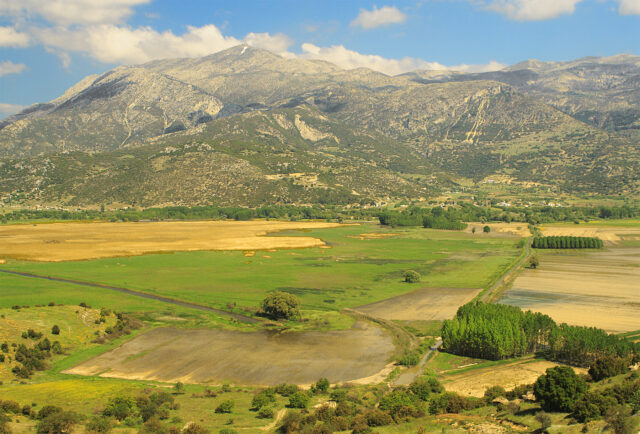
- A typical Greek Landscape (
This caused a huge number of tiny independent city-states to emerge, each with its own fiercely patriotic population – loyal, that is, to its own city-state, rather than to the Greek people as a whole.
Within these city-states, seldom more than ten thousand strong, people knew each other. The cities had plenty of public spaces in which people could interact communally – the Agora (market place), temples, gymnasia, theatres, places for assemblies, and so on. Meeting together was part of the ritual of everyday life; and they talked to each other. In such an environment, ideas and grievances could spread like wildfire, beyond the ability of rulers to control.
Familiar kings
Originally all Greek city-states were ruled by kings. But unlike in the extensive states of other civilizations, the small size of these communities meant that kings could not be remote figures, secluded from their subjects behind high palace walls. The people knew what they looked like, how they spoke and behaved; they could become familiar with them in a way not possible in the kingdoms that emerged in the heartlands of China or India, Egypt or Mesopotamia.
And how does the old saying go? “Familiarity breeds contempt.”
These kings were not divine rulers like those of Egypt and Mesopotamia; in the Greek city-states, their subjects were very aware that they were ruled by mortal, fallible men. The kings had to prove their worth to gain the respect of their people. And they couldn’t bolster their position by using bodyguards of professional soldiers to protect them from their subjects’ wrath. For, in the Greek world, the citizens were the soldiers.
Citizen-soldiers
The mountainous terrain of the ancient Greece was not favourable to cavalry warfare, unlike the broad plains of Asia. As a result, Greek warfare centred on the infantry: battles were fought between massed formations of heavily armed foot soldiers. And the tiny armies of the tiny states were made up of the male citizens of these cities. In all Greek states, it was the duty of every male citizen to fight for his city.
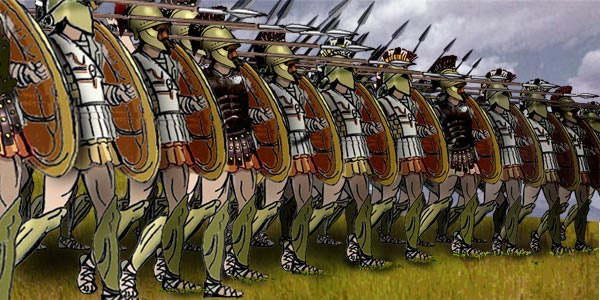
Greek infantrymen (hoplites) fighting in close formation (Public Domain)
The hardships and risks associated with war caused these citizen-soldiers to feel that they had a right to a say in their community’s affairs. Especially, they felt that they should be consulted as to wherever their state should to go to war or not.
And their awareness of the fact that they formed the backbone of the state’s army meant that they were willing to stand up for their rights – and to fight for them if necessary!
And in this lies the fundamental reason why it was in Ancient Greece that political power came (in some states at least) to reside in the ordinary citizens rather than with kings or aristocrats.
Obviously, the actual outworking of this process was far more complex than this very simplified account suggests. And why it was Athens in particular that became the first (or maybe, almost the first) state, to adopt a truly democratic constitution – well, that’s for another post.