
The compass is one of the most significant inventions in world history. To this day it remains a vital instrument of international navigation; without it global trade and travel would be almost impossible, even in these days of GPS and radar. The compass played an indispensable role in the the Age of European Exploration (15th, 16th and 17th centuries), and therefore in the conquest and settlement of new lands by people of European descent, from India to the United States, Canada to Australia, and many more). Without it, world history would have taken a very different turn.
But the compass was not invented in Europe. Nor was it originally conceived as an instrument of navigation.
It originated in China. An instrument that used the same principles was first mentioned in the first century CE, during the Eastern Han Dynasty (25 to 220 CE), although it may date from centuries earlier. But it was not used to help travellers; it was used in the ancient practice of Feng Shui, to align buildings and other spaces….well, to the points of the compass.
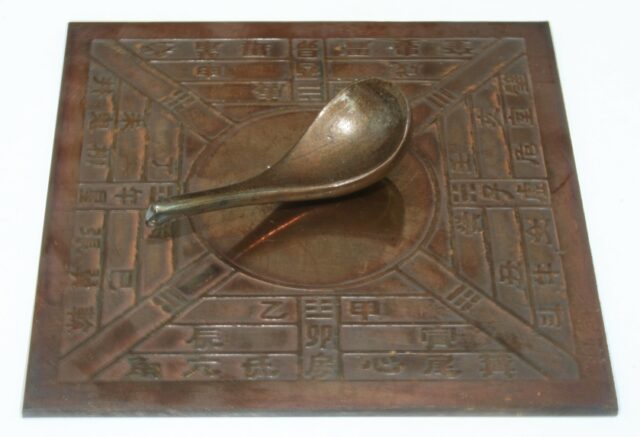
Model of a lodestone table from the Han Dynasty period (Creative Commons Licence)
Feng Shui
Feng Shui (pronounced in Mandarin as “fung shway”) is a Chinese practice focused on creating harmony between individuals and their surroundings. It is rooted in the ancient Chinese philosophy of Daoism, which emphasises the importance of harmony between humans and the natural world.
One element within Daoist teaching is that people benefit from aligning their lives, and the spaces in which they live, with the Earth’s energy (Qi). This means that spaces which people use —homes, offices, or gardens—should be designed to allow Qi to flow as freely as possible through them. Furniture should be positioned to promote peace and reduce stress; mirrors should be placed strategically to reflect light and energy; certain colours and materials should be used to maintain harmony. Above all, buildings should be designed to be aligned with the flow of energy through the Earth.
This is the essence of Feng Shui, and practicing “good” Feng Shui is believed to help people live harmonious, balanced lives. It has a hugely positive influence on people’s health, prosperity, and well-being.
At the start of this post I described Feng Shui as being an “ancient practice”. In fact it is very much alive today, and is used in the design of modern houses, office blocks and even city planning. It doesn’t take much imagination, even for a western dullard like myself, to see that it can encourage an approach which could have important benefits, especially in the creation of stress-reducing environments. But in terms of its relevance to the topic we are discussing here, the key point concerns Feng Shui’s application to the design of buildings, for unsurprisingly Feng Shui practitioners came to identify Qi with the Earth’s magnetic field.
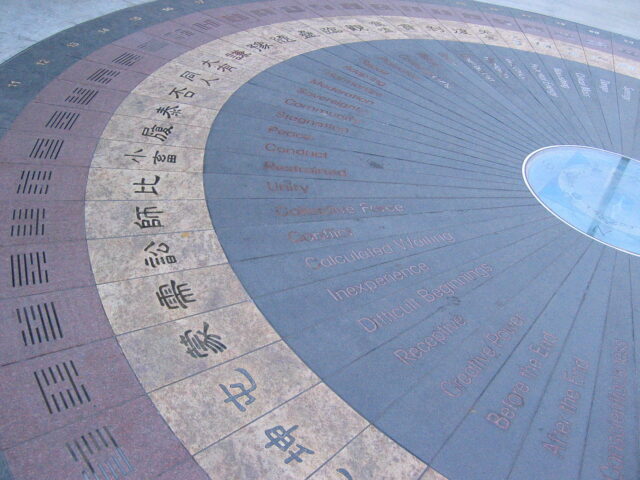
A modern example of Feng Shui – a spiral diagram in Chinatown station, Los Angeles (photo: Arnold C.)
The Earth’s magnetic field had the effect on certain natural objects, such as a rare iron ore called lodestone, to point it along a roughly north-south axis. We can easily see, therefore, how Daoist priests in ancient China, when called upon to ensure that buildings were being designed according to Feng Shui principles, came to use a mysterious instrument in which a piece of lodestone was suspended on a string or floated in water. This was, in effect, the ancestor of the modern compass.
The compass
By the fourth century at the latest, Chinese sailors were using floating lodestones to find direction. Later, in the 11th century under the Song Dynasty (979 to 12279 CE), Chinese technologists made much more convenient instruments by striking lodestones against iron needles to magnetised them.
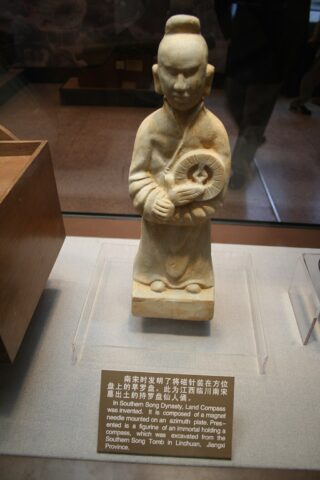
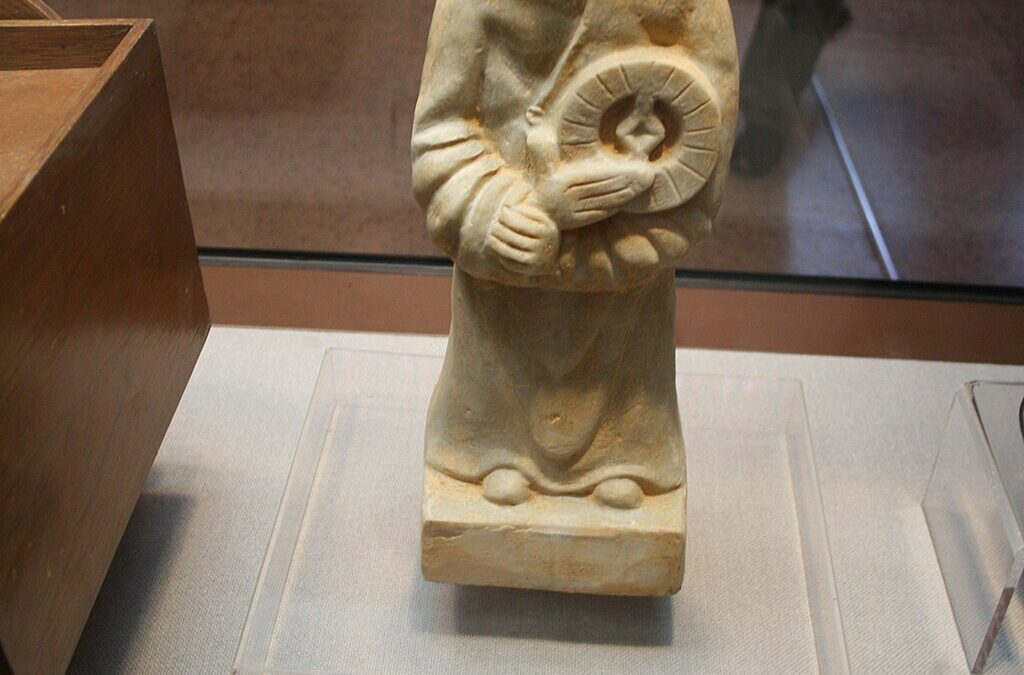
A Southern Song statuette of a figure holding a compass (Photo by Gary Todd: Creative Commons Licence)
.jpg)
It is unsurprising that this innovation occurred at this time. The Song Dynasty was a period of great economic and technical advance for China, in which its maritime trade increased enormously. Chinese sailors and merchants came to dominate the sea lanes between China and South East Asia, and perhaps even India. In particular, Chinese shipbuilders and sailors seem to have deliberately applied technological solutions to challenges which seafarers throughout the pre-modern world faced. For example, they designed ships whose hulls were divided into compartments, so that when one area of a vessel was damaged, sea water would not flood the entire ship (an innovation not used in western shipping until the 19th century). Also, Chinese sailors started to produce printed navigation charts (enabled by the Chinese invention of printing). The invention of the compass as a convenient aid to navigation fitted into this broad process.
Inevitably it was not long (sometime in the 12th century) before the use of the compass spread to Indian and Arab sailors, who were also active in the Indian Ocean. By the 13th century, the compass was being used in European ships in the Mediterranean Sea, in particular by Italian sailors from the great trading cities such as Genoa and Venice. From them it soon spread amongst all the sea-going folk of Europe.
The later history of the compass
As time went by the device was improved as a maritime navigation instrument. And it was European scientists such as William Gilbert, who published “De Magnete” in 1600, who discovered that it was the Earth’s magnetic field which made the compass needle point north.

Portrait of William Gilbert (1544-1603) (Public Domain)
Later, in the 19th century, the liquid-filled compass was developed, to stabilize the needle.
By this time, the Chinese had long ceded their leading position in maritime activity to others – Arabs from the 13th century and Europeans starting in the 15th century. After the spectacular episode of the Ming voyages to the west (reaching as far as the coast of East Africa), the Ming Dynasty chose not to support further maritime expansion, for reasons which I will discuss in another post; and even in the waters around the coast of China, Japanese, Southeast Asian and later European seafarers came to predominate. The fact that many of their activities were criminal (pirating, smuggling) or at best unethical (opium trading) further alienated the Chinese from maritime involvement.
Nevertheless, by developing the compass, the Chinese had made a huge contribution to seafaring, even if it was others who would later reaped the full long-term benefits.