
Ancient Middle East 664 BCE






What is happening in Ancient Middle East in 664BCE
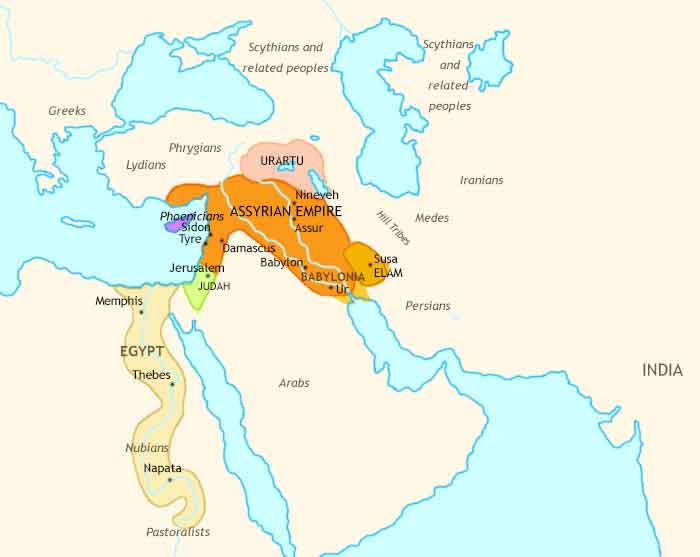
The Assyrian empire is now at its height, and has conquered Egypt.
The Assyrians and Egypt
Having conquered the whole of Egypt, the Kings of Kush then found themselves confronting the huge Assyrian empire. The pharaoh Taharqa unwisely attacked it. The Assyrian king, Earshaddon, responded by invading Egypt and driving the Kushite kings back into Nubia.
The conquest of Egypt brings the Assyrian empire to the height of its size and power.
The Assyrians and Judah
After the destruction of the northern Israelite kingdom, in 722 BCE, the Assyrians made at least one serious attempt to conquer the southern Israelite kingdom, Judah. According to both Jewish and Assyrian sources, this was not a success.
Nevertheless, the kings of Judah have become vassals of the Assyrians. Controlling Judah’s territory is vital for Assyria’s hold on Egypt, as the overland route between Assyria and Egypt passes right through it.
Storm clouds are gathering
The Medes are the most powerful of the Iranian peoples, and have built a powerful state to the east of the Assyrian empire. In Asia Minor, a tribe called the Lydians have founded a wealthy kingdom. Some time around now their kings start issuing the first metal coinage in world history.
The Medes and Lydians, together with Urartu (a warlike state in the north), now form a ring of hostile kingdoms around the Assyrian empire.
By this date, too, nomads from the steppes (the Scythians and Cimmerians) have taken to raiding deep into the northern regions of the Middle East.
Within their empire, the Assyrians’ harsh rule has always provoked rebellions. These are now getting more powerful. Major revolts are breaking out in Babylonia and Egypt.
Trouble is brewing for the Assyrians, both inside and outside their empire.
What is happening in Ancient Middle East in 3500BCE
(Teachers: please follow this link to additional teaching resources)
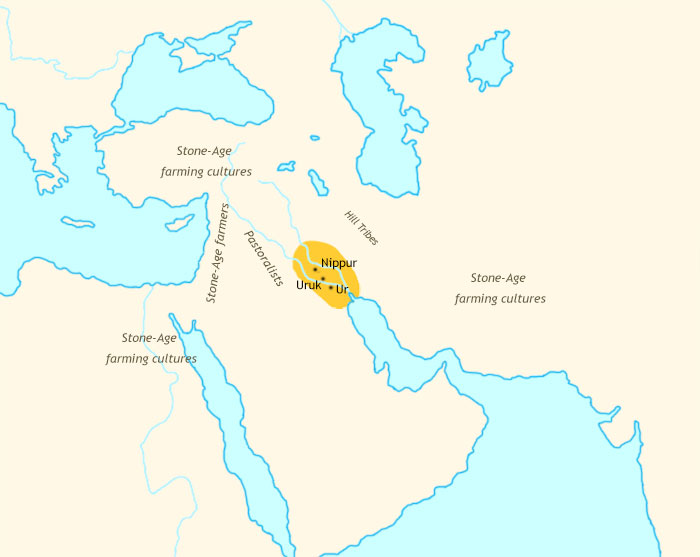
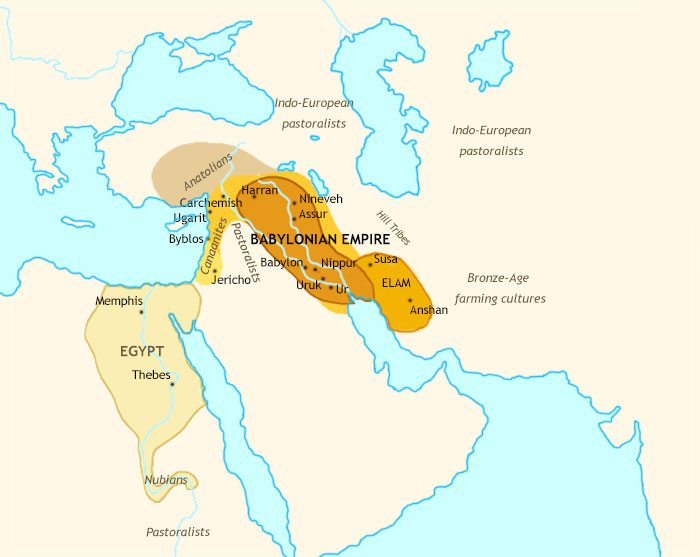
Farming has been practiced in the Middle East since at least 8000 BCE. Settled villages dot the landscape. In one area, southern Mesopotamia, the first civilization in world history is now appearing.
Mesopotamia
The word Mesopotamia means “between rivers” in Greek. Here, on the flood plains of the rivers Tigris and Euphrates, a growing network of irrigation systems has developed over many centuries. This has enabled crops to be grown in the very fertile soil all year round. As a result, a large and concentrated population has grown up here.
This is most true of the southern Mesopotamian plain. Here, the irrigation has allowed a surplus of food to be grown, which supports social groups who need not be involved in agriculture – professional artisans, officials and rulers. These groups live in the first true cities, with temples, palaces, wide streets and public spaces for public ceremonies, and well-built defensive walls.
This area of the southern Mesopotamia is called Sumer. The people who live in the cities here are the Sumerians, and they are developing the earliest civilization in world history.
Sumerian city-states
Each Sumerian city is at the center of its own territory, which forms a political unit that today we would call a city-state. They are fiercely independent, and often at war with one another.
Each city-state is ruled by a priest-king, supported by groups of priests and officials. The Sumerians practice a polytheistic religion, and the kings are seen as the Earthly representatives of the cities’ patron gods.
The economies of these states are very tightly organized. Some or all of the food produced by the farmers is collected into storehouses and redistributed by officials. It is used to support the kings and his attendants in the palace, the priests and craftsmen in the temple, and the officials, overseers, and soldiers.
Writing
To help them organize and keep track of all this activity, Sumerian officials are developing methods of record keeping which will evolve into the first writing system. This is based on the cuneiform script.
This script is made up of hundreds of separate characters, which are in fact based on very stylized pictures (it is therefore called a pictographic script). It is written by pressing a wedge-shaped stylus onto soft wet clay tablets. When the clay dries, it hardens to provide a permanent record of what was written.
The Nile Valley
The Nile is the longest river in the world, with its waters rising deep in central Africa. Its northern portion – roughly 2000 miles – slices through the Sahara desert, creating a thin strip of fertile land about 13 miles wide on average.
By this date, powerful chieftainships have grown up along the banks of the river. These are centered on large walled villages.
[Click here for teachers notes and other Premium resources on the Ancient Middle East]
 Premium content.
 Premium content.
This is an exclusive TimeMap only available to our Premium subscription members.
Start your Premium membership now.
Learn moreAlready have an account? Please login:.
What is happening in Ancient Middle East in 2500BCE
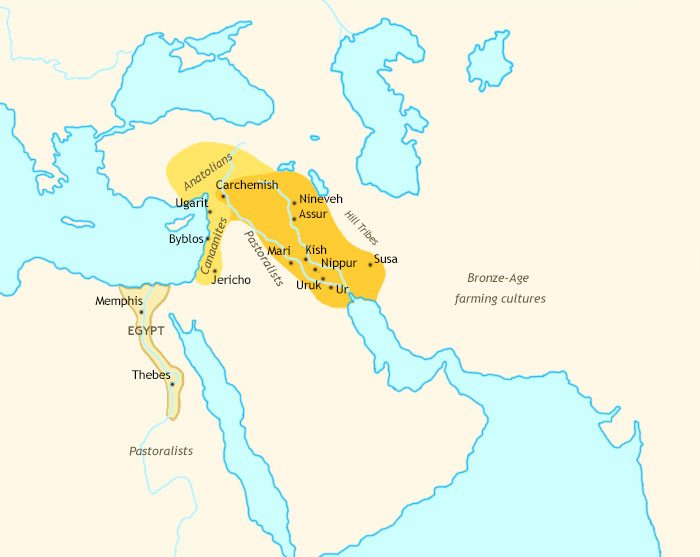
Urban civilization has spread from its original centre in Mesopotamia, outwards into Asia Minor, Syria and Canaan. In all these regions city-states and small kingdoms have developed.
Bronze Age trade routes
The Sumerian cities have a big demand for copper and tin with which to make bronze. This is highly-valued for use in high-status ornaments, but also in weapons. The Sumerian cities are now in one of the first arms races in history, equipping their soldiers with metal armor and weaponry.
To meet this demand, trade routes spread ever further out from Mesopotamia: eastward to India; westward across Asia Minor into south east Europe; and south west to Egypt, either over land through Canaan, or through the port of Byblos (on the coast of Syria) to Egyptian harbors at the mouth of the Nile.
Ancient Egypt: nationwide mobilization of labor
Since about 3000 BCE Egypt has been a single unified kingdom (unlike Mesopotamia, which is divided into numerous city-states). Shortly after its unification, ancient Egypt entered its first period of greatness; this is called the Old Kingdom.
Egypt is ruled by divine kings called pharaohs, regarded as the earthly incarnations of the chief god, Amun.
The Egyptians’ ability to mobilize a work force on a nation-wide scale has allowed the pharaohs and their officials to organize the building of massive structures. The largest of all of them, the Great Pyramids of Giza, are being built at this date. The latest and largest of these has been commissioned by the pharaoh Khufu, probably the best-known of all the Old Kingdom rulers. He belonged to the Fourth Dynasty of ancient Egypt.
To us the building of pyramids seems like an enormous waste of resources. To the Egyptians it was a way of bringing divine blessing on their land.
Egyptian civilization
The Egyptians have developed their own writing systems. A hieroglyphic script is used on stone monuments for public proclamations. For more everyday use a less formal cursive script is used, written on papyrus leaves.
Like Mesopotamian cuneiform, these Egyptian scripts are pictographic, using hundreds of characters based on simplified pictures.
Egyptian achievements in medicine, science, mathematics, and as the Pyramids show, engineering, are very advanced for the time; for example they have developed a 365-day calendar.
What is happening in Ancient Middle East in 2230BCE
The first empire of world history has now appeared in the Middle East. This is the achievement of a Mesopotamian king called Sargon of Akkad.
The Akkadians
Sargon is an Akkadian, not a Sumerian. The Akkadians belong to a group of peoples unrelated to the Sumerians. They speak a Semitic language distantly related to Arabic and Hebrew.
The Akkadians may have originally been nomadic herders, like other Semitic peoples. However, they have long been settled in the farmlands of Mesopotamia, north of the main area of Sumerian city-states. Their homeland will from now on be called the land of Akkad, to distinguish it from the land of Sumer, where the Sumerian city-states were located.
Sargon
The birth legend of Sargon is similar to that of Moses, the first great leader of the Hebrew people. According to this story, the baby Sargon was found in a basket floating on a river by a gardener. This man brought him up as his own son.
Despite this humble background, Sargon apparently entered the service of the king of the Sumerian city-state of Kish. He rose to be the royal cup-bearer. This sounds to us like quite a lowly post, but was probably a very important one.
The first great conqueror
In any case, Sargon was somehow able to take control of Kish for himself. He then defeated a powerful king who claimed to have brought all the Sumerian city-states under his rule. Sargon thus made himself master of Sumer.
He then went on to conquer far and wide – northwest into Asia Minor, west as far as the Mediterranean coast, and east into what is now Iran. He thus created the earliest empire in world history.
At some point Sargon is credited with founding a new city, Akkad (Agade) as his capital. The fact that this city has a Sumerian name, however, suggests that it may have already existed. It has not yet been discovered by archaeologists.
What is happening in Ancient Middle East in 2100BCE
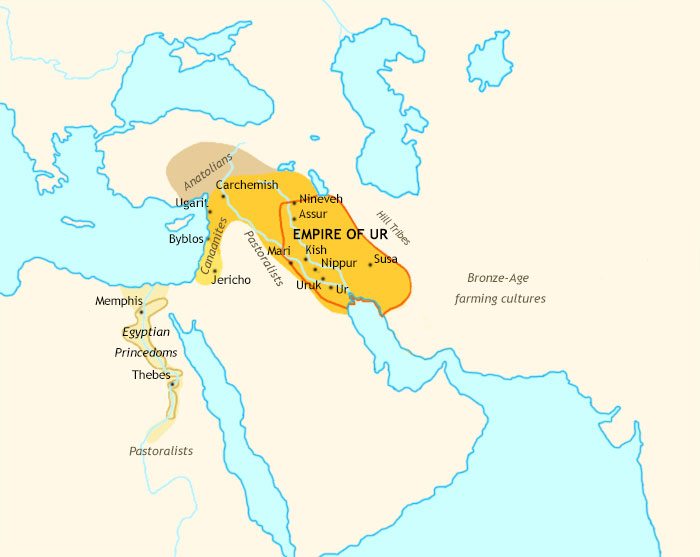
Sargon’s empire lasted barely two generations before it collapsed. Soon another regional power has appeared in Mesopotamia, that of Ur.
The Akkadian legacy
The area of southern Mesopotamia is now called Sumer and Akkad in contemporary sources, showing how influential the legacy of the Akkadian empire is. The Akkadian language, the language of government of Sargon’s empire, has become widely spoken in Mesopotamia.
The city of Ur
Ur is one of the Sumerian city-states. It has grown wealthy on maritime trade in the Gulf, and well beyond. It even has a thriving trade with the Indus Valley cities.
The kings of Ur have now conquered much of Mesopotamia, and some neighboring lands as well. They make Sumerian again the language of government.
Ur has a claim to being the first large-scale bureaucratic state in world history. Thousands of administrative cuneiform documents, all stamped on clay tablets, have come down to us from this period.
They show us that the kings of Ur attempted to control their subjects’ lives very tightly. This was especially true of their economic activities.
It is at this time that the great Ziggurat of Ur, the most spectacular edifice the Sumerians ever constructed, is built.
Egypt
The Old Kingdom has now collapsed. Egypt is now in chaos as rival princes control different parts of the country. This period is known in ancient Egyptian history as the First Intermediate Period.
What is happening in Ancient Middle East in 2000BCE
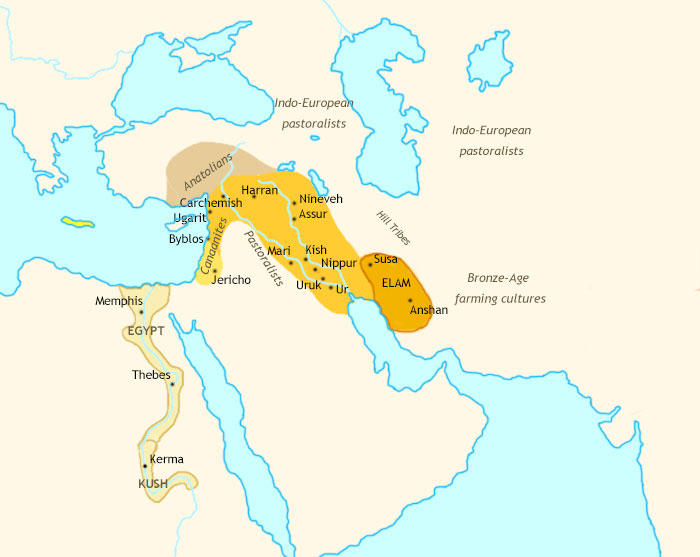
Mesopotamia experiences upheaval as nomadic tribes invade Sumer, while Egypt has been reunited into a single kingdom again.
Mesopotamia
Ur’s period of greatness was also the final era of Sumerian greatness. As Ur’s power has crumbled, nomadic herders from the grasslands bordering Mesopotamia have entered Mesopotamia in large numbers. These people are called the Amorites, Their chiefs establish themselves as rulers over ancient city-states, or establish new ones – for example the city of Babylon.
The newcomers speak a Semitic language, closely related to Akkadian. In due course this language will completely oust Sumerian in everyday life. Scholars will label it “Old Babylonian”.
Abraham
It is probably about now that Abraham, the ancestor of the Israelites, left Ur on travels that would eventually take him and his followers to Canaan (the “Promised Land”).
Abraham would probably have belonged to a nomadic Amorite clan. Nomadic groups like this frequently lived in the neighborhood of Sumerian cities. They were also frequently on the move, grazing their flocks on the grasslands which lay between the different settlements. Particularly in a time of upheaval, as this period was, nomadic clans would frequently be traveling from one region to another in the Middle East.
Egypt
By this time, rulers from southern Egypt have reunited the land and founded the Middle Kingdom (c. 2045 BCE). This is the achievement of the pharaoh Mentuhotep II, of the 11th Dynasty. This has its capital at Thebes, in southern Egypt, not Memphis in the north. This shows that there was a major shift in political power to the southern part of the country.
Kush
In Nubia, the land to the south of Egypt, farming has long taken root. The land is less fertile than in Egypt, however, and cattle grazing is also important.
At around this time, the different chiefdoms of the area come under the control of a single ruler, and the kingdom of Kush is formed. Its capital is at Kerma.
Kush acts as a trade bridge between central Africa, to its south, and Egypt (and the rest of the Middle East) to its north. However, this trade is limited to overland transport (caravans of donkey), as the course of the river Nile is interrupted in this region by a series of fierce cataracts over which boats cannot pass.
This limits the influence of Egyptian civilization in the region. Nubian culture is more similar to other central African cultures of the period.
The Indo-Europeans
By this period tribes from the Black Sea region have been migrating down into the north of the region. They are descended from nomadic herders who have inhabited the steppes of central Asia. They speak an Indo-European language, and their culture is related to other groups now moving into Europe and, later, the Indian subcontinent.
They bring with them a new weapon of war, the chariot. This will give them an advantage in battle over the kingdoms of the Middle East.
Elam
Sometime around now a new kingdom is formed in southwest Iran. It is called Elam, and will be a presence in the Middle East for hundreds of years to come.
What is happening in Ancient Middle East in 1750BCE
Hammurabi, king of Babylon, has united Mesopotamia under his rule.
Babylon
In Mesopotamia, the city of Babylon was founded by an Amorite clan. At first small and unimportant, it gained more and more territory under a succession of vigorous kings.
Eventually it ruled much of central Mesopotamia. Babylon’s famous king Hammurabi (reigned 1792-49 BC), has been able to unite almost all Mesopotamia under his rule, and even extend it over states in Syria.
Hammurabi’s law code
Hammurabi is famous not only for his conquest, but also for issuing a law code, which he has had carved on stone pillars and set up in different locations within his empire.
This law code is not the first in Mesopotamian history; it is likely that many, if not all, Mesopotamian city-states had such codes. However, Hammurabi’s is the most comprehensive that has survived, and has given modern scholars a clear insight into Mesopotamian life at this time.
The purpose of issuing his code is so that all his subjects, wherever they are, are able to obey, and be judged by, a single set of laws, rather than by a confusion of local laws.
Middle Kingdom Egypt
The Middle Kingdom of Egypt has expanded its borders, southward into Kush and outwards into the desert oases surrounding the Nile Valley. These are valuable for the salt, copper and gold mines located there. From Kush come exotic products from sub-Saharan Africa, such as ivory, black slaves and ostrich feathers from Nubia.
Kush
Although the Egyptians have destroyed the kingdom of Kush, their presence in the region is limited to a series of forts. The culture of Nubia remains largely untouched by influences from the north.
Abraham’s clan
According to the Biblical account, by this date, Abraham’s descendants are roaming the land of Canaan.
This nomadic group were not alone. During this period, Canaan experienced an influx of Semitic tribes, including Amorites. They grazed their flocks in the scrub between the small Canaanite cities and their surrounding farmlands.
What is happening in Ancient Middle East in 1500BCE
Southern Mesopotamia
Hammurabi’s successors soon lost much of the empire he had conquered. Southern Mesopotamia, however, remained under their rule, and as a result this region is now called Babylonia.
In 1595 BCE, the city of Babylon was attacked and sacked by the Hittites (see below). This weakened its kingdom, and it fell under the control of rulers from the northeast hill country. These are the Kassites.
Even though they are foreigners, the ancient civilization of Mesopotamian thrives under the Kassites’ control. Although the people of the region no longer speak Sumerian, but a language which modern scholars call “Old Babylonian, their religion, art, architecture and literature, are firmly on lines laid down by their Sumerian forebear.
Hittites and Mitanni
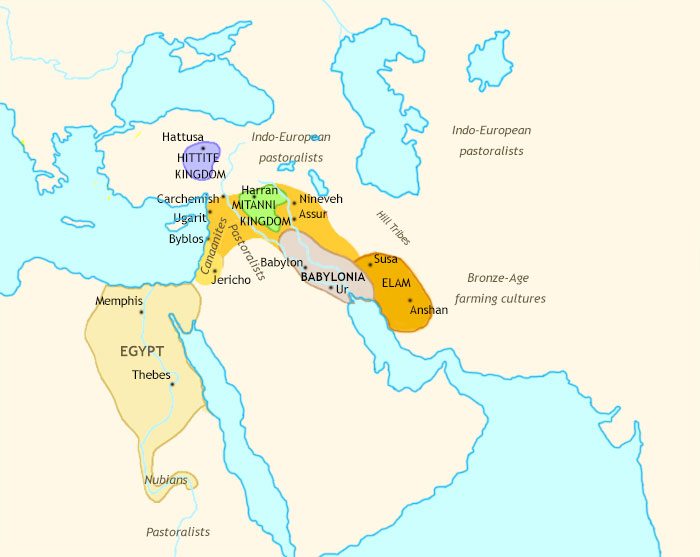
Two groups have established powerful kingdoms in the Middle East, the Mitanni and the Hittites.
Egypt
The Middle Kingdom of Egypt collapsed after a couple of centuries (c. 1650 BCE). This started a century of disunity and chaos in the country, in the period known to ancient Egyptian history as the Second Intermediate period (c. 1650 to 1550 BCE).
During this time, a people from western Asia, the Hyksos, briefly occupied the delta region, the first foreigners to rule Egyptian land. A leader from southern Egypt drove the Hyksos out, called Ahmose I, reunified the country and established the New Kingdom of Egypt. His successors have ruled Egypt as the 18th dynasty.
One of the most extraordinary of pharaohs at this time is Hatshepsut. She is one of the very few women in ancient Egyptian history to rule the country in her own right (rather than as the queen or queen mother of a weak or young male ruler).
Expansion
The monarchs of the New Kingdom are ambitious and warlike. It is likely that the experience of having foreigners (Hyksos) rule part of their land came as a shock to the people of Egypt. This has probably made their rulers much more aware of the need for a stronger army than in previous times.
At about this time, the pharaoh Thutmose I, uses this new powerful army to re-occupy Nubia and to invade Canaan.
Abraham’s clan
According to the Biblical account, Abraham’s descendants are now living in Egypt. They now call themselves the “Children of Israel”. This is after Abraham’s grandson, Israel (or Jacob as he was originally called), who was their more recent common ancestor.
It is likely that they form one group amongst the Hapiru (Hebrew) people. These appear in Egyptian documents of the time as troublesome outsiders who are infiltrating the country.
What is happening in Ancient Middle East in 1275BCE
This period marks the high point of Bronze Age civilization in the Middle East. New Kingdom Egypt and the Hittite Empire are the leading powers of the region.
New Kingdom Egypt
Under the pharaohs of the New Kingdom, Egypt has expanded its territory enormously, south into Kush and northeast into Canaan. It is at this period that ancient Egypt reaches the height of its glory and power.
At this time, pharaohs and their queens are buried in the magnificent tombs of the Valley of the Kings. This is near the city of Thebes (near modern-day Luxor), the capital of New Kingdom Egypt.
Famous pharaohs
Egypt has several famous rulers during this period. A remarkable one was the pharaoh Akhenaten, who tried to install the worship of the Sun god Aten as the official religion of Egypt. He seems to have tried to suppress the worship of all the other gods.
This policy was of course furiously resisted by the priests of Amun, the main god of the Egyptians at this time. Akhenaten’s religious reforms did not survive his death, but some modern scholars see this episode as a first experiment in monotheism.
Akhenaten’s wife was Queen Nefertiti. She apparently became the real ruler of Egypt after his death. A bust of her is one of the most beautiful of all Egyptian works of art.
Her son, the boy king Tutankhamen (reigned 1332-1323 BCE) is today probably the most famous of all the pharaohs. He did not reign long nor did he accomplish much, but his magnificent burial chamber in the Valley of the Kings was discovered in 1922.
Ramesses II (reigned 1279 to 1213 BCE) is the ruler reigning at 1275. He is a successful military leader, and a builder of magnificent monuments. He has either constructed or renovated three of the greatest of all ancient Egyptian temples, at Karnak, Luxor and Abu Simbel. He has enormous statues of himself carved, and on them inscribes his many achievements. Later Egyptians will regard him as the greatest of all pharaohs.
Kush
Under the New Kingdom, Egyptian influences become much more powerful in Nubia. Many Egyptians settle in the region, as soldiers, officials and traders. They establish Egyptian towns in the region, and the pharaohs build huge temples there. Many members of the Nubian upper classes become Egyptianized, and even enter the service of the pharaohs as soldiers and officials.
The Egyptian capital in Kush is the city of Napata. The Pharaoh’s deputy is based here.
Great power competition in Canaan
The many small kingdoms of Syria and Canaan are dominated by their more powerful neighbors, the Egyptians and the Hittites.
The Hittites have greatly expanded their kingdom until it covers a large part of Asia Minor and Syria. Along with Assyria (see below) they have swallowed up the Mitanni kingdom.
The Battle of Kadesh
The rivalry between the Egyptians and Hittites culminates in the Battle of Kadesh, which takes place around this time (probably 1274).
Ramesses II claims it as a great victory on his monuments, but it is not followed up by any territorial gains for the Egyptians. In fact, the Egyptians and Hittites seem to have come to an agreement to divide control of Canaan between them.
In any case, both powers were soon more concerned at the aggressive actions of Assyria than with each other.
The Assyrians
The Assyrians were a people of northern Mesopotamia who had previously been under Mitanni overlordship. They rebelled and won their independence, then dismembered the Mitanni kingdom and divided it with the Hittite empire.
For centuries to come Assyria will appear on the map of the Middle East. The Hittite empire, on the other hand, will be wiped off the map before the century is out.
The Children of Israel
According to the Biblical account of the origins of the Israelites, the Children of Israel have now fled Egypt in a migration known as the “Exodus”.
Of this there is no other evidence in the historical record, and if over two million people had been involved, as a literal reading of the numbers in the Bible implies, then there almost certainly would have been evidence for it. Ancient Egyptian society would surely have collapsed overnight – which it clearly did not.
Nevertheless most ancient origin stories (for this is what the account of the Exodus is) probably did have some basis in history – it is hard to think how otherwise they could have been so broadly accepted by later generations.
What is happening in Ancient Middle East in 825BCE
The period after the late 13th century were ones of turbulence of the Middle East – but also ones when foundations for future advance were laid.
Population movements and the devastation of ancient civilizations
In the late second millennium BCE, a large number of people were on the move. These migrations brought chaos and devastation to the whole Middle East. The Hittite empire was destroyed, old trading cities vanished, Egypt was weakened, Assyria was invaded, and Babylonia and Elam thrown into chaos.
However, by the 9th century BCE things are settling down. Assyria has survived, and is now growing in power again. A trading people, the Phoenicians, are growing in wealth. The Israelite kingdoms have become the centre of a new monotheistic religion. In southern Mesopotamia, the Chaldeans have taken control of the city of Ur (which is why it is called “Ur of the Chaldeans” in the Bible), and will soon take over Babylon itself.
Egypt and Kush
In the 12th and 11th centuries, Egypt came under repeated attack, from the Peoples of the Sea and desert tribes.
Under these blows, the pharaohs first lost control of Canaan, and then of Egypt itself as the country broke up into rival kingdoms. This period of the New Kingdom was replaced by the Third Intermediate Period.
Kush
With the decline of New Kingdom Egypt, however, Nubia came under its own kings again, and a revived kingdom of Kush has been formed. Its capital is Napata.
The Phoenicians
A people new to history have taken over the maritime trade of the eastern Mediterranean. These are the Phoenicians, and they live in prosperous trading cities such as Tyre and Sidon. These have become wealthier than any trading cities before them.
Phoenician sailors and merchants have pioneered new trade routes right across the Mediterranean Sea. They have even ventured beyond, into the Atlantic.
The Israelites
The Israelites probably moved into Canaan in the 13th century BCE.
They practice the first monotheistic religion in world history; it is based on the worship of the One God, Yahweh. This faith is also distinctive for requiring its followers to practice a high standard of morality. The Israelites are taught not to kill, or steal, or covet each others’ goods; instead they are to treat each other – and especially the weaker and more vulnerable members of society such as widows, orphans and foreigners – with kindness and respect. The basis of these ideas are set out in a short law code called the Ten Commandments.
At first the Israelites are divided into different tribes, but in the 11th century they formed themselves into a kingdom. This prospered under its famous kings David and his son Solomon, who ruled from their capital, Jerusalem. Here Solomon built a temple to Yahweh.
In the 10th century, however, the kingdom divided into two: a northern kingdom, Israel, and a southern kingdom, Judah.
From Bronze Age to Iron Age
These troubled centuries have seen the Bronze Age give way to the Iron Age in the Middle East. The spread of the use of iron will have huge consequences for humanity.
Bronze is far too expensive to be used much in farming. Up to now farmers have had to make do with tools made of wood, stone and bone, just as their ancestors did in the Stone Age.
Iron is a much cheaper metal than bronze. This means that it can be made into tools cheap enough for ordinary farmers to own.
Iron plows are much better at turning the soil then wooden ones are, and iron axes make it much easier to chop down trees and clear land for fields. Iron tools therefore make farming much more productive. More food can be grown and more mouths fed. Populations grow, towns and cities expand and more trade can take place. Civilization can now flourish more easily, even in areas away from the floodplains.
The Alphabet
Another change at this time is the spreading use of alphabetic writing.
The cuneiform script of ancient Mesopotamia, the hieroglyphic script of ancient Egypt, and other scripts based on hundreds of symbols, take a long time to learn. As a result, only a small section of the population has been able to read and write.
Compared to these, alphabetic scripts are easy and quick to learn. This means that a larger section of society can become literate and educated.
The Canaanites seem to have developed the earliest alphabetic script back in the Bronze Age. This has now evolving into several different scripts. Phoenician merchants are spreading their alphabet westward, where it becomes the ancestor of Greek, Latin and all modern European writing. The Aramaic alphabet spreads throughout the Middle East, and a little later to India. The Hebrew alphabet is being used in the writing of the Israelite scriptures (the Old Testament of the Christian Bible).
What is happening in Ancient Middle East in 722BCE
The Assyrian empire now dominates much of the Middle East. It is still expanding.
The Assyrian empire
The Assyrian empire now dominates the Middle East.
The Assyrians owe their success to their large, well-organized army. This is the first army known to have had its own siege engines (portable wooden towers, ladders and so on for attacking city walls), and also its own supply organization. The Assyrian kings make sure that their empire is crossed by a good road network, so that troops can march quickly along them to any trouble spots. Also, messengers on horseback can ride swiftly along them to carry orders from the king to his officials in distant parts of the empire.
Often, the Assyrians do not even have to fight battles in order to defeat their enemies. They use terror tactics – massacres of civilian populations, terrible tortures of enemy leaders and so on – very effectively. Enemy forces often melt away before the Assyrian troops arrive. Even if they stand and fight, they are often half-defeated already, such is their fear of the mighty Assyrian army.
Many subject peoples, such as the Phoenicians, continue to be ruled by their own kings. These, however, are only allowed to keep their thrones so long as they send tribute to the Assyrian king and obey his orders.
Resettlement
The Assyrians often deport conquered peoples from their homelands, and resettle them in different parts of their empire.
In place of the deported populations, colonists from elsewhere are brought in to settle the land.
The most famous example of this practice was the kingdom of Israel. This was the northern of the two kingdoms into which the Israelites had been divided. It was conquered by the Assyrians in 722 BCE.
The inhabitants of this state were scattered to different parts of the Assyrian empire, and to take their place newcomers were brought in, mostly, it seems, from Mesopotamia.
This was the fate of many small kingdoms and their cultures. It turned the areas occupied by the Assyrians into a melting pot of many different peoples. Ancient languages were lost and Aramaic became the common language of the region.
The Medes and the Persians
Iran is being occupied by the people from whom it would take its name, the Iranians. These are an Indo-European people, closely related to the Aryans who have settled in northern India (“Aryan” and “Iranian” are related terms).
The Medes are the most powerful group of Iranians. They have settled in western Iran. Their close relatives, the Persians, are settling in south-west Iran, in lands once ruled by the kings of Elam. Both these groups will later form famous states.
Kings from Kush
Kush has became a powerful kingdom. In the 750s its king, Kashta, conquered lower Egypt. Kashta’s son, Piankhi, has completed the conquest of Egypt and established the 25th Dynasty.
These Kushite kings rule Egypt in the tradition of the ancient pharaohs. They see it as their duty, not just to re-establish Egyptian power, but to restore Egyptian civilization to its former purity (it has, in their view, become degraded during the centuries of Egyptian weakness). They build and restore many temples and monuments, and even revive the custom of royal burials in pyramids. This is a practice the Egyptians themselves discarded centuries before.
The Kushite kings rule from Napata. As well as extending their control over Egypt, they have expanded their power a long way southward along the Nile Valley as well.
What is happening in Ancient Middle East in 585BCE
The Assyrian empire is no more: its enemies have fallen upon it and destroyed it.
The fall of the Assyrian empire
In the late seventh century BCE, the mighty Assyrian empire suddenly found itself dealing with too many powerful enemies at the same time. The Medes, Scythians and Cimmerians all invaded the empire in 612-611 BCE, and joined forces with the Babylonian and Egyptian rebels to overwhelm the Assyrian armies. They utterly destroyed the Assyrian capital of Nineveh, along with other Assyrian cities.
They then divided the empire between themselves. The Babylonians took most of it. The Egyptians re-established their independence under a new native dynasty of pharaohs.
The Medes meanwhile expanded their territory by conquering the ancient kingdoms of Urartu and Elam.
Nebuchadnezzar, king of Babylon
Nebuchadnezzar reigns as king of the Babylonian empire (605 – 562 BCE). He adorns his capital with magnificent temples, vast palaces and the fabled Hanging Gardens of Babylon (although its existence has yet to be proved by archaeologists).
It is under Nebuchadnezzar that the Babylonians bring Mesopotamian astronomy to its peak. They are following in a tradition started by the Sumerians two thousand years before.
The destruction of Jerusalem
In 587 the king of Judah rebelled against Babylon. Nebuchadnezzar led his forces in besieging and taking Judah’s capital, Jerusalem. He destroyed Jerusalem and its temple, and deported Judah’s upper classes to Babylon.
Here, unlike all the other peoples who had been deported by the Assyrians and Babylonians, they become more faithful to their own traditional religious beliefs, which revolve around the worship of the One God, Yahweh. At this time many of the Jewish scriptures (the Christian Old Testament) are taking shape.
Egypt and Kush
The re-establishment of Egypt’s independence from Assyria has begun the last great period of Ancient Egypt’s long history. This phase is known as the Late Dynastic Period.
The Kushites had remained a threat to the Egyptian’s southern flank, and the pharaoh Psamtik II of the 26th Dynasty decided to invade their kingdom. His army defeated the Kushites and sacked the capital of Kush, Napata.
The Kushites have now moved their capital to Meroë, much further south. This will be a permanent move. As a result, Kush’s “Egyptian” traditions begin to fade, and Kush’s culture will gradually become increasingly “Africanized”. For example, the old Egyptian gods and goddesses will give way to ones who resemble African animals like elephants and lions. They also develop their own writing script (which has yet to be deciphered by modern scholars).
What is happening in Ancient Middle East in 500BCE
The Persian empire now covers most of the Middle East.
The Persian empire
Cyrus, a prince of the Persians, rebelled against his superior, the king of the Medes, in about 560 BCE. Within a few years he had defeated the Medes, and then went on to overrun the kingdom of Lydia, the Greek city-states of western Asia Minor, and the Babylonian empire. He next turned against the nomadic tribes to the north of Iran, extending Persian control over a huge territory in central Asia. However, he was killed in battle in 530 BCE.
Cyrus has gone down in history as one of the great conquerors of all time.
His son Cambyses (reigned 530-522 BCE) conquered Egypt, before dying unexpectedly, probably as the result of an accident.
By the time of Cambyses’ death a major rebellion had broken out in central Iran. This was put down quickly by a relative of Cambyses, called Darius.
He would go down in history as Darius the Great (reigned 522-486 BCE). He further expands the borders of the empire, mostly in central Asia and into India. By the end of his’ reign, the Persians will rule by far the largest empire that the world had yet seen.
The Jewish return from exile
The Persians rule their vast empire with a much lighter touch than the Assyrians and Babylonians had done. Cyrus the Great set the tone by respecting the traditions and cultures of the conquered peoples.
Most famously, he ordered that the Jewish exiles in Babylon should have their homeland, and above all, Jerusalem, restored to them. Many returned there after 70 years of exile in Babylon, and began rebuilding the temple to Yahweh, the heart of their faith.

Subscribe for more great content – and remove ads