
The Classical Age of India 380 CE






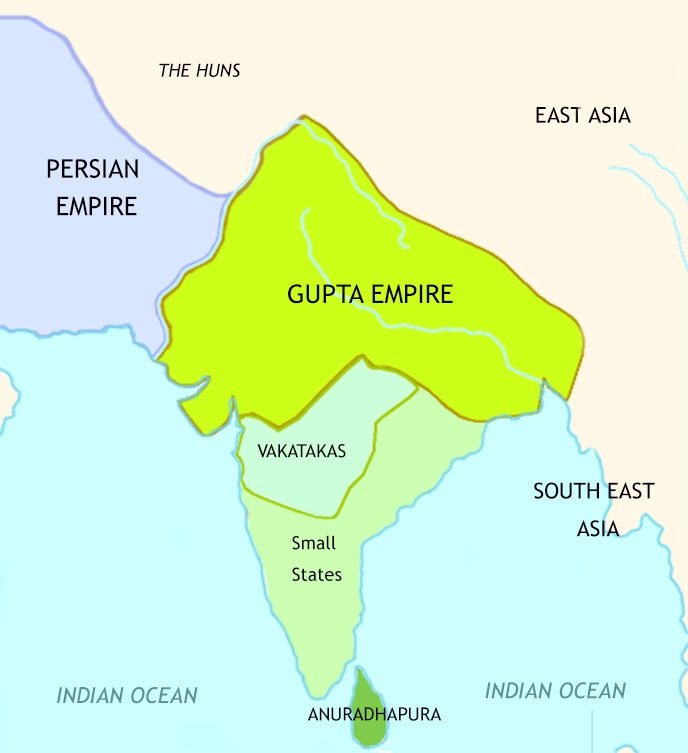
What is happening in The Classical Age of India in 380CE
(Teachers: please follow this link to teaching notes)
The Gupta empire now dominates northern India.
The Gupta dynasty
The Kushana empire disintegrated in the early 3rd century CE. At around the same time the long-lasting kingdom of Satavahana, in central India, also vanished. This cleared the way for the rise of a new power in India: the Gupta empire. This would dominate northern India for two centuries.
The Gupta dynasty came to power in the kingdom of Magadha in the late 3rd century. This was the very kingdom which had expanded to become the Maurya empire, centuries before. Nevertheless there seems to have been no direct link between the Maurya and Gupta families.
The Gupta kings have conquered most of northern India. For a short time the brilliant generalship of Samudra Gupta (reigned 330-375) even forced the kingdoms of eastern India to acknowledge Gupta overlordship, but only temporarily. It is under Chadragupta II (380-415 CE) that the Gupta empire reaches the height of its power.
The Vatakatas
One factor aiding Gupta power is the close alliance between the Gupta royal family and the Vatakata royal family. The Vatakatas have risen to control a large kingdom in central India. Strong marriage ties bind the two dynasties together.
A confederation of kingdoms
The Gupta empire, like other large kingdoms in ancient India, consists of a central core and an outer zone. The core is ruled directly by the emperor and his officials. This is probably through provincial governors ruling in the name of the emperor, as the Maurya empire had been.
This other zone is made up of a large number of tributary kingdoms. Here, rulers owe duty to the Gupta emperor as their overlord, and pay tribute to him. So long as they remain loyal, however, they keep their thrones.
When one emperor dies, however, and a new, untested one comes to the throne, these kings have a tendency to try and break away from Gupta rule.
Fortunately for the Gupta, until the mid-5th century their emperors are successful in putting these rebellions down.
The High point of classical Indian civilization
The Gupta period in India marks the high point of classical Indian civilization. Several important advances are made at around this time.
Mathematics and science
Indian mathematicians discover the concept of zero. Linked to this, they develop the decimal system and so-called “Arabic” numerals.
Astronomers work out that the world is a sphere and that it rotates round the sun. It would be centuries before this was understood in Europe.
In medicine, a great medical textbook is written. This includes instructions on how to make medicines from a huge range of plants and minerals. Remarkably, it also shows that Indian doctors knew the merits and methods of inoculation. They had advanced surgery to a higher level than elsewhere in the world. This included medical procedures which we now call plastic surgery.
In metalwork, Indian craftsmen produce very tough and pure iron. Under the Gupta dynasty, metalworkers build the famous Iron Pillar near Delhi. This is still a major tourists attraction. It has proved remarkably resistant to rust, which remains something of a mystery.
Culture
The Gupta kings are Hindu by religion. Nevertheless, like other Indian rulers they support art and architecture which serves all three religions of the subcontinent. They build Buddhist and Jain temples – for example at Nalanda, which would become one of the greatest centers of Buddhist studies – as well as Hindu ones.
The Gupta period sees a revolution in the design of Hindu temples. Apart from the great cave-temples of central India (see information for 30 BCE), they had previously been small, one-room square stone structures with flat roofs. In the Gupta period, they grow far larger. They gain huge, highly decorated towers. These decorations are carvings of gods, goddesses and other spiritual beings.
This gives free rein to sculptors, and Classical Indian sculpture is brought to its finest beauty. The influences from Gandhara art are very apparent. Statues are finely carved in the round, and full of expression and movement.
In literature, the playwright Kalidisa brings classical Indian literature to its highest peak. He is regarded in much the same light in India as Shakespeare is viewed in English literature.
What is happening in The Classical Age of India in 500BCE
(Teachers: please follow this link to teaching notes)
The Indus Valley civilization vanished over a thousand years before this date. Since then, Aryan tribes have been spreading out across northern India.
The Indus Valley civilization
This civilization flourished between about 2700 to 1800 BCE (see the Premium Unit Early Civilizations).
After that time, it vanished. Modern scholars do not understand the reasons for this great civilization’s collapse. It may have been linked to an immigration of peoples from central Asia, called Aryans.
The Aryans
The Aryans are a branch of the Indo-European speaking peoples. They were originally nomads who herded flocks of sheep and cattle across the grasslands north of the Black Sea.
From there they spread out: west into Europe (where they divided into such peoples as the Greeks, Italians and Celts), south into the Middle East (where their descendants included the Hittites and Kassites), and southeast into Iran and Afghanistan (where they became the Persians and other Iranian tribes – see the Premium Unit The Ancient Middle East).
Some of them then moved from Afghanistan into the northwest of the Indian subcontinent. Here they called themselves “Aryans” (which means “noble ones”). They spoke a language called Sanskrit, which is closely related to Greek, Latin and other Indo-European languages.
Warrior clans
The Aryans came into the Indian subcontinent as nomadic herders. They were divided into many clan groups, each under its own chieftain. These groups began fanning out across the plains of northern India.
The newcomers were a warlike people, and conquered the inhabitants of the farming villagers of the region; their chiefs became the new rulers.
Their different clans were constantly at war with one another, as well as with the native peoples. By this date, however, the clans have merged into a small number of large states.
Early Hinduism
The Aryans follow a religion which is an early form of Hinduism. Another name for it is Brahmanism. This is because it is led by a class of priests called Brahmins. It is only they who are allowed to conduct animal sacrifices to the gods – the central focus of Aryan worship.
The Brahmins have composed large collections of poems, hymns, rituals and so on. These have been passed down from one generation to another by word of mouth. These collections were called the Vedas. When they are written down, many centuries later, they will become the most sacred of the Hindu scriptures. The best-known is the Rigveda.
This religion was polytheistic – that is, it involved the worship of many gods and goddesses. It had the same roots as the other religions of Indo-European speaking peoples such as the ancient Persians, Greeks, Celts and Germans.
Reincarnation
The Aryans’ religion developed very specific features of its own, however. At its core was the idea of karma. This was the balance of right or wrong deeds a person does in their life.
According to this belief, how one lives in this life will determine one’s fate in the next – in particular, whether one would be born into a higher or a lower level of existence.
Karma is thus linked to a belief in reincarnation. This holds that the soul passes from one body to another through many lives.
Castes
The ideas of karma and reincarnation have led the Aryans to impose a caste system on the peoples they conquer. They divide society into different hereditary groups called varnas (in English we call them “castes”). From the top these groups are:
- priests (Brahmins)
- warriors (Kshatriyas)
- farmers, craftsmen and traders (Vaishyas).
- laborers and servants (Shudras)
Outside the caste system are the outcastes. These are outside true Aryan society, and are not really regarded as being fully human. They undertake all the filthy and degrading tasks which a society needs doing, such as collecting refuse and handling dead bodies.
There is evidence that at first the castes were like social classes in other societies – groups with different levels of status, wealth and power but whose members were able to move from one to another. Gradually, however, caste divisions became much stricter. Members belonged to their caste for life, as did their descendants. They were not allowed to marry someone from another caste, or even mix socially with them.
A changing society
Over the last few centuries, iron-using technology has arrived in the Indian subcontinent from the Middle East. This has helped farmers settle the Ganges plain in large numbers, turning thick forests and swamps into excellent farmland. This in turn has led populations to increase.
More recently, trade links have grown up between northern India and the great civilizations of the Middle East. Along with trade has come writing. The Sanskrit alphabet has recently been developed, and is based on the Aramaic alphabet of the Assyrian, Babylonian and Persian empires.
Cities and states
The expansion of trade is leading to towns and cities appearing. In them, urban (town-based) social groups are appearing, such as merchants and craftsmen. These classes are new to Aryan society
Up to now the Aryans have lived in tribes. These are now becoming states, with governments and armies. Most of these are kingdoms, ruled by hereditary monarchs. Some, however, are ruled by groups of nobles. Modern scholars sometimes describe these states as republics.
Central and southern India
To the south of the great river plains of the Indus and Ganges, India is covered by mountains, forests and deserts. This huge region is home to non-Aryan peoples. Some of these groups are hunter-gatherers, some are herders and some are farmers. They live in small settlements – farming villages or temporary encampments – and there are no towns and cities here. Writing is unknown, and iron tools are only now beginning to replace Stone Age technology.
What is happening in The Classical Age of India in 400BCE
(Teachers: please follow this link to teaching notes)
The past century has seen the rise of new religions in India – Buddhism and Jainism.
Religious unease
The big changes in Aryan society have been causing many people to feel dissatisfied with the old traditional Aryan religion. The rise of towns is creating new social groups, such as merchants and artisans. These people can read and write, and have time to think about other things than just surviving. They may also have been influenced by ideas coming in from outside the Indian subcontinent, especially the Middle East.
Many of these want a new kind of belief system, which is not just to do with sacrifices to the gods. They yearn for deeper explanations of spiritual matters, and about how humans can lead happier and better lives.
Some Brahmins are trying to make the ancient Vedic belief system more relevant to the times. They develop ideas which explain the relationship between the gods, humanity and the universe. These are written down in a collection of commentaries on the Vedas called the Upanishads.
At about this time, the Vedas themselves begin to be written down in Sanskrit.
New belief-systems: Jainism and Buddhism.
More and more people, however, are following teachers who call for a more radical break with the past. As a result, new religious movements are appearing. Two of these will endure down to the present day, and one will grow into one of the great world religions.
Both challenged the Brahmin’s monopoly on religious leadership; they rejected the practice of animal sacrifice, and were opposed to the caste system.
Jainism
Jainism was founded by Mahavira (c. 540-468 BCE), who taught non-violence against all living creatures, along with the renunciation of physical pleasures and worldly ambitions.
Buddhism
Buddhism was first preached by a prince of one of the northern Aryan states, called Siddhārtha Gautama (lived 563-483 BCE). He became known as “the Buddha”. He taught his followers not to pursue wealth, status or power. Instead they are to live lives of simplicity and compassion, treating all people and animals with kindness. If they do this, they will move towards Nirvana – liberation from the cycle of rebirths into a state of complete peace.
The founders of both Buddhism and Jainism collected groups of disciples around them. In the century since then, these disciples have passed on their teachings down the generations and spread these religions across northern India. Most of these disciples came either from the warrior class or the new urban group of merchants.
Jainism would remain mostly confined to India, but Buddhism would eventually spread right around Asia, and is today finding many followers in the West.
The Kingdom of Magadha
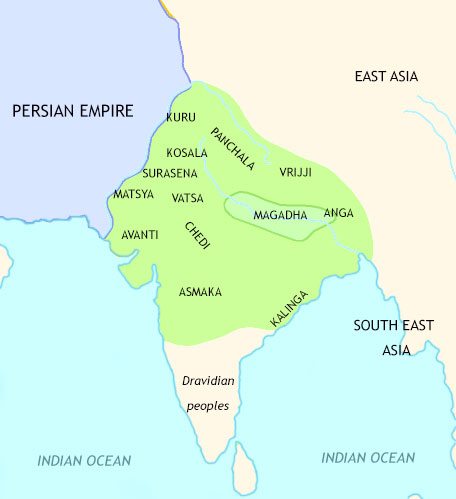
The kingdom of Magadha is located in the south-eastern Ganges plain. Its kings have been favorable to both Buddhism and Jainism. It has expanded its borders at the expense of some of its neighbors. It will grow into the first great empire of Indian history.
What is happening in The Classical Age of India in 323BCE
(Teachers: please follow this link to teaching notes)
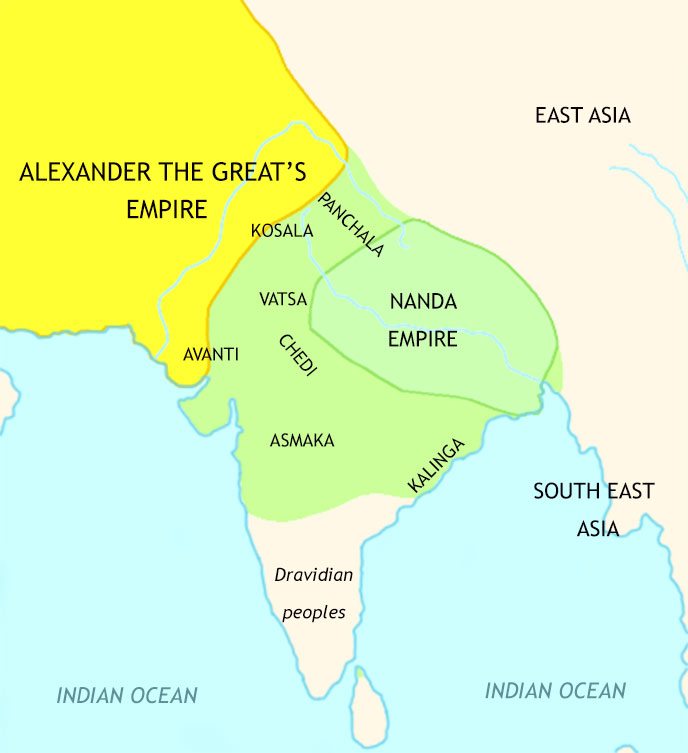
Magadha, now under the Nanda dynasty, has expanded dramatically. Meanwhile western India has been conquered by the army of Alexander the Great.
Alexander the Great
Alexander the Great was the young king of Macedonia, just north of Greece and far to the west of India. His father had made himself the master of all Greece, and Alexander inherited that position.
He then led a large army of Macedonians and Greeks in conquering the Persian empire.
After completing this, Alexander invaded India in 327/6 BCE. He marched further and further into the subcontinent, crossing the river Indus. However, his army eventually mutinied at being so far from home. This forced his hand, and he had to turn back.
Alexander’s legacy
Alexander’s brief invasion will have long term consequences. The north-western parts of the sub-continent (more or less today’s Pakistan) has been incorporated into his huge empire.
Alexander’s conquest has introduced Greek culture into the Indian subcontinent. This will later have a big influence on Indian art and architecture.
The kingdom of Maghada
The kingdom of Magadha has expanded by conquering many of its neighbors. It now covers most of the Ganges plain.
It is now ruled by kings of the Nanda dynasty. Apart from pushing out the kingdom’s borders dramatically, they have gathered power more firmly into their own hands. Royal officials take over tasks such as collecting taxes and raising troops, which were previously carried out by the nobles. The Nanda kings also create a secret service to keep themselves informed of plots against them, and of the mood amongst the people.
What is happening in The Classical Age of India in 297BCE
(Teachers: please follow this link to teaching notes)
Chandragupta Maurya seized the throne of Magadha from the last Nanda king, and conquered the whole of northern India.
Alexander’s successors
In the years after Alexander’s early and unexpected death, his generals divided up his empire amongst themselves. One of these, Seleucus, gained control of the eastern part of Alexander’s empire. This included the Indian provinces. He thus founded the powerful Seleucid empire.
Chandragupta Maurya
Chandragupta Maurya seized the throne of Magadha from the last Nanda king and founded one of India’s greatest dynasties, the Maurya.
Building on the foundations laid by the Nanda, Chandragupta centralized Magadha’s government further. He appointed capable ministers and officials to serve him. He enlarged his army, which included many war elephants. He also followed the Nanda kings in gathering as much information as he could by using an efficient spy network.
Chandragupta’s conquests
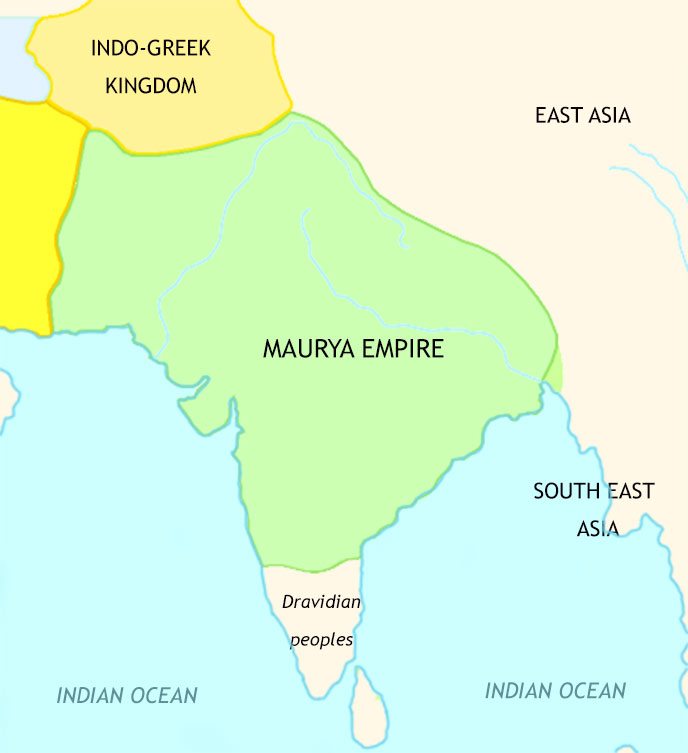
Chandragupta continued the Nanda policy of expanding the empire. He brought more and more Indian states under his control. Then, in 303 BCE, he defeated the Seleucid kingdom. As a result, the Seleucids handed all their Indian territories to him. He thus gained control of the whole of northern India.
According to tradition, Chandragupta decided to become a Jainist monk in 301 BCE. However, his son has continued to conquer new territories.
What is happening in The Classical Age of India in 232BCE
(Teachers: please follow this link to teaching notes)
Little is known of the reign of Chandragupta’s son, Bindusara (297-272 BCE), but the Maurya’s empire-building seems to have continued. By the end of his reign most of central India had been conquered.
Asoka
The Maurya throne passed to Bindusara’s son, Asoka (reigned 268-32 BCE). In 261 Asoka conquered Kalinga, one of the few remaining areas of northern India hitherto beyond Maurya rule.
The heavy casualties of this war of conquest (over 100,000 people were said to have died, and a further 150,000 had their homes destroyed) led Asoka to undergo a profound personal change. He became a devout Buddhist, and, renouncing warfare, he set about governing as a benevolent ruler. Today he is considered one of the most remarkable figures in world history.
Asoka set up stone pillars throughout the length and breadth of the empire, urging his subjects to live good lives. He sponsored missionary expeditions to spread Buddhism to neighboring countries. Probably the most successful of these was to the island of Sri Lanka, which would eventually become a mostly Buddhist country.
Peace and prosperity
The peace which the Maurya empire gives to much of the Indian subcontinent allows trade to thrive. This is aided by a network of roads which the rulers cause to be constructed throughout the empire. Asoka ordered trees to be planted along the road sides to give shade to travelers, and had wayside rest houses built where they could relax and refresh themselves. Expanding trade leads to new cities appearing in the southern parts of the empire (what is now central India, or the Deccan), and Aryan culture becoming firmly established here.
The Indo-Greek kingdom of Bactria
While the Maurya empire has been growing and flourishing, in north-west India a remnant of Alexander the Great’s empire had broken away from the kingdom of Seleucus and his heirs. It now formed the independent kingdom of Bactria. This kingdom is ruled by kings of Greek descent. They encourage the spread of Greek culture in their kingdom. However, they also feel the effects of Indian civilization. Some of these kings become Buddhists. In fact, Bactrian culture becomes a fusion of Greek and Indian influences. For example, statues of the Buddha show him wearing Greek-style cloaks.
Asoka’s successors seem to have been mediocre rulers, and the Maurya empire went into decline.
What is happening in The Classical Age of India in 140BCE
(Teachers: please follow this link to teaching notes)
India after the Maurya empire
In c. 185 BCE, the Maurya dynasty was ousted from their rule over the rump of their empire. It was replaced by the Shunga dynasty. However, their kingdom now forms just one amongst many kingdoms into which India is now divided.
The most powerful of these is the central Indian kingdom ruled by the Satavahana dynasty.
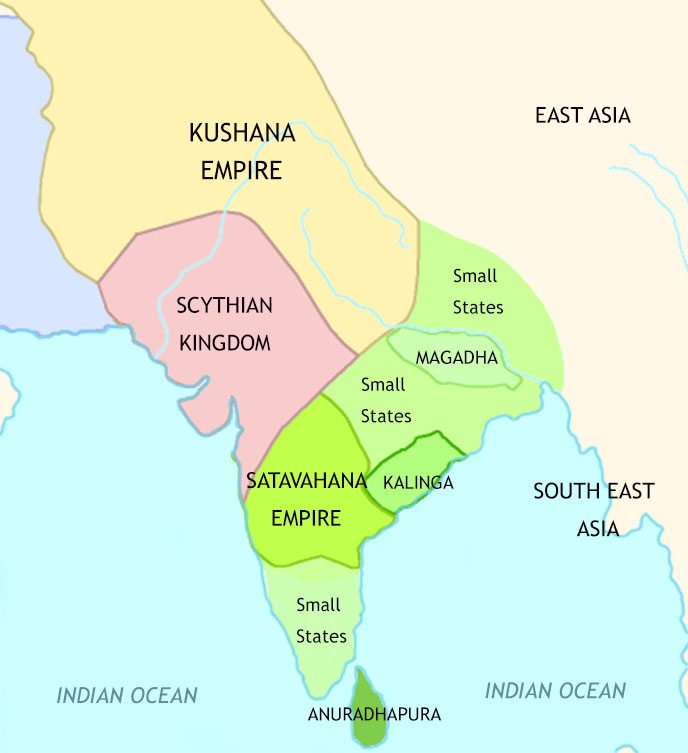
The Indo-Greek kingdoms have continued to expand across northern India. However, a nomadic group called the Scythians (known in Indian history as the “Saka”), have established a kingdom to the north-west of the Indian subcontinent, after being driven from their central Asian homeland by upheavals in the steppes.
Religious developments
The Indo-Greeks, including their kings, are receptive to Buddhism – perhaps because the caste system of proto- and early Hinduism is not welcoming to outsiders.
By this period, early Hinduism is emerging from the ancient Aryan religion. The clearest expression of this is the rise of Vishnu and Shiva as the two main deities. These are objects of more personal devotion than the previous, more distant gods of the Aryans.
What is happening in The Classical Age of India in 30BCE
(Teachers: please follow this link to teaching notes)
Northern India
The Saka (or Scythians) have expanded their power deep into central India. They have conquered all the Indo-Greek kingdoms, plus many small Indian kingdoms, and the kingdom of Satavahana is experiencing severe pressure from their attacks.
The Shunga dynasty, which replaced the Maurya, has now been replaced by the Kanva dynasty (72 BCE). This is a line of Hindu kings who promote their religion at the expense of Buddhism.
Gandhara art
The Indo-Greeks favored Buddhism. The Scythians – or Saka as they are known in Indian history – have followed their example.
The patronage of first the Indo-Greeks and then the Saka is creating a unique Indian-Greek-Persian culture. Historians call this the Gandhara art style.
An examples of this fusion, imported from Geek art, is the depiction of the human form, in statues of the Buddha.
Gandhara art will have a huge influence on later Indian art. Its influence will also be felt in Persia and even China.
Central India
The Satavahan kingdom dominates central India after the fall of the Maurya. Aryan civilization (or Indian civilization, as we shall now call it) had spread here even before the Maurya empire conquered this region, and Sanskrit writing, early Hinduism, caste, Buddhism, Jainism are all now well-established here.
The Satavahana kings have promoted long-distance maritime trade across the Indian Ocean with the Middle East on the one hand, and with South East Asia on the other. The kingdom has also seen a big expansion in the regional trade which connected northern and central India with the south. From all this trade the kings drew much of their revenue.
South India
Indian civilization is now beginning to spread south towards the tip of India. Growing trade contacts with South East Asia are bringing new wealth to the region. Towns and cities are appearing, and literacy and urban lifestyles are taking root. Hindu, Buddhist and Jain missionaries are all setting up monasteries and winning converts. Centralized kingdoms are emerging in place of the old tribal societies.
Sri Lanka
In the island of Sri Lanka, a unified kingdom has appeared. This is under a line of Buddhist kings who claim descent from Aryan immigrants from northern India. Their kingdom is noteworthy for the development of a huge and efficient irrigation system which allows a flourishing agriculture to flourish in the arid hinterland of the island.
Developments within Hinduism
Early Hinduism (Brahmanism) is gradually evolving into modern Hinduism.
The prominent gods in the Vedas were Indra, Agni and Soma. These are now receding into the background. In their place, new gods are coming to the fore, above all Brahma, Vishnu and Shiva.
These gods (particularly Vishnu and Shiva) have their own followers, drawn from all levels of society. They are worshiped in a much more emotional way than the old Vedic rituals allowed. These new cults therefore meet people’s needs for a more personal and spiritual religion.
Religious harmony
These developments allow Hinduism to compete effectively with Buddhism and Jainism for converts. They are rapidly growing in popularity. Yet throughout the subcontinent, Hinduism, Buddhism and Jainism coexist peacefully – indeed it is doubtful whether they are seen as distinct or rival belief systems.
Spectacular cave-temples
The Satavahan kings, for example, are generally Hindu by religion, but they also patronize Buddhism (like many Indian kings at this time). This can be seen clearly in the astonishing series of cave-temples they carved out of rock. Some of these were Buddhist, others Hindu.
These temples were decorated with many colorful paintings. Only tiny fragments have survived, but these give us our clearest idea of what Indian art was like at this time.
What is happening in The Classical Age of India in 150CE
(Teachers: please follow this link to teaching notes)
The Kushana empire
The Yuezhi, another nomadic group from the steppes of central Asia, invaded the Saka empire in the early 1st century CE, after having been forcibly unified under the leadership of one of their clans, the Kushana. Before long they had conquered most of the Saka empire. The Saka were confined to western India, just a fraction of their former realms.
Buddhism divides
The most famous of the Kushana kings, Kanishka (reigned c. 78-144), was a devout Buddhist. He was a follower of the Mahayana strand of Buddhism, which had divided from the original, Theravda school, sometime in the previous centuries. The Theravada school is the more conservative of the two, sticking closely to the original teachings of the Buddha.
Whereas Buddhism had originally been a set of teachings by a human teacher, the Buddha, on living a particular way of life, Mahayana Buddhism had elevated the Buddha to divine status and worshipped him as a savior. A host of other saints and divine beings had also accumulated, each able to help mortals on the way to salvation.
Buddhist missions
Under Kanishka the Kushana empire has become a center of missionary activity for that religion. With their northern provinces straddling the great trade route across central Asia known as the Silk Road, the Kushana missions are well placed to take their message far and wide in Eurasia. Little came of their missions to the west, but in the east, their missionary activity led directly to Buddhism becoming one of the leading religions in China. From there it would spread to Japan, Korea and other places in East Asia.
The Buddhism which the Kushana follow is Mahayana Buddhism, and it is this form which spreads to these distant lands.
Gandhara art
The Kushana period marked the high point of Gandhara art (see previous map). This was a Buddhist form of art, and represented a beautiful fusion of Greek, Persian and Indian art styles. It would profoundly influence later Indian art, and also Persian and Chinese art.
Other Indian kingdoms
The expansion of the Kushana empire confined the Saka to a smaller area than before. Here their kings take the title of “satrap”, or provincial governor, perhaps because they are formally subservient to the Kushana rulers. The Saka of this period are therefore called the “Western Satraps” by modern historians.
Most of the rest of India is covered by numerous small states, many of which barely figure in the evidence we have for the period. Two of the larger kingdoms are Magadha, since 28 BCE no longer under the Kanva dynasty, and Kalinga.
Most of these are kingdoms, but some are republics. Some are under Buddhist rulers, others are under Hindus.
The south of India is also now covered by a network of small Hindu kingdoms. South Indian ports are now thriving centers of the Indian Ocean trade, boosting the wealth of the region. Aryan civilization is finally becoming firmly established in this region.
Two great Hindu epics
At some time between the 2nd century BCE and the 4th century CE, two great Hindu epics are composed: the Mahabharata and Ramayana. Both are massive works (the Mahabharata is the longer of the two at almost 100,000 verses). They are amongst the greatest works of world literature.
The Mahabharata deals with the conflict between two royal clans, but it also contains many sections in which religious teachings are explored. The most famous of these is the Bhagavad-Gita (the “Song of the Lord”), which looks at the tensions between being a responsible ruler. and being a good individual.
The Ramayana was about a prince named Rama, who was the god Vishnu in human form. The poem uses his life and deeds to portray ideals in human relationships – father-child, husband-wife, servant-master, king-subjects and so on.
Both epics were written in Sanskrit. By this time most Indians speak many different languages but Sanskrit remains the language of literature and scholarship.
Another work written in Sanskrit at some point is the Panchatantra. This is a book of stories written to teach lessons. Over the centuries it has been translated into many other languages, including English (in the 16th century) and other European languages. Throughout the world as a whole, it is the most popular of all Indian works.
What is happening in The Classical Age of India in 250CE
(Teachers: please follow this link to teaching notes)
Old powers waning
The Kushana empire disintegrated in the early 3rd century, and after 225 a revived Persian empire under the Sasanid dynasty conquered into north-western India.
The long-lasting Satavahana kingdom also vanished in the early 3rd century.
The Saka, or Western Satraps, however, have more or less maintained their power in western India.
New powers on the rise
The rest of the subcontinent is covered by numerous small states. However, two dynasties have come to power which will dominate India’s history for the next two centuries or more. In Magadha, the Gupta dynasty now rules, while in central India the Vakataka dynasty rules a small kingdom.
What is happening in The Classical Age of India in 500CE
(Teachers: please follow this link to teaching notes)
The Gupta empire is now in decline.
The White Huns
From the mid-5th century onwards, troubles multiplied for the Gupta empire. A fearsome people from the central Asia steppes, the White Huns, based themselves in north-west India, and from there launched attack after attack, deep into Gupta territory. They were beaten back only with difficulty.
Civilization damaged
In these fierce raids, trade was disrupted and many cities sacked. Many temples and monasteries were destroyed. Major centers of learning vanished – the Huns particularly targeted Buddhist centers, and permanently weakened the religion in the subcontinent.
The decline and fall of the Gupta empire
Meeting this threat drained the Gupta treasury. It also encouraged local kings, previously loyal to their Gupta overlords, to take matters into their own hands. They defended their territory, and established their independence, from both the Huns and the Gupta.
By the end of the 6th century, the empire was clearly in decline. Gupta “emperors” sat on the throne for a further half century before, almost unnoticed, disappearing from history.

Subscribe for more great content – and remove ads