
The Classical Age of China 100 CE
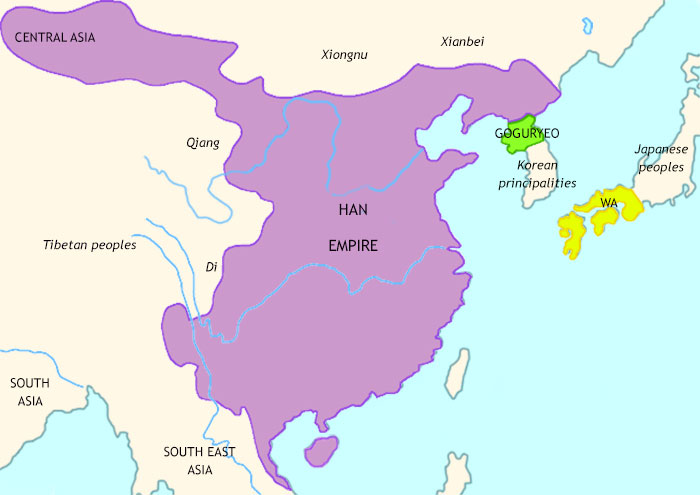
What is happening in The Classical Age of China in 100CE
(Teachers: please click here for teachers notes and additional resources)
The Han dynasty is still in power three hundred years after its start – although there was a brief interruption between 9 and 23 CE.
Coup and counter-coup
In 9 CE a powerful chief minister, Wang Mang, seized the throne. By 23 CE, however, his policies, aimed at trimming the wealth and power of landowners, had created so many powerful enemies that he was killed.
After a period of widespread and very destructive disturbances, the Han dynasty was restored.
The coming of Buddhism
Buddhism has come to China from India during the 1st century CE. It was brought by traders and monks along the Silk Road.
This alien religion is treated with great suspicion at first. Some Chinese, however, do convert, even at the highest level of government.
Paper
Sometime during the Later Han, the technology of paper-making has been developed in China.
This innovation apparently occurred at the imperial court itself. Previously, bamboo scrolls had been used, but these were awkward to make and heavy to carry. Silk was suitable for writing on, but far too expensive for everyday use. Paper is cheap and simple to make, and easy to carry around. Its use has quickly spread throughout China.
Long-term trends
Long-running social trends are at work to weaken the Han empire. After the downfall of Wang Mang, the Han dynasty largely owed its restoration to the support of the landowning class. Since then, therefore, government policies have favored this group. Landowners are growing wealthier as their estates grow larger. Many peasants are losing their land to become tenant farmers or serfs.
In short, the rich are getting richer, and the poor are getting poorer.
Things have got worse recently, because a series of weak emperors have allowed standards of government to slip. Corruption is spreading within the civil service, and government officials are becoming more oppressive.
The peasantry are growing more and more rebellious. There is danger ahead for the Han.
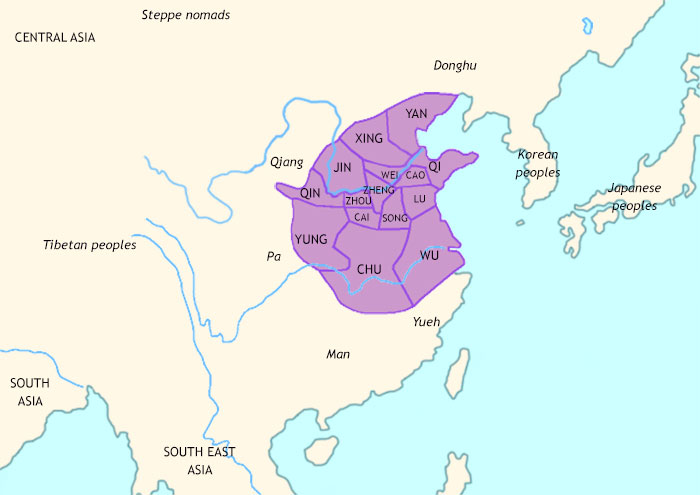
What is happening in The Classical Age of China in 500BCE
(Teachers: please click here for teachers notes and additional resources)
The decline of the Zhou kingdom
In northern China, kings of the Zhou dynasty came to power in the 11th century BCE. Their kingdom expanded over an ever-larger area of China. To help them govern their growing realm, the Zhou kings divided it into many districts, each under a powerful local lord.
These lords served the Zhou kings loyally for a long time, by providing them with troops and tribute. Gradually, however, they became more concerned with ruling their own territories, rather than with helping the kings in ruling the kingdom as a whole.
Many states
In 771 BCE a group of barbarians and rebels sacked the Zhou capital, Haojing. The Zhou kings never recovered their authority. Although they remained as kings, real power now passed to the local lords.
These lords soon fell to fighting amongst themselves. The more powerful grabbed land from the weaker. Some territories become smaller and disappeared, while others become larger and more powerful. The survivors are no longer merely local lords. Although they pretend to acknowledge the superiority of the Zhou kings, in reality they are princes of independent states.
Power-struggles within states
Competition between these states has been hotting up. At the same time, power-struggles within the states have become more frequent and more violent. Old ruling families vanish as sons kill fathers, brothers murder brothers and ministers assassinate their masters. New ruling families take their place, taking and holding their positions through raw political ruthlessness.
New schools of thought
What is happening at the top infects the whole of society. Traditional loyalties are forgotten as clans break up into warring groups. Old virtues – reverence for authority, respect for elders, obedience to fathers – seem to have been forgotten.
This is a time of uncertainty and change. Beliefs and practices which had previously been accepted without question now come under scrutiny. Teachers travel through the land putting forward new ideas. This is the period in China known as the One Hundred Schools, as competing ideas battle with one another.
The most influential of these schools of thought are Legalism, Mohism, Daoism and Confucianism.
Legalism
This teaches that people are inherently wicked, and need to be kept in line by means of harsh punishments. People should even be punished for their neighbors’ crimes. As for rulers, they should do whatever it takes to maintain and strengthen their power. Treachery, trickery and force are all to be used when needed.
Mohism
This believes that all men, especially rulers, should treat others with respect and compassion. A ruler can go to war, but only to defend his subjects from attack.
Daoism
This was supposedly founded by the philosopher Laozi around 600 BCE. Its key text is the Dao De Jing (The Way and its Power).
The “Dao” means the “Way.” This teaching holds that men should live in harmony with nature (or the universe), and encourages them to “go with the flow” of life. For example, where a problem needs to be resolved, direct action should be avoided; an indirect approach is much better. A wise ruler should interfere with his people’s lives as little as possible.
Confucianism
The teaching put forward by Confucius (Kongfuzi, or Master Kong) calls for people to live moral lives in harmony with one another. To do this, all should give others their due respect. Children should obey their fathers (thus showing filial piety), wives their husbands, subjects their rulers and so on.
In due course, Confucianism would become the leading belief-system in China. It will help to create a society in which obedience and respect for authority is the usual state of affairs. It will play a large part in bringing stability and peace to the enormous country for long periods of time.
The key text for Confucianism is the Analects, a collection of the sayings of Confucius and some of his early disciples.
The Mandate of Heaven
One idea, already ancient by this date but which Confucians emphasize, is to do with the Mandate of Heaven. This holds that a line of rulers (a dynasty) has Heaven’s support only so long as the rulers govern the people justly. If they don’t, Heaven will transfer its support to another dynasty, and the first dynasty will fall from power.
Heaven’s disfavor can be seen when disasters such as floods and famines occur. Confucian thinkers say that if such signs show that Heaven’s favor has been withdrawn from a dynasty, then the people have the right – the duty, even – to rebel against it and install another dynasty.
(Teachers: please click here for teachers notes and additional resources)
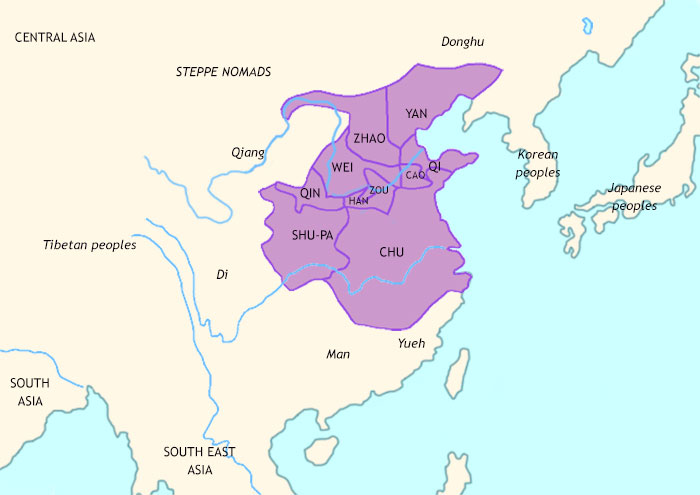
What is happening in The Classical Age of China in 400BCE
(Teachers: please click here for teachers notes and additional resources)
As the Chinese culture area expands into the “barbarian” territory which surrounds it, it is those states on the frontiers which benefit most from this process. They become the largest and most powerful of the states, even though despised by other Chinese as semi-barbarian.
Stronger states
These centuries in Chinese history are traditionally called the Warring States period (this overlaps with the “Hundred Schools” period).
Smaller states have been conquered by larger ones. There are now far fewer states than there were before, but the ones that remain are much more powerful.
To survive in this period of fierce warfare, states have to raise larger and larger armies. To pay for them, rulers have to find ways of collecting taxes more efficiently. It is no longer enough to rely on the tribute the nobles send the prince.
A new kind of government official
Increasingly, princes send their own officials to collect taxes directly from the farmers. They also employ them to supervise irrigation projects, and to organize the construction of roads and canals.
These officials are well-educated men who are not members of the old aristocracy. They do not owe their positions to their family’s status or wealth. Instead, they are entirely dependent on their prince’s favor; they only hold their jobs while the prince and his ministers is satisfied with their work.
In centuries to come, such men will come to dominate government in China. Their values and tastes will be important in shaping Chinese civilization.
Society in transition
Although there are frequent wars, in many ways this is a time of progress in China. As we have seen, the princes are in need of revenues in order to pay for ever-larger armies. One good way of increasing taxes from farmers is by increasing the amount of crops which they produce.
State governments encourage the use of iron tools in agriculture. This makes it easier for farmers to clear forests and turn them into farmland. Some states also carry out large-scale irrigation projects. This brings much new land into cultivation, or makes existing farmland more productive.
Trade and towns expand
Taxing trade is another good source of revenue. Many princes therefore encourage the growth of trade. They make trade easier by minting coins (metal coinage is introduced into China in about 400 BCE).
Towns and cities grow, and new ones appear. The number of those who live in towns, such as merchants and artisans, increases.
Technological innovations
There are major technological advances at this time. Most notably, the Chinese develop the manufacture of steel, more than a thousand years before the West. In the military sphere, the crossbow appears. This is a more effective weapon than the bows and arrows of the time.
In this period, also, canals are first built in China for transportation, rather than just for irrigation. Chinese engineers would be by far the most skilled canal builders in the world for the next two thousand years.
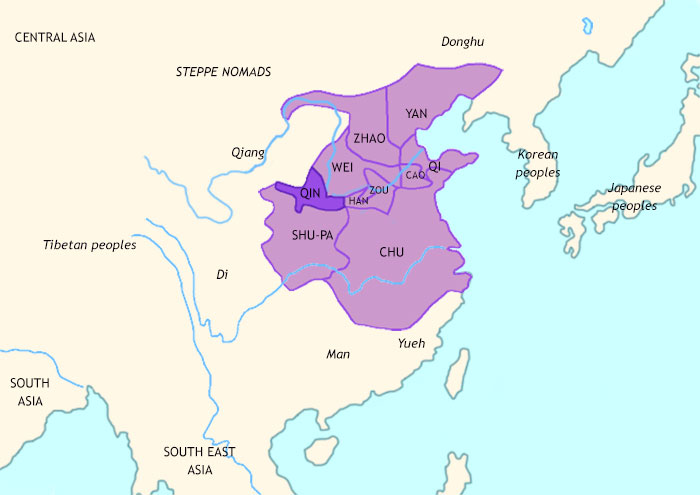
What is happening in The Classical Age of China in 360BCE
(Teachers: please click here for teachers notes and additional resources)
Located as it is on the western borders of the Chinese culture area, the rulers of the Qin state are constantly facing threats from the non-Chinese “barbarians” on their doorstep. They therefore put into practice the teachings of the Legalists school of thought, which espouses the idea that obedience to the state is the most important of virtues.
The Qin rulers ruthlessly centralize power, appointing officials and commanders on the basis of merit rather than birth – that is, from the rising gentry class rather than the old feudal aristocracy. They introduce harsh laws on their subjects and insist on unquestioning obedience to them; they impose heavy taxes and labour duties, and make all men liable to military service; they make all people responsible for the crimes of their neighbors as well as themselves.
Of all the states, Qin is the most active in bringing new land under the plough, through drainage, forest clearance and irrigation.
In these ways the Qin regime develops the strongest state in all China.
What is happening in The Classical Age of China in 220BCE
(Teachers: please click here for teachers notes and additional resources)
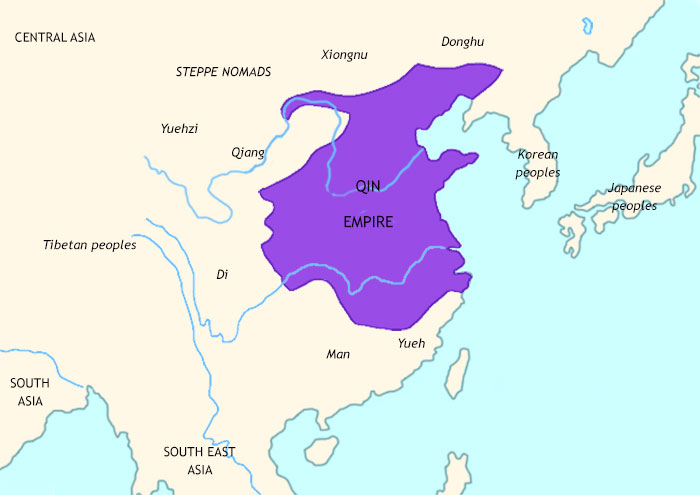
The Qin conquest
The Qin use their powerful army, as well as clever diplomacy and cunning espionage, to overcome all the other states. By 221 BCE they had unified the whole of China under their rule.
They thus create one of the largest empires in the Ancient World. The Qin ruler now styles himself the First Emperor of Qin: Qin Shih Huang.
This is an appropriate title, as he is the founder the first imperial dynasty of China.
Qin armies then venture out into barbarian territories and conquer large parts of southern China.
Defense against the nomads
To the north, the Qin face the warlike nomads of the steppes. Instead of trying to conquer them, the Qin emperor take steps to protect his empire by constructing strong defenses.
Over previous centuries, the frontier states of China had built a number of long defensive walls. The Qin government now links these up to create a single defense system. The resulting wall is the forebear of the present Great Wall of China.
This is not the amazing stone wall that tourists see today – this would be built centuries in the future, under the Ming dynasty (1368-1644 CE). The Qin wall is built of beaten earth. Nevertheless it is a massive undertaking, requiring the forced labour of millions of peasants. Tens of thousands die from the harsh conditions under which they work, and many more never see their homes again.
What is happening in The Classical Age of China in 210BCE
(Teachers: please click here for teachers notes and additional resources)
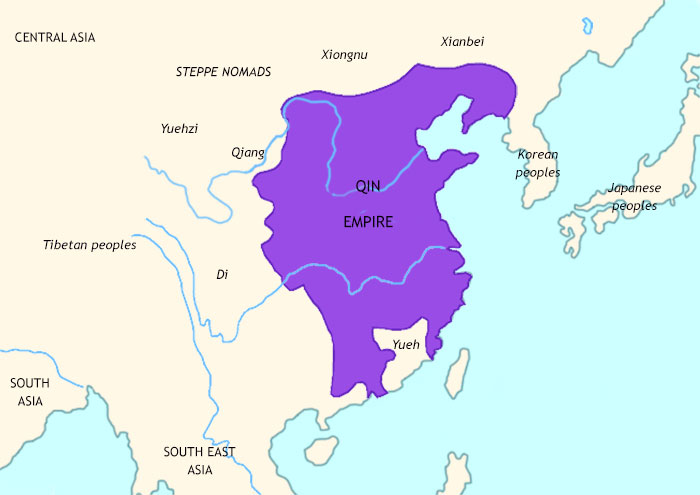
The Qin establish their power
Having conquered the other states of China, the Qin take measures to firmly establish their power.
The government divides the empire into provinces, each under a governor appointed by the emperor. These provinces are themselves divided into districts, under prefects also appointed by the emperor. Through this chain of command the emperor and his ministers can enforce their will across the whole state.
A network of roads is laid out to link the capital with the frontiers. This enables the government to send troops quickly to wherever there is a threat of invasion. The government also sets up a postal service in which government couriers take messages very swiftly to all parts of the empire.
The Qin also repair canals and build new ones. These are both for transportation and for large-scale irrigation projects.
To reduce the danger of revolt by the people of the conquered states, the First Emperor has thousands of their noble families relocated to the capital, the better to keep an eye on them.
Standardization
The Qin find themselves ruling populations with many different laws and customs. They sweep all these local laws and customs away and impose the harsh Qin law code across the whole empire.
Coinage, weights and measures, writing styles, road widths and cart axel sizes, are all strictly standardized.
The Qin even attempt to standardize the thoughts of the Chinese people. They ban all schools of thought other than their own Legalist philosophy. To enforce this ban, they confiscate and burn thousands of Confucian, Mohist and Daoist books.
The Mohist school vanishes under this attack. Not so Confucianism and Daoism.
Many Confucian scholars risk death to hide their books. Hundreds pay with their lives by being buried alive, but they succeed in preserving their philosophy.
Rebellions
The ruthless methods by which the Qin carry out their policies has caused immense misery, especially among the peasants. They have had to pay the heavy taxes and provide the forced labor for the great public works schemes – not just the roads, canals and frontier walls, but also a gigantic tomb for the First Emperor (now one of the most famous tourist attractions in the world).
They have also been drafted in their hundreds of thousands into the Qin armies. They are stationed on the frontiers, often condemned to spend the rest of their lives far from home and family.
By the time of the First Emperor’s death, millions will take no more of this. Rebellions are springing up in different parts of the empire.
What is happening in The Classical Age of China in 180BCE
(Teachers: please click here for teachers notes and additional resources)
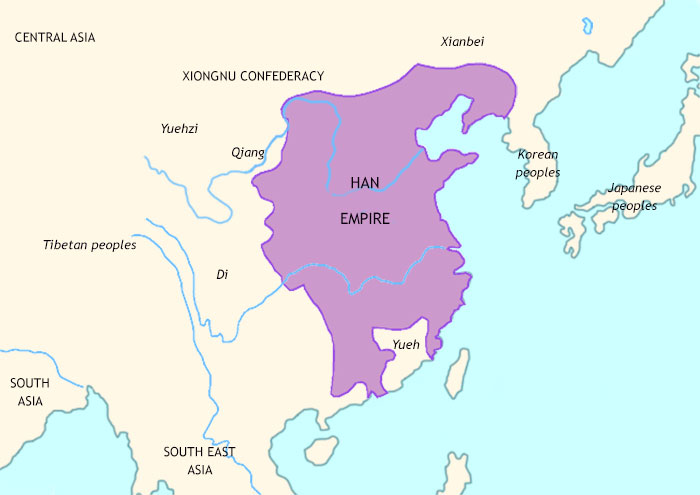
The Han dynasty comes to power
Following the First Emperor’s death, the Qin regime is soon overwhelmed by rebellions, and China swiftly descends into chaos.
Rival rebel forces have then fought with one another until one group has emerged victorious. This is led by Liu Bang, a man of peasant origin with little education. What he does have is outstanding shrewdness and ability.
By 202 BCE he has triumphed over his enemies to found the Han dynasty. It would took several more years for him and his successors to deal with challenges to their regime. However, once firmly established, the dynasty would last four centuries, the longest-lasting of all China’s imperial dynasties.
Keeping things the same, but different
Liu Bang – or the emperor Gaozu, as he becomes known as on taking the throne – continues many Qin policies, but applies then less harshly. For example, he…
- reduces the taxes that peasants have to pay;
- makes the punishments of the legal code less severe;
- is careful not to embark on major projects that require huge amounts of forced labor.
This approach brings him the widespread support of the ordinary people of China.
What is happening in The Classical Age of China in 100BCE
(Teachers: please click here for teachers notes and additional resources)
Building on the Qin heritage
The Han have kept most of the Qin regime’s government organization – the provinces and districts, the huge army, the postal service and so on.
To supply their frontier armies, and move troops around their empire, the Han have maintained and expanded the road and canal network inherited from the Qin.
In some ways the Han have gone further than the Qin. The Qin appointed officials on merit, but the Han have taken the first steps towards creating the famous imperial examination system of later centuries. Men recommended for government service have to come to the imperial court and be tested on their educational attainments.
Confucian government
The Han emperors have increasingly surrounded themselves with Confucian scholars, and under the emperor Wudi (reigns 140-87 BCE) this school of thought becomes the official philosophy of government. For example, when men seeking government posts are examined on their educational attainments, they must prove themselves knowledgable about Confucianism.
Confucianism teaches that rulers and their officials should govern in the interests of the ordinary people. This helps the Han rule remarkably well by pre-modern standards.
For example, under the Han, just as in Qin times, all males are liable for military service and labor service, but the Han government tries to to make sure these these duties are not too heavy.
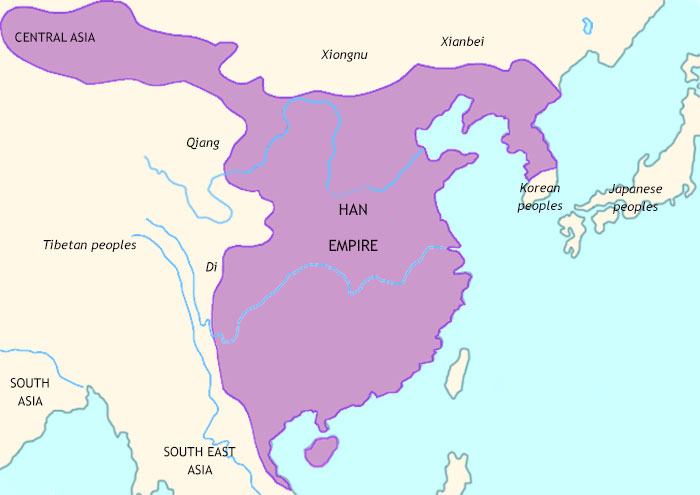
Imperial expansion
Southern China
Under the vigorous rule of the emperor Wudi, the Han are bringing vast areas of southern China under their rule. Southern ports such as Canton will enable Chinese merchants to become involved in the maritime trade of the Indian Ocean.
Central Asia and the Silk Road
Wudi has also brought the eastern steppes of central Asia under Han control. He has achieved this as much by diplomacy as by military action.
Wudi has then sent diplomatic missions to central Asia and on as far as the Middle East, to establish trade relations with the peoples there. This has led to the organization of a great trade route to the West across central Asia.
A high-value commodity
One of Wudi’s main aims has been to purchase the fine horses bred by the nomads on the steppes. In exchange, the nomads purchase silk, that highly-prized fabric which the Chinese have been making for centuries. They have successfully kept the secrets of how to make silk, so other nations can only get it from them.
The nomads then exchange the silk for other commodities with peoples further west. These included the Romans. They value silk so highly that the Roman government would come to worry that the purchase of silk was draining the empire of silver and thus damaging its economy.
It was the importance of this textile to the trans-Asian trade route that led to it becoming known as the Silk Road.
Korea
Chinese armies also occupy a large part of the Korean peninsula at this time. Other states in the peninsula become vassals of the Han.
A prosperous empire
The standardization which the Qin introduced, and the Han have continued, has helped trade to flourish within China. A uniform system of coinage, weights and measures, writing, and axle widths on carts are used all over the empire. This helps merchants from different regions to trade easily with each other.
The roads and canals, which first the Qin and then the Han have constructed, allow merchants to transport goods much more easily and cheaply than before.
Most importantly, the peace that the Han government has brought has allowed commerce and industry to flourish, uninterrupted by war.
Farming also has benefitted from Han rule. It has expanded into new lands, often with government aid. The wheelbarrow is developed in China at this time, as is an early version of a seed drill.
What is happening in The Classical Age of China in 220CE
(Teachers: please click here for teachers notes and additional resources)
From 180 CE a succession of child emperors allowed violent factionalism to go unchecked at the Han court, completely undermining stable government. Corruption spread, and the rich landowners prospered at the expense of the poor farmers. A huge peasant uprising, that of the “Yellow Turbans”, broke out in 184.
This rebellion almost toppled the Han regime, but armies under the control of three generals eventually defeated it.
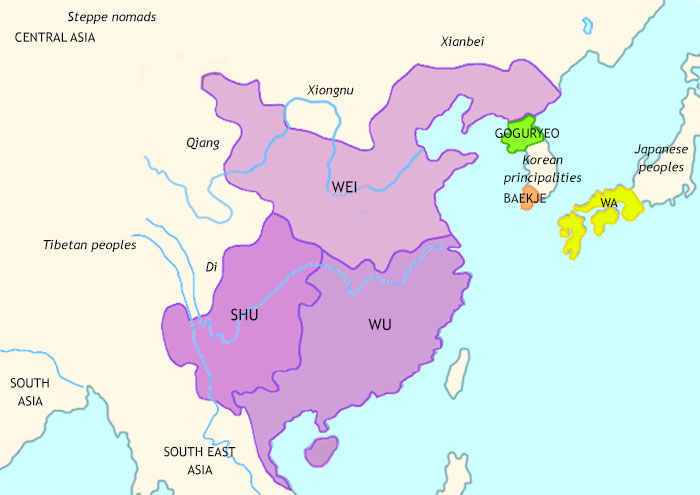
These three generals, however, effectively divided the empire between themselves. In 220, one of them removes the last Han emperor (a child) from his throne and proclaims himself king. The other two immediately follow his example and declare themselves kings as well. One of the greatest dynasties in Chinese history has gone, its huge empire divided into three kingdoms.
What is happening in The Classical Age of China in 280CE
(Teachers: please click here for teachers notes and additional resources)
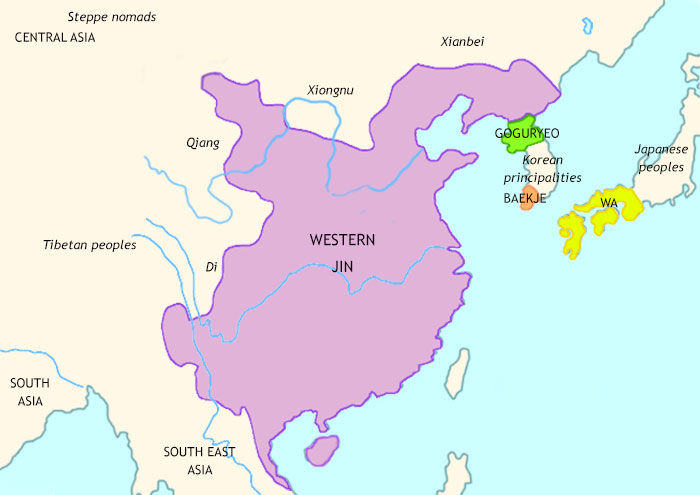
The three kingdoms which had divided the old Han empire amongst themselves struggled against each other for supremacy, until one of them, Wei, has conquered the other two. Just at the moment of reuniting China under its rule, however, the last emperor of the Wei dynasty is overthrown by one of his generals. This soldier has founded the Western Jin dynasty.
A time of troubles
The period of the “Three Kingdoms” is a famous one in Chinese history; many thrilling stories are set then. In reality, however, it was a wretched time for the people of China, in which millions lost their lives, and many more lost their livelihoods.
The troubles in the north have sparked a massive migration of peasants into southern China. Those that remain have effectively become serfs on the estates of the landowning families. Here they at least receive protection, for, such is the insecurity of the times, the estates are defended by the landlords’ private armies.
What is happening in The Classical Age of China in 316CE
(Teachers: please click here for teachers notes and additional resources)
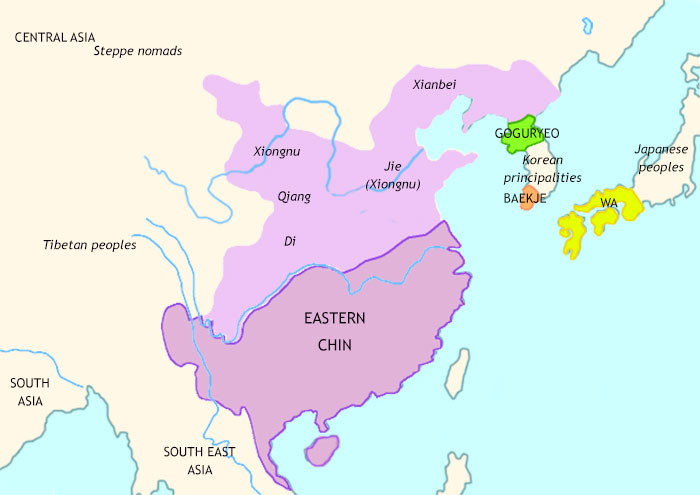
The Western Jin court, wracked by violent faction-fighting, was unable to impose effective control on the huge country. Several nomadic groups from the beyond China’s borders have taken advantage of this woeful situation to move into Chinese territory. They have devastated farms and homes across large areas of land and sacked many cities, including, in 311, the Jin capital, Louyang. These disasters led to millions of more deaths, and set in motion another massed flight of peasants southward.
The Jin emperors also have been forced to retreat to southern China, where they have made their capital in Nanjing and continue to rule a rump of the empire.
Buddhism
The upheavals of the period, and the widespread suffering these have caused, have led many Chinese in all ranks of society to search for a deeper meaning beyond the life of the here and now. Confucianism focuses mainly on how to live a good life within this world, and offers no deep hope for the afterlife. Many Chinese, of all ranks, are therefore turning to Buddhism.
This religion had first arrived in China in late Han times, carried along the Silk Road by monks from central Asia. It offers a powerful message of salvation to people experiencing insecurity and suffering in their lives.
What is happening in The Classical Age of China in 407CE
(Teachers: please click here for teachers notes and additional resources)
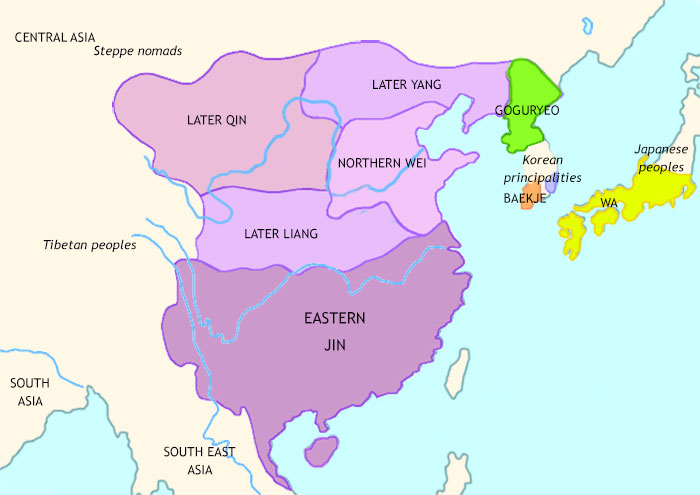
The barbarian invasions of the north set in motion a further massive flight of peasants southward. This has led to population levels in southern China rising sharply. In northern China, non-Chinese dynasties rule several kingdoms, while in the south there is a single state, ruled by the Jin dynasty.
Southern China
During the Han dynasty, southern China was a frontier zone. The mass migration of peasants from northern China, however, has led to population levels rising sharply here. New land is being brought into cultivation through the draining of lakes and swamps, the clearing of forests and the creation of irrigation systems. This is a process which will continue for centuries to come.
The Jin dynasty of south China is a faction-ridden and unstable regime, too weak to mount a full-scale reconquest of the north.
The Northern kingdoms
The barbarians in the North have established several kingdoms. These too are mostly unstable. Their rulers need Chinese bureaucrats to administer and tax their Chinese subjects, and in time these tend to become very influential. There is an almost irresistible tendency for these barbarian regimes to become more and more Chinese in culture and way of life. Many tribal nobles, however, feel sidelined and are bitterly resentful of the influence of the Chinese officials. They try and put a stop to the trend by rebelling, and sometimes massacre the Chinese officials. They rebel against emperors whom they view as too pro-Chinese. But the trend towards more Chinese ways soon starts again. Nevertheless, this violent factionalism causes kingdoms to split apart or fall to stronger neighbors (which in turn soon split).
The spread of Buddhism has continued at an increasing rate, in both north and south. Buddhist monasteries and temples proliferate. Buddhist styles of art and architecture appear, based on Indian models. Later, Buddhist art becomes more Chinese in its style. For example, the Buddhist stupa – a domed-shape building – soon evolves into the Chinese pagoda. As it spreads in China, Buddhism gradually changes, particularly as it comes under influence from Daoism. Distinctly Chinese forms of Buddhism begin to emerge, such as the Pure Land sect and, later, Chan Buddhism. These emphasize faith and meditation more than traditional Buddhism. (Chan Buddhism will later spread to Japan as Zen Buddhism.)
What is happening in The Classical Age of China in 500CE
(Teachers: please click here for teachers notes and additional resources)
A merging ruling class
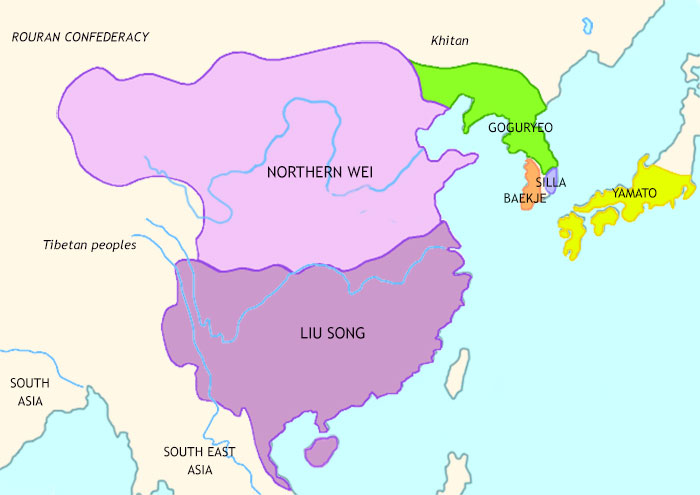
In the North, the barbarian tribal aristocracies and the Chinese landowning class have gradually merged to form one ruling class – a process which reaches maturity under the Northern Wei state. The leading families of non-Chinese origin are becoming ever more Chinese in their ways, and more and more of them take up an official career in the bureaucracy, filling the highest offices of state. The men are educated along Confucian lines (though they mostly remain Buddhist by religion).
As a result, the hostility between tribal and Chinese factions has been diffused somewhat, and the instability that this has caused dampened. The Northern Wei state is much more stable than previous “barbarian” states have been, and has succeeded in conquering all the other northern states in the early 5th century. It will endure for almost 150 years.
South China
In the south, the Chinese empire there continues to experience instability. The Jin dynasty was overthrown in 420, and four weak dynasties follow in quick succession. Nevertheless, the economy of southern China has continued to expand, with increased agricultural production, a rising population and reviving trade.
Buddhism
In both north and south, Buddhism has now spread throughout all ranks of society. Confucianism retains its hold largely as a medium of education.

Subscribe for more great content – and remove ads