

The Kangxi Emperor was born in 1654, the third son of the Shunzhi Emperor, the first Manchu emperor of China.
The Shunzhi Emperor had been just a teenager when the Manchus had invaded China and replaced the Ming dynasty on the Chinese throne. The de facto leader of the Manchus at that time had been the regent, Dorgon. However, Dorgon had died prematurely in 1650, whilst out hunting. Shunzhi, though still only 13 years of age, then assumed full powers. However, he only ruled for eleven years before his own death, of smallpox, in 1661.
His seven year old son was chosen as his successor, and came to the the throne as the Kangxi Emperor.
Kangxi takes charge
In the Kangxi Emperor’s early years, a regency council governed in his name. The members of this council soon engaged in a power-struggle with one another, from which a minister called Oboi emerged triumphant. He dominated the Qing government until 1669, when the 15 year old emperor asserted his power and had Oboi arrested and imprisoned.
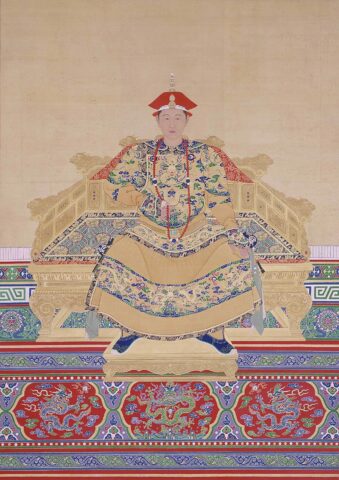
The young Kangxi Emperor (Public Domain)
Oboi had pursued policies which kept power almost exclusively in the hands of the Manchu leadership. On taking full control, the Kangxi emperor changed tack, and set about reconciling the Chinese elite to Qing rule (“Qing” was the name which the Manchu rulers had given their dynasty). From the outset he was careful to present himself as a model Confucian ruler. In 1670 he issued the Sacred Edict, which set out the core principles of Confucianism in simple language. It was sent out to every county in the empire, to be read to the common people twice each year (a practice which was maintained until almost the end of the dynasty).
Kangxi maintained the imperial examination system, which the Qing had inherited from the Ming, as the main method of recruitment to a government career. This had the wider effect of promoting the study of the Confucian classics (on which the candidates were examined), and won him the support of the great majority of Chinese officials and gentry. He also commissioned a definitive dictionary of Chinese characters. This is known as the **Kangxi Dictionary**, and is still today a vital resource for the study of Chinese linguistics. In doing this, the Kangxi emperor was following in a long tradition of Chinese emperors sponsoring huge scholarly works. He may have wished to further reconcile scholars to his rule by setting them to work on a project of vital interest to them, and so little-by-little drawing them into a position of loyalty to the Qing regime.
Kangxi later ordered the compilation of a vast collection of Confucian Classics. This was completed under his successor.
The Three Feudatories
In the early years of his reign, Kangxi faced a serious military challenge to his rule. Years earlier, at a time when the Manchu conquest of China had been in the balance, the regent Dorgon had placed three ex-Ming generals, who had come over to the Qing side, in charge of vast territories in southern China. They were known as the “Three Feudatories”.
In 1673, seeing these powerful figures as potential threats to the stability of Qing rule in China, Kangxi ordered them (or, in two cases, their descendants) to resign their powers and come to Beijing. They responded by rebelling against their Qing overlords.
It took years of hard fighting for the Qing forces to overcome the rebellion. It was eventually achieved in 1682, but the pacification of the south was delayed for a further year by pro-Ming rebel forces based in the island of Taiwan. The Qing therefore invading the island, and put an end to opposition from that quarter.
The Northern Border
Meanwhile the empire’s northern border was coming under threat. Kangxi met this danger by strengthening Qing control over Mongolia and then bringing Outer Mongolia under Qing rule. In the following years, Kangxi’s forces extended their control over Tibet, Mongolia, and Taiwan, vastly expanding the borders of his empire.
To round out these conquests in Inner Asia, the Kangxi Emperor’s officials signed the Treaty of Nerchinsk with Russia in 1689, which had been expanding from the West. This treaty resolved some border disputes which had been arising, and formalised trade between the two empires.
A Humane Ruler
We have noted that, on taking power, Kangxi sought to win the support of the civl service to the Qing dynasty. Essential though this was in stabilising Manchu rule in China, he also had a genuine desire to ensure that the Qing government served the needs of his subjects as effectively as possible. He maintained a system of regular evaluation of government officials, so that they were promoted on merit rather than connections. He was deeply concerned that standards of government integrity were maintained, and that the people were ruled justly, and not oppressed by public officials. He also followed the traditional Chinese imperial policy of ensuring that flood defences were properly maintained and that the waterways – above all the Grand Canal – were kept in good repair.
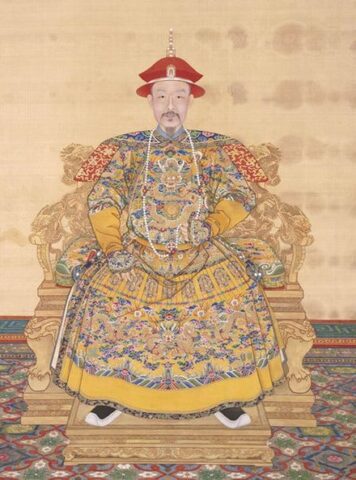
The Kangxi Emperor in middle age (Public Domain)
During his reign, the Kangxi Emperor completed six major tours of inspection of southern China. These were designed to keep officials aware that their emperor was watching them; but it also demonstrated his wish to understand the lives of his subjects, and the conditions in which they lived.
The peace and economic expansion that his reign witnessed enabled Kangxi to progressively reduce taxes, and in 1712 he ordered that the land tax be frozen at the level it then stood at, in perpetuity. This was aimed at alleviating poverty amongst the Chinese masses. Unfortunately this had negative consequences under later reigns by restricting government revenues which, in the 19th century, proved inadequate for dealing with the growing challenges that the Qing dynasty faced at that time. In the immediate future, though, the expanding population and economy allowed the government to be properly funded.
The Jesuit missionaries
In his capital at Beijing, Kangxi encouraged Jesuit missionaries to work at his court. His main interest in doing so was to introduce European scientific and technological knowledge, particularly in astronomy, cartography and weaponry, into China. The Jesuit mission remained under imperial protection until 1715, when the pope (back in Europe) forbade the missionaries from participating in Chinese rituals. The emperor immediately banned Christian missions in China.
Death and Legacy
The Kangxi Emperor died in 1722, after a reign of 61 years – the longest reign of any emperor of China, and regarded by most scholars as one of the most successful.
He himself was a far-sighted and humane ruler, with highly impressive qualities of leadership. He put an end to all major military threats to the Qing regime, and the internal peace which he thus achieved brought a long period of internal peace, economic prosperity and military expansion for the dynasty. He succeeded in reconciling the Chinese elite to Manchu rule, and this laid solid foundations for political stability into the 19th century.
In summation, the Kangxi Emperor was one of the truly great rulers in world history.