

Mehmed II, “The Conqueror”, was one of the most famous sultans to rule the Ottoman Empire. This fame, and his designation “The Conqueror”, is mostly due to his capture of the great city of Constantinople in 1453.
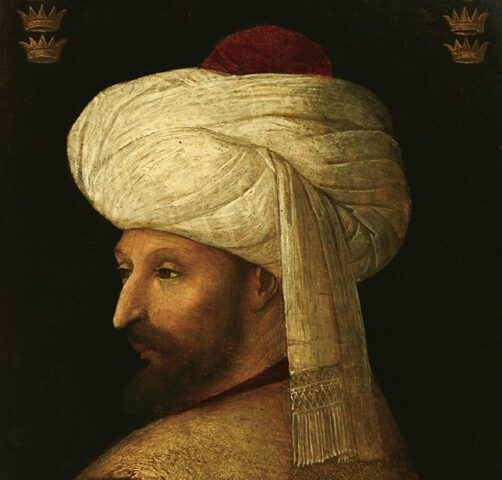
Sultan Mehmed II
Mehmed was born in 1432. His father, Sultan Murad II (1404-1451) seems to have been a retiring man, fond of religious contemplation. He found the practice of governing tedious, and therefore abdicated the throne in 1444 in favour of his 12-year-old son Mehmed. Murad retired to a private castle, while real power in the empire rested with the vizier (chief minister), Halil Pasha. This official sought to exclude the young Mehmed from real authority.
A major invasion from Hungary followed soon after this event. This was defeated, but the experience seems to have caused the vizier to realise that having an experienced ruler on the throne was a necessity. He therefore pressured the young Mehmed to ask his father to return to power.
Sultan Murad died in 1451, and Mehmed became sultan for a second time. By now he was an able and ambitious 21 year old. He seems to have harboured resentment for the vizier, Halil Pasha, but kept him in post for the time being.
The Capture of Constantinople
After dealing with a rebellion in Asia Minor, Mehmed turned his attention to the capture of Constantinople. This was the historic capital of the Byzantine Empire, and was one of the most revered cities in Christendom. He made careful preparations for the campaign, including strengthening roads and bridges to take the huge, heavy cannons that he was planning on deploying. His forces laid siege to the city in April 1453, and two months later they were able to breach the walls and storm in.
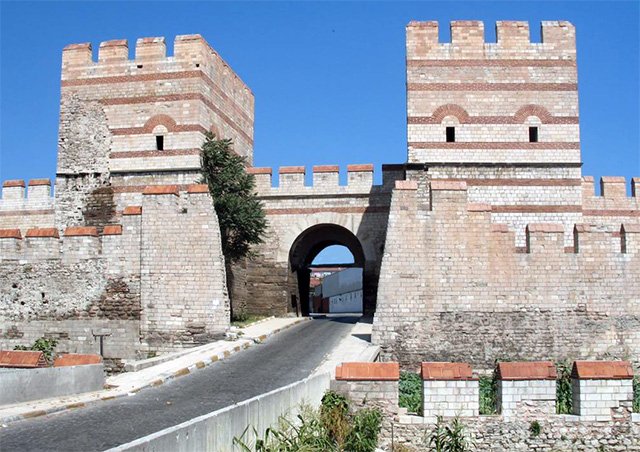
Part of the walls of Constantinople
One of his first acts after this victory was to have the vizier arrested and executed. Mehmed was now able to exercise untrammelled authority.
Mehmed made Constantinople his capital. He took measures to encourage the inhabitants who had fled the city to return, and to have new families resettled there. For the remainder of his reign he beautified the city with splendid new buildings, notably the Fatih Mosque and the Topkapi Palace. All in all he – and his immediate successors – restored Constantinople to its status as an imperial capital, the largest city in Europe and one of the foremost cities in the world.
After the capture of Constantinople, Mehmed claimed the title of Caesar (Roman Emperor). He based this claim on the idea that whoever possessed the imperial capital was the ruler of the empire.
Mehmed was unable to rest on his laurels for long. Indeed he spent much of the rest of his life campaigning against the hostile powers surrounding the Ottoman Empire. All these seem to have been ruled by tough and able leaders – Durad Branković of Serbia, John Hunyadi of Hungary, Vlad “the Impaler” (Dracula) of Wallachia, Skanderbeg of Albania and others. Each if these was determined to resist the onward advance of the Ottomans.
Serbia
Mehmed led a series of campaigns into Serbia between 1454 and 1459. Serbia was supported by Hungary, and the Ottomans had a hard fight on their hands. The most famous event in these campaigns was Mehmed’s siege of Belgrade, in 1456. After some initial successes, Mehmed’s forces had to retreat in the face of the Hungarian army under John Hunyadi, which arrived to relieve the besieged city.
Finally, following the death of the Serbian ruler, Durad Branković, factional in-fighting within the Serbian ruling family undermined that country’s resistance. Mehmed was finally able to complete the conquest of Serbia in 1459.
The last pockets of the Byzantine Empire
In 1460 and 1461, Mehmed eliminated the last two pockets of Byzantine territory, in southern Greece (in 1460), and the Empire of Trebizond (in 1461).
Wallachia
Another country neighbouring the Ottoman’s northern frontier was Wallachia. Like Bosnia, it had been a tributary of the Ottomans since earlier in the century. The Ottomans were keenly aware of its strategic value as a buffer zone between them and their formidable opponent, the kingdom of Hungary, and had repeatedly tried to ensure that each new Wallachian ruler was someone favourable to themselves. In this they had met with little success. The ruler since 1456 was one Vlad “the Impaler”, the inspiration for the legendary figure of Dracula. He had been an Ottoman ally, but in 1462 turned against them, refusing to pay Mehmed homage.
In 1463 Mehmed invaded the country and occupied the capital. Vlad fled and Mehmed placed Vlad’s brother, Radu, on the throne. Radu was then allowed to govern the country without interference so long he paid the annual tribute to the Ottoman court. He and his successors were able to maintain this limited form of independence for their country for more than a century.
Bosnia
With Serbia now a part of the Ottoman Empire, the country which now bordered the empire’s northwest was Bosnia. This had already been a tributary kingdom of the Ottoman Empire when in 1463, after a dispute over the tribute paid annually by the Bosnians, Mehmed invaded that territory and conquered it.
Venice
Mehmed now became involved with a long war with the Venetian Republic (1463-1479). Venice was a sea power which possessed coastal fortresses and trading bases right along the eastern Adriatic, including in southern Greece. All these were now threatened by the expanding Ottoman power in the region.
In the Venetians’ struggle with the Ottomans they were supported by the Hungarians. Venice and Hungary launched a two-pronged attack on the Ottomans. Venetian forces occupied southern Greece, while the Hungarians launched an attack on Bosnia. At the same time, the Pope, Pius II, was busy arranging an anti-Ottoman alliance that encompassed not only these Christian powers, but also Muslim states on the eastern borders of the Ottoman Empire as well as in the Crimea.
Mehmed immediately sent an army against the Venetians, who were driven back to their fortresses on the coast. In Bosnia, after initial failures, the Ottomans forced the Hungarians to withdraw. At the same time the death of Pope Pius II (1464) ended attempts to forge a Christian-Muslim alliance against Mehmed.
Albania
Meanwhile, the Albanians had become a thorn on the side of the Ottomans. The Ottomans had repeatedly invaded Albania since earlier in the 15th century, but instead of weakening them these attacks had led to the Albanians to unite under an aggressive and forceful leader called Skanderberg. They had become a thorn in the side of the Ottomans, and had entered into an anti-Ottoman alliance with Venice. In 1466, therefore, Mehmed led a large army against them. Despite strenuous efforts he failed to bring them to heal until after the death of Skanderberg in 1468. He was then able to occupy much of the southern and central parts of the country.
Many Albanians continued to hold out in the north, however. Resistance centred around the key fortress of Shkodra, and the Venetian sent forces to support the Albanian garrison there. Ottoman efforts to take this fortress failed. Even when Mehmed himself led an army to besiege Shkodra (1478-9), it continued to resist. Finally Mehmed himself returned to Constantinople, leaving his army to starve the fortress’s garrison into surrender.
The war in Albania ended when the Ottomans and Venice signed the Treaty of Constantinople (1479). By this, the Albanians ceded Shkodra to the Ottomans, completing Mehmed’s conquest of Albania. The Venetians also ceded several of their most valuable possessions in the Aegean and Adriatic to the Ottomans. They also had to pay an annual tribute in return for which they were able to continue trading in the Black Sea.
This treaty was clearly advantageous to the Ottomans. An emboldened Mehmed then sent an army to invade Hungary, but was defeated at the Battle of Breadfield (1479).
Other campaigns
While these wars were going on on the northwestern flanks of the Ottoman Empire, Mehmed had also become involved fighting in several other areas.
In 1456, the ruler of Moldavia had agreed to pay the Ottomans an annual tribute, and acknowledged Mehmed as his overlord, in order to protect his realm from attack. His successor, Stephen the Great, repudiated this agreement in 1473, and war inevitably ensued.
In 1475 the Ottomans were soundly defeated at the Battle of Vaslui. This prompted Mehmed to invade Moldavia with a large army the next year, and inflicted a decisive defeat on Stephen. However, an outbreak of plague in his army, together with difficulties in provisioning his army, prevented Mehmed from following up this victory effectively, and he was forced to withdraw.
In Asia Minor, also, forces under Mehmed’s generals – and at critical times under Mehmed himself – spent the years 1464 to 1473 campaigning to shore up and expand Ottoman power in the region. In the process he defeated a powerful coalition of Turkish tribes called the Aq Qoyunlu (which translates as the White Sheep Turks) who had become a threat to his eastern flank,. His victory over them in 1473 stabilised the Ottoman frontier there for many years.
In 1475 Ottoman forces annexed the southern coast of the Crimean peninsula, in the Black Sea, and brought the rest of it under subjection to the Ottoman court as a tributary state.
Finally, an Ottoman army even invaded southern Italy in 1480, capturing the city of Otranto. This occupation came to an end on Mehmed’s death the following year.
Internal Affairs
Mehmed followed the traditional Ottoman policy of allowing members of the different religions within the empire to worship freely.
At his court, Mehmed surrounded himself with artists, scholars and scientists from Italy as well as from around the Muslim world. He had his portrait painted by the Venetian artist Gentile Bellini. He built up a large library of works by Italian, Greek, Arabic and Persian writers, and showed a keen interests in the cultural developments of the Italian Renaissance. One motivation behind these moves seems to have been the desire to take the role of being a European as well as a Muslim ruler seriously, and trying to create a court in which these two civilisations could mingle. Unfortunately for him, this policy was not popular amongst his courtiers, and was reversed under his successors.
At court, Mehmed also concentrate power more into his own hands. In contrast to previous sultans, who had drawn their advisors from the ranks of the aristocracy, Mehmed appointed ministers drawn from the ranks of the palace slaves. These had, like the elite Janissary soldiers, been forcibly recruited from Christian European families to serve in the palace. Having no connections within the traditional Turkish elite, they were entirely dependent upon the sultan for their positions, and therefore could be counted upon to serve his interests more assiduously.
These officials imposed a greater level of professionalism on the bureaucracy, both at court and in the provinces. One benefit of this was to allow the government to continue running the routine affairs of state efficiently during the times when Mehmed was away from the capital on campaign.