
All battles are awful affairs, but ancient battles must have had a awfulness all their own.
Up close and personal
A few years ago I went on a tour around some First World War battlefields. The tour guide talked about what it was like for ordinary soldiers to attack enemy lines. First of all the getting up out of one’s own trenches into a hail of bullets. Then the long, slow walk (you couldn’t run with all the heavy gear you wore) across no man’s land to the enemy trenches, again under a hail of bullets. And then, if you made it, the attempt to take the enemy’s position by hand-to-hand fighting with bayonets. Soldiers said that this was the worst experience of all, and I can believe it!
But this was what ancient battles were ALL about: up close and personal, fighting hand to hand with sword and shield against an enemy as determined to kill you were as you were to kill him.
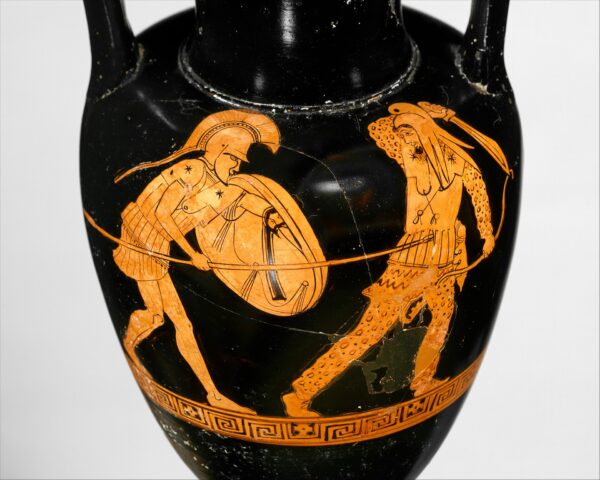
A depiction on a Greek vase of a Greek and Persian soldier in combat (Creative Commons Licence)
You would have thought that, under these circumstances, casualty rates would have been absolutely horrendous. After all, if a battle was made up of countless such duels, and if such duels ended in the death or severe wounding of one or other of the participants, then very few soldiers would have been left standing by the end of the action.
Unreliable figures
There are a number of big caveats about what casualty figures actually were in ancient times, of course. The first is that they were notoriously unreliable. Even the very size of armies was hard for contemporaries to count. And in the aftermath of a battle, the survivors would have had very little idea about how many people had been killed or wounded. The defeated would have been too busy fleeing, and the victors too busy looting. As the scale of the victory/(defeat) became a little clearer, the participants would have had an incentive to maximise/(minimise) the casually figures.
The second caveat is that, in modern warfare, for every front-line combatant there are a host of supporting personnel – logistics staff, engineers, cooks, medics and so on. These would certainly have experienced the perils of war, but usually not in front-line battle conditions. This wasn’t the case in ancient warfare, at least not nearly to the same extent. The vast majority of men in a Greek phalanx or a Roman legion would have been fighting soldiers.
A third caveat is that, in 20th century and 21st century conflicts, modern medicine means that the majority of the wounded survive, whereas this was far from being the case in pre-modern warfare. Moreover, many (most?) ancient battles were followed by the dismal ritual of soldiers of the victorious side systematically killing the wounded from the defeated army. Looking after the enemy wounded would have been too much of a strain on restricted resources.
But all these things point to how much more awful ancient warfare must have been compared with modern warfare (at least for combatants). And yet casualty rates seem to have been roughly equivalent – averaging less than 10% of participants.
Catastrophes
Some battles were far worse than this, but these were famous precisely because of the very high casualty rates. The Romans lost whole armies on several occasions, when pretty much all their soldiers present were killed. Most notable of these were in the war against Hannibal (the Second Punic War, 218-202 BC, especially Lake Trasimene and Cannae). Above all ,the Battle of Cannae in 216 BC was probably the most famous military catastrophe that Rome ever suffered. Other occasions were the Battle of the Teutoburg Forest (AD 6), when the men of three legions (plus auxiliaries) perished, and the Battle of Carrhae (53 BC), when the majority of men in seven legions were killed.
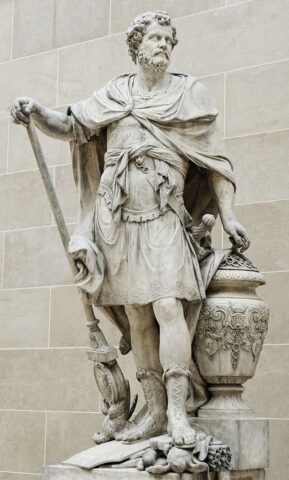
An 18th century statue of the Carthaginian general Hannibal (Public Domain).
Such battles were few and far between. An indication that even 10% casualties was seen as the upper limit of the normal range is found in the very word for this: “decimation”. This word, as everyone knows, means that one out of ten soldiers died. It indicates very heavy loss of life, and thus implies than normal casualty figures, even for defeated armies, were significantly less than this.
Given the nature of ancient battles, how can casualty figures not have been higher?
Well, I’ve been exploring some websites (Historia, Reddit, History Stack Exchange) which talk about historical warfare, to find out if they shed any light on the subject. And indeed they do. Or at least, they provide plausible answers to this question.
Pushing and shoving
The first answer is that, contrary to what I stated at the very start of this post, ancient battles did not consist of numerous individual duals. When ancient armies locked with each other in battle, soldiers fought as a solid mass. This meant that only the first rank of men were actually in contact with each other – often for the whole battle.
As for these unfortunate men (although – would you believe it! – it was generally considered a prized honour to be selected to fight in the front rank), their shields overlapped to form a wall though which it was difficult for enemy soldiers to stab or slash.
Also, the sheer weight of the ranks of men behind them meant that the front ranks of soldiers were pressed tight up against each other, with virtually no space to move at all. In fact, many ancient battles were in fact more pushing matches than actual fighting, with the heavier and more powerful force literally pushing the other side off the field.
It was when the front rank broke that casualties started to mount. Those soldiers who fell to the ground would as likely have been trampled to death as stabbed or hacked to death.
When an army turned and ran, casualty figures grew. The first thing a fleeing soldier would do is discard his heavy shield and helmet so as to be able to run for his life. His pursuers on foot would have kept their armour intact, and so have been handicapped; this would have given the fleeing an advantage. But pursuit was often carried out by horsemen, and these would have had not only the advantage of speed but of height as well.
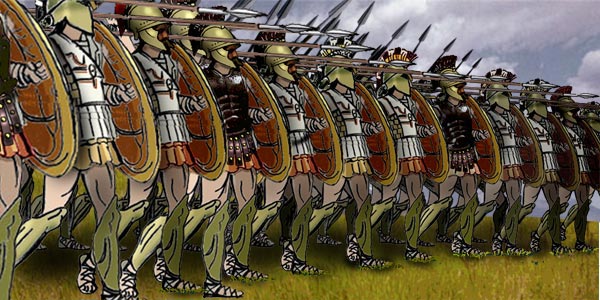
A modern depiction of a Greek phalanx (Public Domain)
But the really catastrophic battles occurred when an army was ambushed. This was what was so brilliant about Hannibal’s generalship; he repeatedly lured Roman armies into traps from which they couldn’t extricate themselves, and which allowed the Carthaginian army to use surprise and terrain to fight on three own terms. Similarly, in the Teutoburg Forest, the Romans, strung out along a narrow path between trees, were ambushed and cut down in their thousands. At Carrhae, the Romans were up against a completely new tactic: the Parthian archers kept their distance and circled around them on horseback, pouring volley after volley of arrows on them (the Romans soon learned to deal with this, and in subsequent wars almost always had the upper hand against the Parthians).
Voting for war
So, this is why casualty figures in ancient battles were not as horrendous as one might at first have thought. I suppose this explains why Roman citizens voted year after year to go to war, even knowing that it was they themselves that would do the fighting (the Roman army was a citizen militia until the last decades of the Republic). They would expect that most of them could expect to return home and enjoy the fruits of victory (honour, booty, and very likely a slice of newly conquered land).