
The Pony Express formed one of the legendary episodes of the “Old West” of the United States.
Foundation
It was founded by three freight transportation entrepreneurs, William H. Russell, Alexander Majors, and William B. Waddell. These men owned and ran the Central Overland California and Pikes Peak Express Company, with the aim of providing a fast and reliable communication system between the eastern United States and the rapidly growing western regions. California is particular had experienced spectacular growth in the previous decade, after gold was discovered there in 1848. By 1860 its population had reached 380,000.
The plan was to establish a fast mail service using a more direct route than hitherto, with mounted riders instead of the stagecoaches which had been used up to that point. They committed the Pony Express, as the service was called, to delivering letters across the route in 10 days. Many said this was impossible.
The three founders put the organisation they need to provide the service together in just two months, in the winter of 1860. This involved hiring several hundred personnel (including 80 riders), setting up 184 stations, purchasing 400 horses, and dealing with a host of other issues.
The *inaugural ride began on April 3, 1860, in St. Joseph, Missouri. The rider, Johnny Fry, galloped out of St. Joseph to cheering crowds and the sound of cannon fire. The mail pouch contained 49 letters, five telegrams, and special newspaper reports. The ride ended in Sacramento, California, just 10 days later, to widespread astonishment across the nation. From Sacramento, much of the mail was placed on steamboats to San Francisco, completing the delivery.
Operating the service
The route from Missouri to California spanned 1,900 miles. It crossed some of the most challenging landscapes in North America, including the Great Plains, the Rocky Mountains, the Great Basin Desert, and the Sierra Nevada. Riders had to negotiate mountain passes with steep inclines and unstable footing; deserts (such as the Great Salt Lake Desert), where extreme heat and lack of water posed a constant threat; flooded rivers in the spring that were dangerous to cross; and long sections which had no marked trails the follow, where riders had to rely on memory and instinct.
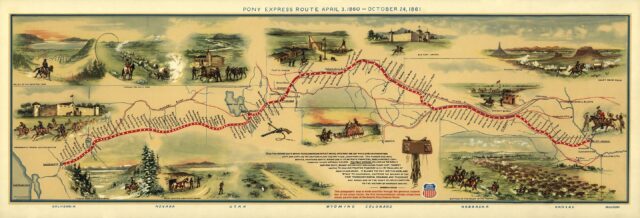
Illustrated map of the Pony Express route, by William Henry Jackson (Public Domain)
Sleep was rare, food was minimal, and riders were exposed to the elements at all times. Riders faced intense heat in the deserts, snow storms in the mountains, and torrential rain on the plains. Hypothermia, sunstroke, and dehydration were constant threats. Many stretches of the route had no natural water sources, and though relay stations provided limited supplies, if a rider missed a station for any reason, they could be left without water or food for miles.
Relay stations, some little more than wooden shacks, were positioned every 10 to 15 miles along the route. They providing fresh horses, food, and some shelter from the elements. Every 75 to 100 miles were “Home Stations”, where they would pass the mailbag onto another rider. Home stations were larger outposts where riders would pass the mailbag to a fresh rider. Some were fortified and protected by stockades, manned by soldiers, and surrounded by small settlements. Others were much more isolated. But all were places where they could get some rest and food before continuing on with their run with a new mailbag.
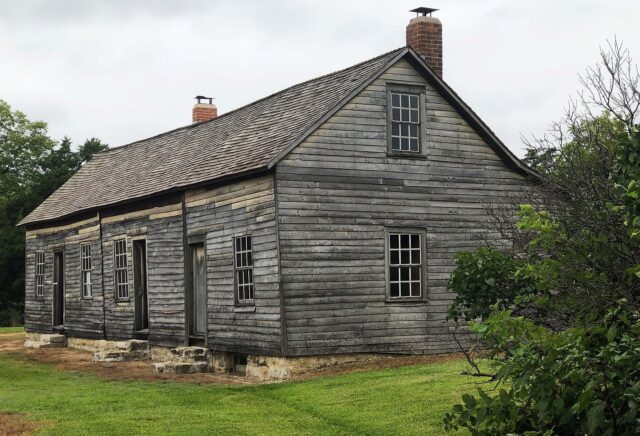
Hollenberg Home Station, Kansas (Creative Commons Licence)
On some occasions, a rider would came across a station which had been destroyed in an attack. This could leave him short of food and drink. These attacks could come from Native Americans or bandits. Relations with native tribes varied along the route, but during periods of heightened tension (e.g., the “Paiute Indian War “of 1860, when many relay stations were burned and station workers killed), riders were in real danger of ambush or attack.
Also, the Pony Express carried valuable mail, including money or sensitive government communications. This made the riders tempting targets for bandits and outlaws.
More mundanely, if for some reason a relief rider was not available to take over the run at a home station, a rider might have to cover over 300 miles or more in one ride.
Horses of course were also at risk from dehydration, exhaustion, and injury from falls. These could be catastrophic for the animal, and potentially a mortal threat to the rider.
The Riders
On top of all this, riders were under intense pressure to maintain the 10-day delivery schedule. Delays could cause serious financial loss for the company, as well as undermine the service’s reputation. The riders all seem to have been imbued with a sense of the importance of their task, and had a strong determination to complete their runs under almost any circumstances. On recruitment, each rider was required to swear the following oat:
“I, … , do hereby swear, before the Great and Living God, that during my engagement, and while I am an employee of Russell, Majors, and Waddell, I will, under no circumstances, use profane language, that I will drink no intoxicating liquors, that I will not quarrel or fight with any other employee of the firm, and that in every respect I will conduct myself honestly, be faithful to my duties, and so direct all my acts as to win the confidence of my employers, so help me God.”
Although it is hard to believe that most riders lived up to this solemn commitment completely, for many this oath will have had the psychological effect of strengthening their commitment to their duties.
The riders were typically young men, often teenagers, and of light stature to reduce the load on the horses. One of the most famous was William “Buffalo Bill” Cody, a legendary figure in the history of the “Wild West”. He joined the Pony Express as a rider at the age of 15. He became legendary for completing one of the longest continuous rides in its history when he rode 322 miles non-stop after his relief rider was killed. He switched horses frequently but stayed in the saddle for nearly 24 hours—a considerable feat of endurance and courage.
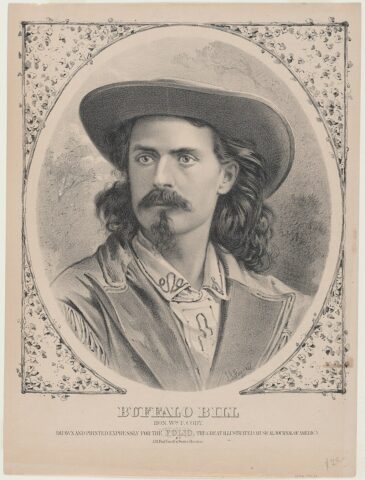
Lithograph portrait of “Buffalo Bill” Cody by Samuel S. Frizzell (Creative Commons Licence)
Cody was a skilled self-publicist in his later life as a famous showman, and some of the tales he told may have been exaggerated. But there’s no doubting his skill as a horseman, his courage and his resilience. In all these respects he is a fitting symbol of the frontiersman of the mid-19th century.
Another famous rider was “Pony Bob” Haslam. He is best known for making a very dangerous ride during the Paiute Indian War. He volunteered to carry the mail over 120 miles round trip through hostile territory, and though shot through the jaw with an arrow succeeded in completely the run, ensuring the mail was delivered.
A third rider, Jack Keetley, is famous for completing the longest round trip on record for a Pony Express rider – 340 miles without stopping, except to change horses. When he finally dismounted after completing his run, it’s said he fell asleep in the saddle from sheer exhaustion.
The record for the fastest run was set in March 1861, when the text of Abraham Lincoln’s Inaugural Address as president was carried across the country to California. The riders delivered the speech from St. Joseph, Missouri to Sacramento, California in just over 7 days.
The End of the Pony Express
On 24th October 1861, the first transcontinental telegraph line was completed. At a stroke, almost instantaneous communication right across the United States became possible. The Pony Express was no longer needed, and two days later it was shut down. It had been in service for just 18 months.
Despite a heavy government subsidy, the Pony Express never made a profit. Its founders lost a great deal of money on it, despite the effort they had put into making it the fast and efficient service it was. Nevertheless, it clearly demonstrated the benefits that a unified transcontinental communications system could bring to a country the size of the United States.
In the short time that it operated, the Pony Express secured its place in American folklore as a symbol of courage and determination in overcoming many seemingly insuperable challenges. Its young riders and fast little horses in particular came to be romanticized for their toughness and resilience, which came to be seen as key features of the American frontier.