
When we westerners look at Chinese history we often come to the conclusion that the last dynasty of China was a total failure. However, that is mostly because we focus a lot on that bit of Chinese history after the Europeans started to have a real impact. One of our main take-aways from that is that the Westerners had far superior technology (especially military technology) than the Chinese, and that China was ruled by a deeply conservative regime which totally failed to grasp the challenges posed by the westerners.
This regime was the Qing dynasty – perhaps better known in the West as the Manchu dynasty.
So, in western thinking, the Manchus are often put in a similar category as dinosaurs and dodos – that is, extinct species which failed to adapt to changing conditions. But this is by no means the full story.
Who were the Manchus?
The Manchus were a non-Chinese people from inner Asia, closely related to a people who had taken over China in the 13th century, the Mongols. The Manchus had replaced the last native line of rulers of China, the Ming Dynasty, from power. They called their dynasty the “Qing” (pronounced “Ching”) – which means “Bright” or “Pure”.
Were they the failures whom we often view them as being? The answer is a definite “no”. Indeed, it can be argued that under the Qing, the Chinese reached a position of power and influence never seen before in history. And this is saying something, as for most of the previous three millennia China had either had the most advanced, or one of the most advanced, civilizations on the planet.
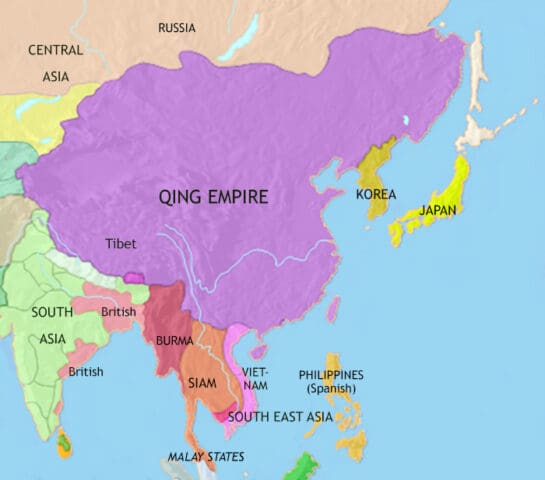
A map of East Asia in 1789, clearly showing how enormous the Qing empire was at the date (Timemaps).
A Great Dynasty
The clearest manifestation of the Manchu success was the vast expansion of territory which the Chinese empire which the dynasty presided over. New additions included Tibet and a large part of inner Asia. The Qing empire was the fourth largest empire in the whole of world history, and significantly larger than that ruled by any other Chinese dynasty.
Internally, too, the Chinese people prospered under Qing rule. The political stability and internal peace that the Qing emperors oversaw, coupled with the pro-growth initiatives they sponsored – such as promoting the spread of new crops and stimulating migration to under-developed land – allowed the Chinese economy to flourish. This in turn enabled the population to grow to the point where, in 1800, the Qing ruled a larger share of the world’s population than any other regime in world history, before or since.
All this was not just the result of the great impersonal forces of history. The quality of the Qing rulers had a large part to play in this too.
The dynasty produced three of the most intelligent, hard-working and benevolent emperors to govern China: the Kiangxi emperor (reigned 1661-1722), the Yongzheng emperor (1722-1735) and the Qianlong emperor (1735-1799).
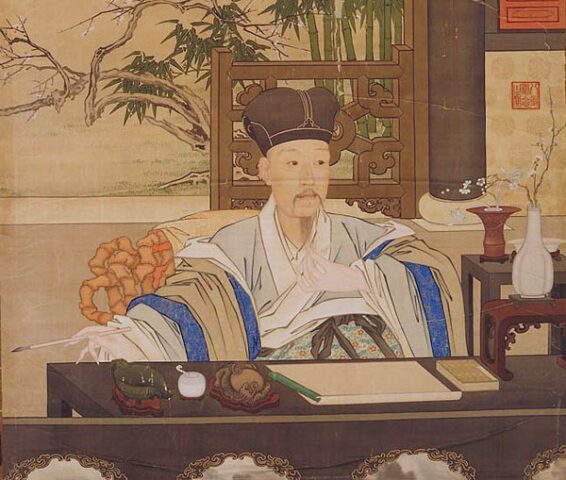
The Qianlong Emperor at work in his study
These all strove to ensure that their realm was well governed, and, like the good Confucian rulers they were, took great interest in the welfare of the people. They spent long hours in their offices, diligently working their way through the huge piles of paperwork that crossed their desks. They also made sure that they got to know their far-flung dominions first-hand by going on periodic tours of inspection.
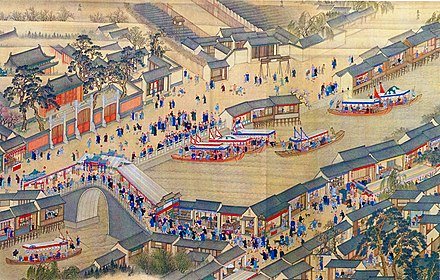
The Kangxi emperor on a tour of southern China
A Tale of Two Halves
All the above refers to the period up to the later 18th century. After that, the fortunes of the dynasty began to turn. The 19th century was one of economic decline, political instability, social unrest on a mammoth scale, humiliating defeats the hands of despised foreigners, and ultimately, in the early 20th century, the end of the imperial order which had served the Chinese people so well for millennia. It is this period with which westerners are most familiar, and has fed their idea that the Manchu dynasty was a disaster for China.
Not only so, but westerners’ experience of 19th century China boosted their feelings of superiority. They were aware that they had played an important part in the decline of Qing China, but this was down to the advanced technology that they possessed – and of the failure of China to “keep up”. Today, westerner historians are now seeing that their role in all this is something more to be embarrassed about than proud of. Whatever we feel, however, the West’s role in the imperial system’s decline and fall, though important, was not pivotal. Most of China’s troubles were generated by forces within China itself.
But that is for another post.