
Early Civilization 4000 BCE

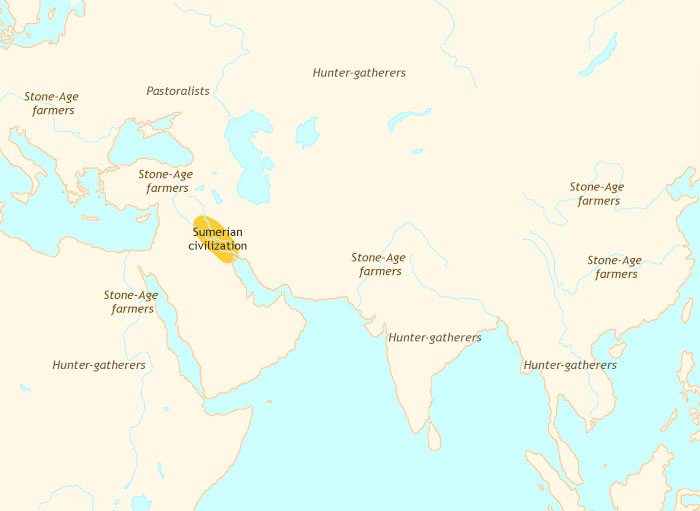

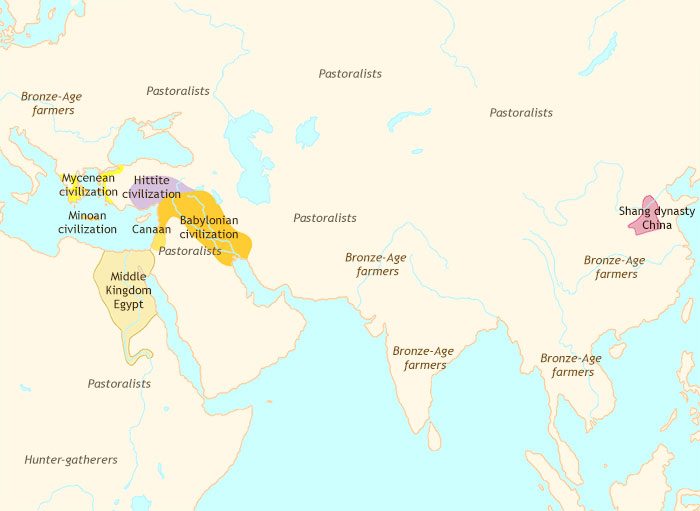

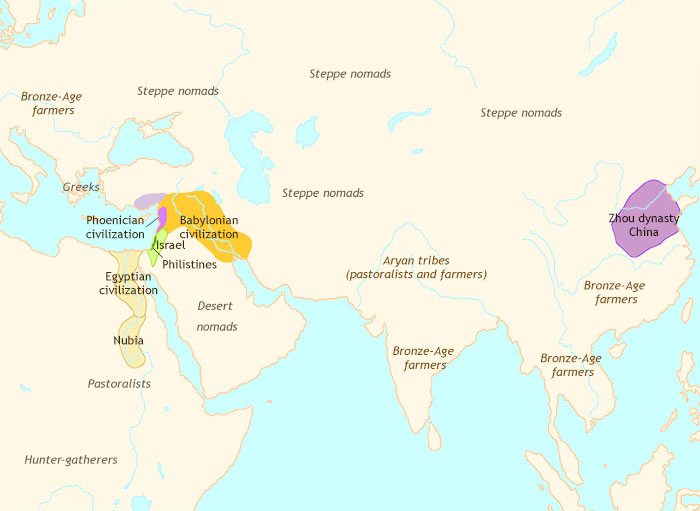
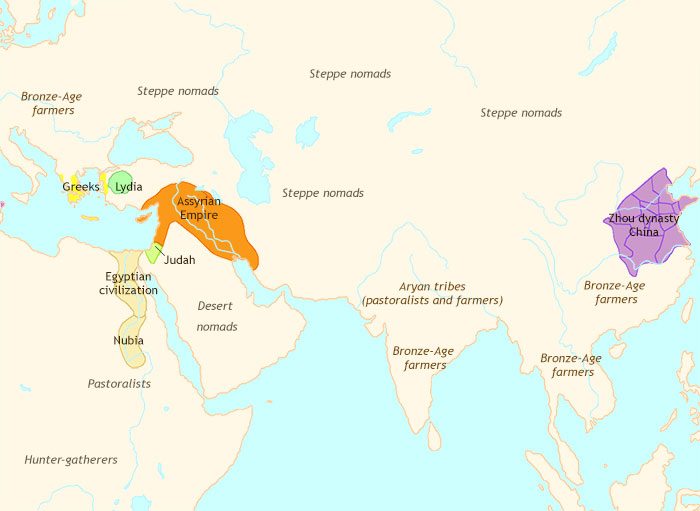


What is happening in Early Civilization in 4000BCE
(Teachers: please follow this link to teaching resources)
Agriculture has been spreading around the Eastern Hemisphere for several thousand years. It now covers most of the Middle East, East Asia, South Asia, Europe and North Africa.
Pastoralism
In the grasslands of the Middle East and central Asia, pastoralists follow a nomadic way of life, regularly moving from place to place to find new grazing lands for their animals.
Hunter-gatherers
Although agriculture has been spreading for the thousands of years, it has yet to reach many areas of the world – much of central Asia, the northernmost parts of Europe, most of Africa south of the Sahara, large parts of South Asia, and nearly all of South East Asia (plus all of the Western Hemisphere bar a few areas in Mexico and Peru; this unit only covers the Eastern Hemisphere, however). Here, hunter-gatherers still roam, living in small encampments. For food they hunt wild animals and search for nuts and berries.
Civilization is on the way
Within some of the farming areas, above all in some river valleys, civilization is on its way. (Those parts of the river valleys where civilizations grow up should more accurately be called flood plains. This is because the earliest civilizations did not develop in narrow valleys. Instead, they appeared where broad rivers flow through wide plains).
Irrigation – the key to early civilization
Irrigation is playing a key role in this. Farmers use ponds, dykes and irrigation ditches to control the flow of river water. This makes the land so fertile that it can support large populations than ever before. More importantly, farmers can produce more food than they need for themselves and their families (historians call this a surplus).
The surplus means that a small section of the population are free from spending all their time farming. Groups of full-time artisans, soldiers, priests and rulers are beginning to appear. Society is becoming divided into different social classes. Non-farming groups live in communities which are growing in size, from villages into towns (which modern scholars term urban settlements).
What is happening in Early Civilization in 3500BCE
(Teachers: please follow this link to teaching resources)
The Sumerian civilization
The earliest civilization in world history is located on the flood plain of two great rivers, the Tigris and Euphrates. The plain forms the land of Mesopotamia, which makes up the most fertile portion of a larger area, known as the Fertile Crescent. This covers an arc of territory going (from east to west) through Mesopotamia, Syria and Canaan.
Once irrigation is in place, the rivers bring their flood water and rich mud, or silt, to make the land very fertile.
Cities and city-states
A number of cities have now grown up here, each with tens of thousands of inhabitants. These cities have temples, palaces, craft workshops, wide streets and open spaces for public ceremonies. They are surrounded by defensive walls, built of stamped earth or dried brick.
The Sumerian cities are independent from one another. They are the first city-states in world history. They are ruled by powerful priest-kings, assisted by priests and officials.
Their populations are divided into classes, with differing levels of status, wealth and power. Kings and their families are at the top, then high officials, nobles, priests, scribes, craftworkers and, at the bottom, ordinary farmers. The lower classes are required to do forced labor on irrigation works, temples, palaces and city walls.
Writing
The temple officials are developing methods of record keeping, to help them manage the collection and distribution of food and other goods. These are evolving into the earliest form of writing, which is called cuneiform.
They have also developed skills in mathematics and engineering to aid them in constructing large buildings and canals.
Arts and craftwork
Sumerian artisans produce more beautiful things than in former times – paintings, sculptures, metalwork, jewelery, textiles and so on. These are used in the decoration of temples and royal palaces, and for personal wear.
The production of refined art and craftwork is one of the key hallmarks of civilization. This is because their societies include a division of labor – no longer is everyone a farmer. This in turn allows specialist craftworkers to develop their skills to a far higher level than was possible when everyone had to be farmers.
What is happening in Early Civilization in 2500BCE
(Teachers: please follow this link for teaching resources
More major civilizations have appeared: Egypt in North Africa and the Indus Valley civilization in South Asia.
Egyptian civilization
From about 3000 BCE, the land of Egypt has been ruled by a single kingdom. This makes it very different from Mesopotamia, which is divided into numerous city-states.
The kingdom is ruled by a succession of rulers called pharaohs. Like all peoples of the period, the Egyptians have a polytheistic religion, and they regard the pharaohs as the earthly incarnations of their chief god, Amun.
The Great Pyramids of Giza
The pharaoh and his officials can order huge numbers of people to work on vast projects. Already by 2500 BCE the great Pyramids of Giza have been built. These are the magnificent burial-places for the kings.
Egyptian writing
The Egyptians have developed their own writing systems. A hieroglyphic script is used in public proclamations. For more everyday affairs, the scribes write in a curved script (called cursive).
Egyptian achievements in medicine, science and mathematics are very advanced for the time.
The Indus Valley civilization
More than a thousand miles to the east, in the Indus Valley, a number of large cities have emerged, notably at Harrapa and Mohenjo-daro. These cities are the first to be laid out on a street plan based on grids. This suggests how well organized their societies are. These cities also boast the earliest sewage and piped-water systems yet found.
The Indus Valley cities have a writing system, but modern scholars have not been able to decipher it. As a result, far less is know about their civlization than about those of the Egyptians and Sumerians.
The spread of civilization
The peoples of Mesopotamia and Egypt trade with many other lands, and trade routes spread ever further out, reaching into Asia Minor, through Syria and Canaan, down into Nubia and even as far as Europe and India. This is the period known as the Bronze Age, and there is a brisk trade in copper and tin to make bronze. This is used in beautiful objects but also in weapons.
Wherever trade goes, small trading cities spring up. Civilization is spreading out of the river valleys and into neighboring lands.
What is happening in Early Civilization in 1700BCE
(Teachers: please follow this link for teaching resources)
The Mediterranean
Minoan civilization has recently appeared, on the island of Crete. It is centered on magnificent palaces, especially that of Knossos. Minoan traders sail far and wide in the search for goods to buy and sell.
More recently, Mycenaean civilization has appeared on mainland Greece.
China and India
China
By this date, a well-organized kingdom with a Bronze Age civilization covers much of the Yellow River region. This is ruled by kings of the Shang dynasty – the first of a long succession of dynasties to rule China.
The Chinese have already developed a writing system which, even at this early date, is almost identical to the modern Chinese script.
India
By this date the Indus Valley civilization has vanished – for reasons scholars still do not properly understand. It may have been due to new peoples migrating into the area, or perhaps to climate change.
Central Asia
On the central Asian steppes, a nomadic people have already made a major impact on world history. Modern historians label them the “Indo-Europeans”, because they speak a language which will evolve into a group of related languages stretching from India to Europe (including English, French, Spanish, Italian, Greek, Persian and Hindi).
The Indo-Europeans were the first to domesticate horses (c. 3500 BCE) and later developed wheeled vehicles (c. 3000 BCE) – which, by c. 2000 BCE, had evolved into war chariots.
Mesopotamia
In Mesopotamia, the Sumerian city-states are now of only secondary importance. The more recent city of Babylon has become the leading city of the region. This is thanks to the conquests of a Babylonian king called Hammurabi. Hammurabi is also famous for the law code he issued.
The Babylonians base their art, architecture and literature firmly on that of the Sumerians.
What is happening in Early Civilization in 1300BCE
(Teachers: please follow this link to teaching resources)
This era marks the high point of the Bronze Age world.
The Middle East
This period of Egyptian history is called the “New Kingdom”. In this, Ancient Egypt reaches the height of its power, conquering the largest empire it ever possessed. It rules much of Canaan, and has expanded south, deep into Nubia.
The Hittite empire, founded some centuries before by Indo-European rulers from central Asia, is Egypt’s main rival. Egypt and the Hittites contest control of Canaan.
The Mediterranean
The Minoan civilization of the island of Crete was gravely affected by earthquakes and tsunamis in around 1600 BCE.
The Mycenaean civilization has continued to flourish.
China
The kings of the Shang dynasty now rule a large part of northern China, and dominate an even larger area.
Under the Shang, the Chinese are manufacturing some of the most beautiful bronze vessels ever produced.
South Asia
Indo-European tribes have migrated from central Asia into South Asia, and are now spreading across northern India. In South Asia they call themselves Aryans (which means “Noble Ones”). They are forming tribal kingdoms ruled by warrior aristocracies.
The Aryan religion is related to the belief systems of other Indo-European peoples such as the Ancient Greek, Persians and Germans. Like them it is polytheistic, believing in many gods and goddesses.
Its priests, called the Brahmins, transmit their beliefs and practices orally (i.e. by word of mouth) from one generation to the next. This growing collection of prayers, hymns, rituals and other sacred verses are called the Vedas.
The Vedas would later be written down (scholars debate the date, with estimates varying by more than a thousand years). As the most ancient scriptures in India, they would form the foundations on which the great religion of Hinduism later develops.
What is happening in Early Civilization in 1000BCE
(Teachers: please follow this link to teaching resources)
This has been a time of great upheaval. Civilizations have been damaged, or even destroyed. The period has also been one of great progress, however.
The Middle East and Mediterranean
In the eastern Mediterranean, migrations of the mysterious “Sea Peoples” and other groups have destroyed the Hittite and Mycenaean civilizations. At the same time desert nomads have invaded Syria and Mesopotamia, throwing Babylonia and other ancient kingdoms into chaos. Only Egypt has succeeded in repelling invaders, but she too has become weak and divided.
The Phoenicians
With the old centers of power weakened, new peoples have come to the fore. A people who live on the shores of the eastern Mediterranean have survived the attacks of the Sea Peoples, and are becoming wealthy through trade with other Mediterranean lands. These are the Phoenicians.
The Israelites
The Israelites invaded and occupied the land of Canaan in the Thirteenth or fourteenth centuries BCE. They brought with them their worship of the one God, Yahweh. In their new homeland they are develop a religion which will be ancestral to the three great monotheistic faiths of the modern world, Judaism, Christianity and Islam.
By this date their tribes have been united into a single kingdom, under their Kings Saul and then David.
Advances
This period sees a series of advances as the Bronze Age gives way to the Iron Age. The use of iron technology is spreading. Iron is a tougher, more plentiful and less expensive metal than bronze, so that iron farming tools and weapons are coming into common use. This leads to agriculture becoming more productive, and larger armies of metal-armed soldiers being raised.
Another major advance is the spreading use of alphabets in the Middle East. Alphabetic writing is much quicker to learn than the older cuneiform and hieroglyphic scripts, and so makes literacy possible for many more people.
China
Because of its distance from the Mediterranean and Middl East, China has not experienced the upheavals of those regions. The Shang dynasty in northern China has been replaced by the Zhou dynasty (c. 1046 BCE). Apart from this political change, Chinese civilization and society continue much as before – though the tradition of making beautiful bronzes begins to fade.
What is happening in Early Civilization in 700BCE
(Teachers: please follow this link to teaching resources)
New civilizations are appearing, and old ones are changing, as iron technology spreads out from the Middle East. By now the two regions closest to it, Europe and India, have largely entered the Iron Age.
The Assyrian Empire
In the age of chaos (see notes for last map) the Assyrian kingdom had been invaded and occupied by desert tribes. In the following centuries, however, the Assyrians have been able to take back territory by turning themselves into a strong military power – and then gone on to conquer a huge empire which covers much of the Middle East.
The destruction of the kingdom of Israel
If a conquered kingdom rebels against their rule, the Assyrians march in, take many of its people and settles them in another area of their empire, hundreds of miles away. In their place, they bring in other settlers. They thus wipe the kingdom and its culture from the map.
The most famous instance of this is with the Israelites. The original Kingdom of Israel had divided into two, forming the kingdom of Judah in the south and the kingdom of Israel in the north. The latter has been destroyed by the Assyrians (in 722 BCE). Judah remains in existence but only as a subject state of the Assyrians.
The Phoenicians
The Phoenicians (who live on the eastern shores of the Mediterranean and are now under Assyrian domination) have pioneered trade routes right across the Mediterranean, and beyond. They have had a huge influence on western peoples such as the Greeks by spreading the use of the alphabet and other elements of Middle Eastern civilization to them.
The Greeks
The Greeks are developing their own urban civilization. They live in hundreds of city-states, most of which are by now republics rather than monarchies. The Greeks are a nation of seafarers and traders, and they are establishing trading posts and colonies right round the Mediterranean Sea.
India
In India, trade routes from the Middle East are bringing in cultural and technological change. Iron technology and the alphabet are two of these. Iron implements help farmers clear land for crops; the huge Ganges river plain, until now marshy and densely wooded, is seeing a large upswing in population as more land comes under cultivation. Towns are beginning to appear there.
China
In China, the Zhou kingdom has expanded, but the kingdom is fragmenting into different states. The kings are losing authority, and local lords set themselves up as independent rulers and become virtually independent princes.
What is happening in Early Civilization in 600BCE
(Teachers: please follow this link to teaching resources)
The Assyrian empire has now vanished. It has been replaced by three large states – the Babylonian empire, the empire of the Medes, and a revived Egypt.
The Middle East
The Assyrian empire has collapsed as peoples within the empire, especially the Babylonians and the Egyptians, rose in revolt. They were helped by peoples from beyond the empire’s borders, such as the Scythians (a nomadic people from the steppes of central Asia) and the Medes.
The leading power in the Middle East is now the Babylonian empire, which has taken over the core of the old Assyrian empire. Under their famous king Nebuchadnezzar, the Babylonians have conquered the Israelite kingdom of Judah and taken its elite into captivity.
The Medes are an Iranian people who have created a large empire in Iran.
A revived kingdom of Egypt has become a leading power in the Middle East. The pharaohs of the time are attempting to recreate the glories of past centuries, not only in their conquests but in the art and architecture they sponsor.
In Asia Minor the kingdom of Lydia has also become wealthy and powerful. It starts to use stamped metal coinage minted by royal command – the first state to do this. Its close ties with the Greeks mean that the use of metal coinage soon spreads westwards.
The Greeks
The Greeks now dominate the trade routes of the eastern Mediterranean. Greek settlers have established colonies around the Mediterranean and Black Sea. In the western Mediterranean they face competition from the Phoenician colony of Carthage, located in North Africa.
The great days of Greek civilization still lie in the future, but already those great oral epics, the Iliad and the Odyssey, attributed to a blind poet called Homer, have been composed. These are still regarded as among the finest works in Western literature.
The Indian subcontinent
Urban, literate civilization has returned to the Indian subcontinent. This is now centered on the great plain of the river Ganges, not the Indus river valley.
Northern India is divided between several powerful states: most are ruled by monarchies, but some are apparently under councils of nobles. Some modern scholars see them as types of republics.
China
In China, the independent states into which the Zhou kingdom has now divided are constantly at war with one another. In order to raise larger and better armies, some rulers are establishing bureaucracies to collect taxes more efficiently and to organize public projects such as irrigation systems better. These moves undermine the authority of the old feudal nobility.
What is happening in Early Civilization in 500BCE
(Teachers: please follow this link to teaching resources)
New religions and philosophies being taught at this time will shape human history right up to the present day.
The Persian Empire
Much of the Middle East is now ruled by the huge Persian empire.
The Persians are an Iranian people closely related to the Medes. Under their king Cyrus they have rebelled against the Medes and taken over their empire. Cyrus and his successors have then expanded its borders dramatically.
The Persian kings are much more moderate then the Assyrian and Babylonian rulers were. Nebuchadnezzar, king of Babylon, had deported many Israelites from Judah to Babylon, in 585 BCE. The Persian kings Cyrus and Darius have ordered that these people be allowed to return to their homeland.
There, the former exiles will continue to develop their monotheistic religion, Judaism.
The Greeks
Greek civilization has continued to develop. The Greek city-states have already produced great mathematicians, thinkers, poets, sculptors and architects; in politics, the first democracy (at the city of Athens) has appeared.
The Greeks are now waking up to the Persian threat from the east.
Two great schools of thought
In this period, two great schools of thought are appearing in Asia.
Buddhism
In India, the Buddha is teaching his disciples about the need to renounce such worldly ambitions as gaining wealth and status. Rather, they should make it their objective to have compassion on all creatures.
The great world religion of Buddhism will arise from these teachings.
Confucianism
In China, this is the period when the philosopher Confucius is active. He teaches that society will only know harmony when all people know their place within it and treat each other with kindness and respect. His teachings, Confucianism, will influence Chinese thinking right up to the present day.

Subscribe for more great content – and remove ads