
As I indicated in my last blog post, it is a truism amongst historians of the ancient world that early civilizations first arose on large floodplains. Here, fertile soils, fed by large-scale irrigation and flood control systems, enabled densely concentrated populations to grow. These were able to support the emergence of highly complex city-based societies.
This was not the case for the great pre-Columbian civilizations of the Americas, however. There are no great floodplains here (apart from that of the Mississippi, but this is in a latitude well to the north of where early agriculture was able to flourish). Also, the indigenous inhabitants of the Americas lacked other important features which benefitted Old World societies, such as draft animals like cattle and horses, wheeled transport and iron technology.
In Central America, the earliest civilization, that of the Olmec, arose in a landscape bisected by a dense network of small rivers – not the long, large rivers along whose banks the great civilizations of the Eastern Hemisphere – Ancient Egypt, Ancient Mesopotamia and so on – emerged. Similarly, none of the later civilizations of Central America, such as those of the Maya and the Aztec, were located along great rivers.
In South America, the foundational Chavin civilization was located in the highlands of Peru, amongst the Andes mountains, some of highest in the world. The area’s high altitude meant that it had mostly poor soils, enjoyed only a cool, short growing season, and lay in a dramatically fragmented terrain of high peaks and steep valleys – as far away from flat river floodplains as you could possibly get.
So, let’s look at each of these regions in turn, and take a deeper dive into how civilisations did emerge in them.
Central America: The Olmec
The Olmec civilization first appeared around 1400 BCE, in the hot, humid lowlands along the Gulf Coast of modern-day Mexico. The terrain is swampy, and covered by thick jungle. Small rivers criss-cross the landscape, and the alluvial soil (i.e. made up of sediment deposited by the rivers) is well-watered and very fertile. The area also produces other resources such as cacao, rubber, fish, and minerals, and with a fine line in exotic minerals such as jade, obsidian and basalt. The river systems make transport by boat, and therefore trade, easy.
In the second millennium BC this highly productive environment encouraged a densely concentrated population to grow up. One of the factors which aided the rise of early civilizations on floodplains of the Old World, however, was missing. This was the need for large-scale irrigation: the Gulf Coast environment provided enough water naturally to growing abundant crops. The need for irrigation forces communities to work together to dig channels, build dykes and other constructions in order to take water to where it is needed (and keep it there during the growing season). Having to build and maintain an irrigation systems also required management, so stimulates the growth of authority structures including kings, officials, scribes and overseers. All this encourages societies to be welded together into well-organized states.
Perhaps it was because they had no need for irrigation that the Olmec never (so far as we can tell) built large cities or developed powerful kingdoms which are the hallmarks of Old World civilizations such as Ancient Egypt, Babylon and Shang China. This was despite the fact that they controlled a sufficiently dense population to sustain an elite of priests, who paid for highly skilled professional craftworkers to produce striking artefacts such as the enormous basalt sculptured heads and jaguar figures.
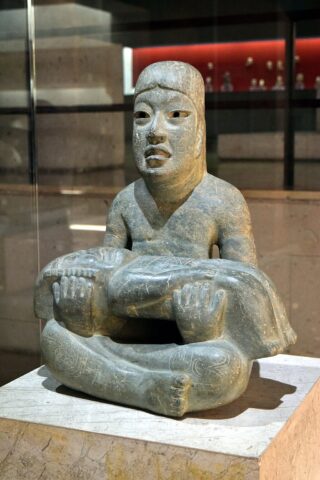
Olmec sculpture in the Museum of Anthropology, Veracruz, Mexico (Creative Commons Licence)
The Olmec spread their culture hundreds of miles throughout Central America, to form the foundations of new civilizations such as the Maya, Teotihuacan and Aztec. And these all did build true cities and developed powerful, highly organized states. Some also created sophisticated literatures and sciences.
None of these Central American societies lay along the banks of long rivers. Each, however, did have challenges to overcome. The Teotihuacan and Aztec civilizations were located in the high terrain of central Mexico, where the growing of food in sufficient quantities to support a large and concentrated population demanded a large measure of ingenuity and high levels of communal co-operation. These included the creation of artificial floating islands in lakes, in order to grow crops very intensively. The Maya, on the other hand, lived in a similar environment to that of the Olmec – tropical, well-watered and highly fertile. There are few rivers, however, and to turn densely a forested landscape into one where an increasingly intensive farming was practiced, required discipline and co-operation, and so provided the incentive for structured states to emerge.
So, although there are no large floodplains in Central America, there are locations where concentrated populations could grow up. Where challenges had to be overcome which required a disciplined and well-managed workforces, sophisticated civilisations could emerge.
South America: Peru
When we turn to South America, a closer look at the origins of civilization here shows that we are not quite right to say that floodplains played no part in their rise. In recent decades, archaeologists have uncovered the remains of large settlements that were built on the banks of fast-flowing rivers which traversed the narrow coastal plain of Peru, between the high Andes mountains to the shores of the Pacific Ocean. This coastal plain has one of the driest climates on Earth, so irrigation would have been key to the development of settlements here. And sure enough, between about 3000 BCE and 1800 BCE, such settlements, like the one at Caral-Supe, did exist.
These river valleys, however, were on a far smaller scale than the great floodplains of the Old World, and the societies they supported were similarly smaller in scope than those on the banks of the Nile, the Tigris and Euphrates, the Indus and the Yellow River. They never formed the basis of a major civilization.
In any case, these societies had died out long before the rise of the Chavin, which has a much greater claim to being the foundational civilization in South America.
The site of Chavín de Huántar, which gives its name to this civilization, is by far its the most important archaeological site. It flourished as a major centre between 900 and 200 BCE. It was located at an altitude of about 3,200 meters (10,500 feet) in the Andes mountains of Peru. High mountain terrain, with its steep slopes, rocky soil and short growing season, is usually far less productive than lowland terrain. However, this very fact meant that communities had to be disciplined and hard working to wring a living from the land, let alone a surplus to support any form of high culture.
When it comes to farming, the Andes are one of the most vertically challenging landscapes in the world. Crops are highly altitude-sensitive: potatoes are able to grow at higher levels, maize lower down, and coca at the lowest levels. No one ecological zone can support all human needs. So in ancient times survival depended upon communities at different levels co-operating with each other across the different altitude. Only then could they gain all the necessary nutrition they required.
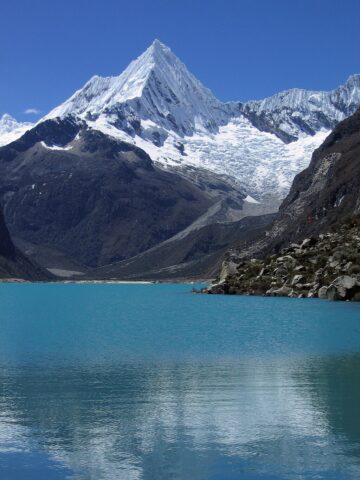
The heartland of the Chavin culture (Creative Commons Licence). Not a flat river flood plain!
This in turn led to the development of a dense system of trade routes, both locally and across longer distances. It also gave rise to several communities pooling their labour, not only to transport goods (on the backs of humans), but also to construct the miles and miles of stone terraces – and the associated water channels – needed to grow crops on the steep mountain slopes.
As a result of all this, the Chavin people were accustomed to labouring on multi-communal projects and in carrying heavy loads to distant locations. But how could this situation have given rise to the amazing stone structures whose remains can still be seen at Chavín de Huántar?
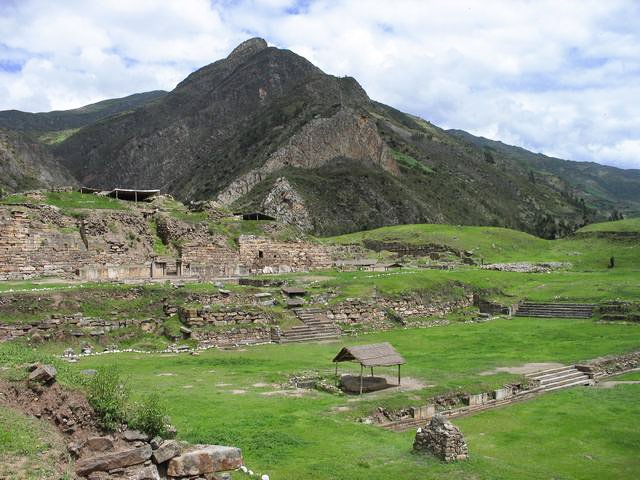
Ruins at Chavin de Huantar (Creative Commons Licence)
What scholars think may have happened was this. For reasons outlines above, the local people had developed a cultural disposition to co-operate intensively with one another. This would have been underpinned by a belief system that encouraged a high level of communal trust, sharing and co-operation. A class of priests were thus able to build on this. Based at Chavin, which was located in a natural passage through the Andes which linked the Amazon basin to the east with the Pacific coast to the west, they could tap into multiple ecological zones. Chavin never became a true city; it was instead a major ceremonial centre, served as a kind of inter-regional pilgrimage and trade hub. It was thus able to extend its ideological and cultural influence for hundreds of miles around, drawing numerous communities into system in which they contributed their labour and shared their surpluses on a large scale, and to build the astonishing structures at Chavin.
Conclusion
Both the Olmec and the Chavin cultures produced large constructions and striking artworks. But neither gave rise to large cities, nor, so far as archaeologist can tell, to powerful, centralised states. Rather, they depended on religiously-sanctioned exchange networks, which in both cases came to embrace areas hundreds of miles across.
Both the Olmec and the Chavin were thus able to tap the resources of distant peoples, and also to exert a considerable influence on their cultures (and presumably belief-systems). In many ways, these were not civilizations in the sense that Ancient Egypt and other cultures of the Old World were; however, on their own terms, they were both highly successful cultures which endured for many centuries and had a large impact on the civilizations which came after them.