
The earliest civilizations (in the Eastern Hemisphere at least) all arose in river plains – the Euphrates and Tigris in Mesopotamia, the Nile in Egypt, the Indus in South Asia and the Yellow River and Yangtze in China.
This is because large rivers flood these plains in spring, and deposit their loads of fertile silt they have brought down from the mountains, thus create very fertile soils.
Also, once the population who live on these plains have developed irrigation systems to hold back the flow of flood water, so that their cops can be watered throughout the growing season, these areas produce abundant crops with can feed huge numbers of people. Populations grow and become more concentrated, villages expand into towns and towns into cities. Gradually great civilizations emerge.
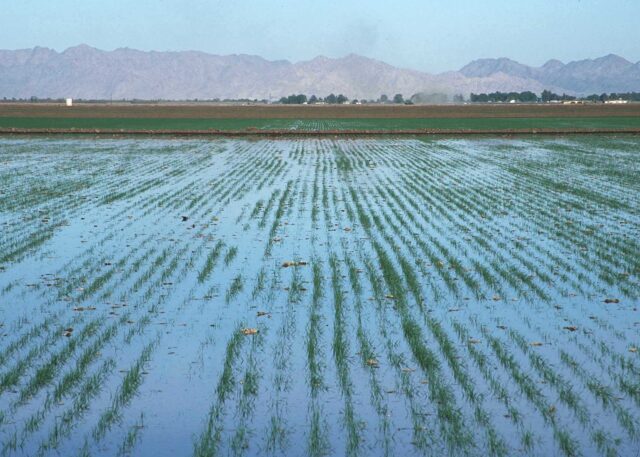
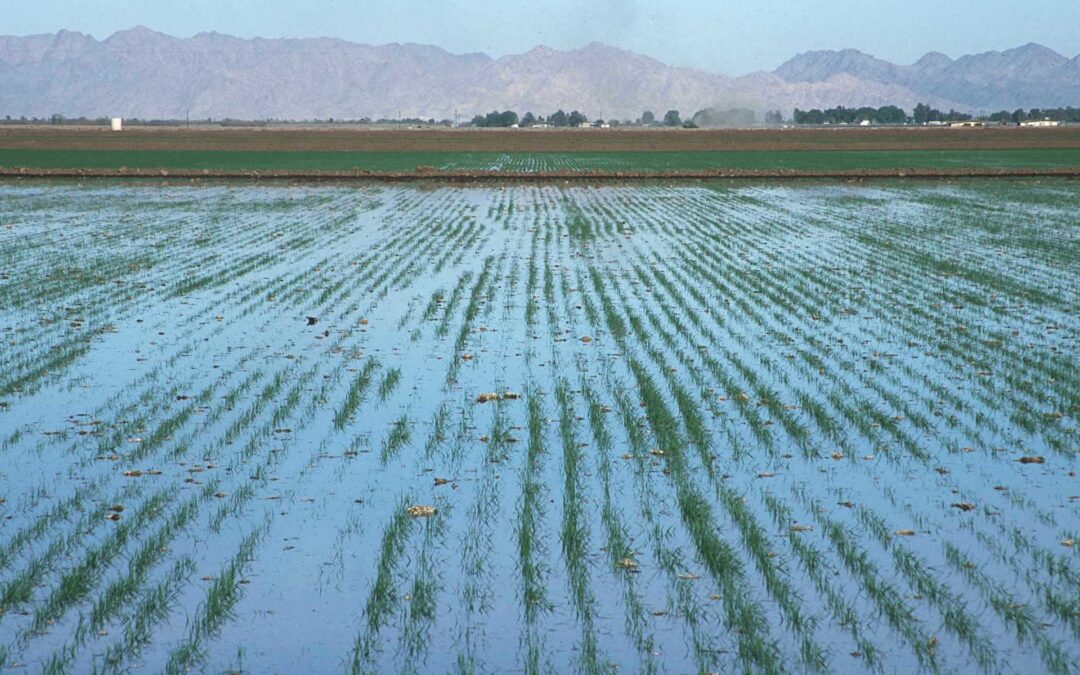
Irrigated fields in the Middle East (Public Domain)
The above very brief account leaves out many subsidiary factors, but is enough to show why the floodplains of great rivers were the homes to the great civilizations of the ancient world. And it prompts us to ask – how did civilizations take root in areas where the soil was not so fertile, and populations could not become so concentrated?
The short answer, according to historians, is trade.
Trade and towns
As civilizations developed, trade routes stretched out from their homelands into surrounding territories. In the case of the earliest civilization to form, for example, the Sumerians of southern Mesopotamia had a growing need for wood for construction, and later copper and tin to produce bronze weapons and other artefacts.
Sumerian traders probed northeast, up the Euphrates and Tigris rivers and on into Syria and Asia Minor and down into Palestine. There they met traders coming from Egypt, and with them formed one of the key trade routes of the ancient world. Eastwards they travelled into Iran and on into northwest India.
As the traders traveled ever further, they established trading posts along these routes. These trading posts attracted more traders, and small towns grew up – the first trading colonies in history. The Sumerian traders brought with them their own culture and technologies – their art, architecture and religion, along with techniques such as building in durable materials, and most importantly, literacy. In short, these small urban centres became showcases of a more sophisticated culture, and a channel through which new techniques could reach an ever-widening area.
Specialisation
A number of more subtle influences would have followed, as, over time, local economies were transformed in crucial ways. Before the arrival of the Sumerian traders, local peoples would have been more or less self-sufficient. The villages would have produced all their inhabitants needed to sustain themselves. The presence of the newcomers, however, would have modified this situation substantially. The root cause of these changes was that the new towns would have acted as centres of consumption, and so established a market for local produce.
This would have made it far easier for local people to buy and sell produce, not only with the traders but also amongst themselves. This in turn would have encouraged specialisation within the local populations. Until now, every village would have had to grow its own food, make its own bread, process its own meat, manufacture its own pottery and so on. Now, however, the presence of a market in the nearby town would have allowed some people to specialise in craft work, becoming (for example) professional potters, leather workers and metal smiths. The majority would have continued to work on the land, but they could now focus their efforts much more on this activity, and not have to devote themselves to such a wide range of other tasks was well. They could therefore increase their farming productivity and grow more food.
Farmers would have been encouraged to do this by the presence of the local market, where they could trade their surplus produce in exchange for pots, leatherwork and so on – maybe even a few luxuries rom far away.
New crops, new land
Furthermore, the local market would have enabled farmers to break through the constraints of having to grow all their own food themselves, by swapping what they grew in exchange for produce grown by others. They could therefore now focus on growing what the soil of their own plot of land was most suited for, be that wheat, barley, peas, beans or whatever. They could buy what they hadn’t grown at the town market.
This would have made all farmers more productive, and even helped them to bring more marginal land into cultivation. On dryer ground, for example, they could raise crops which would have not been economic for them to grow before, such as olives and vines. The area of cultivated land would thus have been expanded.
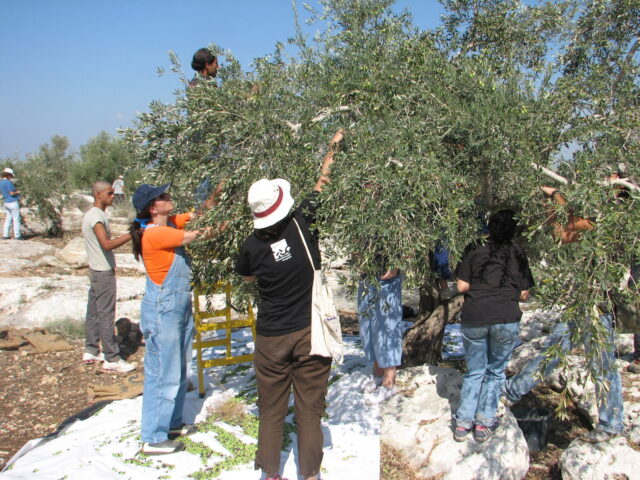
A photo pop a modern olive grove in the Middle East, clearly showing the dry soil in which these crops can flourish (Creative Commons Licence).
By the same token, local nomads would have been able to benefit from exchanging their animal products (meat, hides and other things) for grain or manufactured items.
Over time, these changes would have led to an increase in the local population, with more productive farming allowing more mouths to be fed.
Cheaper transport
The effect of all these factors would have been boosted by less expensive transportation. Whereas villages, with their small numbers of inhabitants, would mostly have attracted traders coming by foot or with donkeys, larger settlements would have made it worthwhile for them to bring their products to market in boats.
Water transport was far more efficient than land transport (and would remains so until the coming of railways, thousands of years later): boats can carry several tons of cargo much more cheaply than donkeys can. So river (and later canal) transport would have greatly lowered the cost of trade.

Silver model of a boat discovered at the ancient Sumerian city of Ur (Public Domain).
Even more so, sea-borne trade, operated by much larger vessels usually powered by sails and travelling far greater distances, super-charged the growth of such centres as Byblos and Ugarit on the Syrian coast, and Knossos, on the island of Crete. Their ships travelled far and wide over the eastern Mediterranean, and were able to tap the surplus products of many coasts and their hinterlands. Their activities stretched from Egypt, Syria and Asia Minor in the east to Sicily, Italy and possibly France and Spain in the West. The highly sophisticated Bronze Age Minoan civilization was built on the back of this trade.
New states
A final impact of the spread of trading towns around the ancient world was political.
With their much larger populations (including professional soldiers) than the surrounding villages, these urban settlements would soon have gained control over wider areas. They would thus have been able to extract – by force of necessary – a surplus from the farmers of the local countryside. In time, they would have formed a new city-state – at first small but gradually expanding to form sizeable states, such as the Hittite Empire of Asia Minor.
A by-product of such processes would have been that the farmers in the villages enjoyed a much higher measure of protection from raiding nomads or rival villagers. It seems likely that, before the rise of organized states, villages would have existed in a condition of chronic insecurity. With the rise of new kingdoms in place of tribal or clan-based societies, a new measure of security would have prevailed. Villages would have been able to concentrate better of peaceful activities, including their work as farmers.
So, this brief account outlines some of the mechanisms that would have been in play by which urban, literate civilization spread beyond the river valleys. And this of course was a process which would go on and on, right up to the present day, as more and more people were drawn into the world of cities, commerce, education and so on.