
Sometimes, historians have to deal with topics which are way outside their natural field of knowledge. For me, one such topic is horse riding.
The only time I have been on a horse’s back was when I was about seven years old. A man with a horse came one day to a park near where my family lived and offered rides to children for a small amount money. Myself and my brother went along and had a go.
It was not a success. When it came to my turn, the man heaved me up (it seemed like an enormous animal) and I went right over its back and had to clutch onto its reins and saddle to stop myself from falling off the other side. I eventually got myself up and reasonably comfortable, and trotted around for a bit – but when the time came to dismount, gravity again took over and I fell off. I wasn’t hurt, but I thought to myself that horse riding wasn’t for me.
A starring role in world history
But horses have played a huge part in history. It’s not going too far to say that they have profoundly shaped society. Not for nothing were Roman aristocrats called equites (horsemen) and French aristocrats chevaliers (ditto). Horsemanship conferred status on upper class individuals, which ultimately derived from advantage in war. A man on horseback was faster and more mobile than a foot soldier, and of course fought with the benefit of height. Keeping horses was expensive, and so only the richer members of society could do this. All this meant that horse-riding went hand in hand with elite status. You just have to think, “Knight in Shining Armour”, to get my drift.
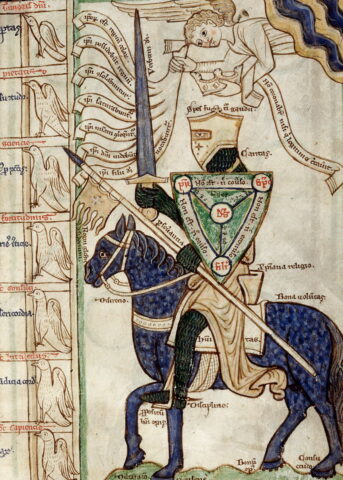
A contemporary image of a Medieval Knight (Public Domain)
Now, I would have thought that stirrups were fairly important when riding. And I’m not the only one who thinks this. My new go-to source of knowledge about practically everything, ChatGPT, agrees with me: “Yes!”, it says, “Stirrups are crucial for horse riders because they provide stability, balance, and control while riding.”
So, there you have it – there could be no higher authority. And yet, it took hundreds of years for this simple piece of equipment to be invented.
Stirrups – a vital piece of equipment?
Horses were first domesticated in around 4000 BCE. This was on the steppes of Ukraine and Russia. But it wasn’t until thousands of years later, in around 200 CE that the earliest proper stirrups were invented. This was apparently in China, where soldiers developed the stirrup in order the meet horse-riding invaders from the steppes of central Asia on a more equal footing (no pun intended).
From China, the stirrup spread to other regions, but didn’t arrive in Europe until the early Middle Ages, maybe 700 CE.
To a layman like me, this is astonishing. Horse-riding was a well-known practice of the Greeks and Romans, for example – their upper classes fought on horseback. Did they really do this without stirrups? Well, you can see that they did from this image of an equestrian statues of the emperor Marcus Aurelius.
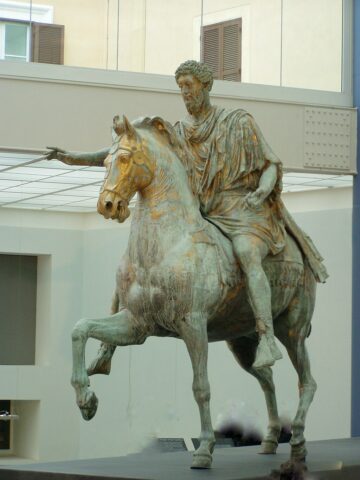
Statue of the Roman Emperor Marcus Aurelius (reigned 160-182 AD), showing him riding without stirrups. (Public Domain)
At first I thought I could see a stirrup. However, the Wikipedia article about it (as of March 2025) says specifically that the emperor is shown “riding without the use of stirrups.” A magnified version of the image does indeed show that this is indeed the case.
The historian Lynn White argued that the stirrup was developed to enable warriors on horseback use lances, as they could then out their whole weight behind this large, heavy weapon. This seems to make sense to me. Other scholars, however, have apparently shown that you can use a lance perfectly well without stirrups. Indeed, reliefs from ancient Iran show catafracti (heavily armoured horse soldiers) using lances against each other, without a stirrup in sight.
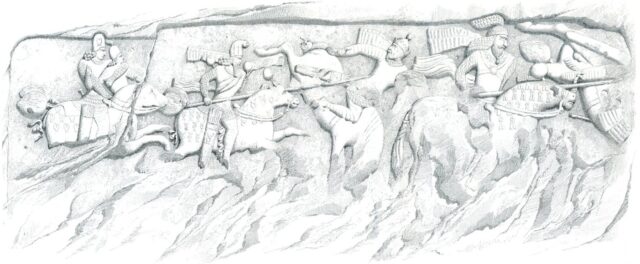
Relief from Iran showing Persian catafractii (heavily armoured horse soldiers) in battle (Public Domain).
So, why did stirrups take so long to be invented? Well, as a non-rider, the first thing I can think of is that stirrups weren’t – and aren’t – as crucial as some, including ChatGPT, have argued. I don’t want to cast aspersions but I have to ask, has ChatGPT ever ridden a horse? Probably not.
An enduring impact
However, Wikipedia does suggest a good two-part answer to this question. The first part is that the stirrup was preceded by a development called the “toe-stirrup”. This seems to have been invented in India hundreds of year before the full stirrup was developed, perhaps as early as 500 BCE. This was made of fabric, and must have given some stability. It presumably needed the rider’s feet to be without shoes on, and sounds rather uncomfortable – I assume it involved your whole body being balanced by your two big toes.
The second part of Wikipedia’s answer is that the coming of the proper stirrup had to await the development of a “tree” saddle.
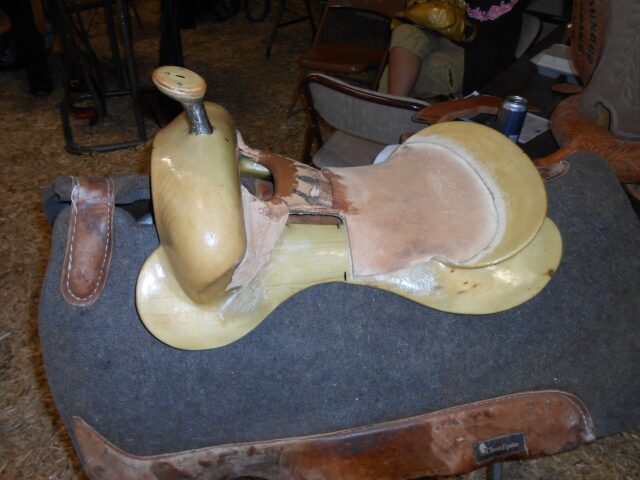
Photo of a Tree Saddle (Creative Commons Licence)
This is a much stouter saddle than earlier ones, with a hard wooden support in front of the rider. It was this innovation, rather than the stirrup, which (it is argued) allowed riders to hold heavy lances, and also allowed metal stirrups, which need to be firmly attached rather than just toed on, to become a part of the overall equipment of the mounted soldier.
At least, that is how I understand it. And this change was also made in China, so it seems to fit in with the general scheme of things.
Whatever the reason for the development of the true stirrup, there seems to be no doubt that it was part and parcel of a package of innovations (including saddles and bits) which led to the rise of the medieval knight, which so profoundly shaped society during the European Middle Ages. And this, of course, shaped the development of Western civilization right up to the modern day, long after horses have departed the battlefield.