
So far as places go, Venice and China are in many ways – in most ways – complete opposites. Venice is a small city; China a vast country. Venice isn’t even a state in its own right; it belongs to Italy. China is one of the most powerful states in the world. Venice is situated on tiny islands set in the midst of the sea; China is essentially an enormous land mass.
They have dramatically contrasting pasts. Venice was a small maritime republic (and yes, in the past it was indeed an independent state); China was a huge, land-based monarchy. Economically, Venice depended on the sea and derived its wealth from ship-borne trade. The Chinese, with they Confucian mindset, rather disparaged trade.
A tale of two canals
But in one thing they were similar. They both had Grand Canals running through them.
Or at least, they both had waterways which were labeled “Grand Canals”. But there the similarity ends. For Venice’s was less than two miles long, while China’s was more than a thousand miles long.
Unsurprisingly, China’s was by far and away the more consequential of the two. But did it actually do China any good?
A long history
It was certainly one of the most remarkable engineering achievements in human history; and its roots go back more than 2,500 years.
The Chinese began building canals – or at least, canals began to appear in China’s historical record, though they almost certainly date back to well before this – in a time traditionally labelled the “Spring and Autumn” period of Ancient China (about 770 to 476 BCE). These were all small, local canals, whose main purpose was for irrigation. Nevertheless, they were also used for transporting goods; and some of these small waterways are still in existence – as segments of today’s Grand Canal.
In the following “Warring States” period (476 to 221 BCE), new canals were dug and older ones were widened and lengthened, and their transport function became more prominent – including the movement of armies from one area to another. Once China had been unified under the Qin (221 – 207 BCE) and Han (204 BCE to 220 CE) dynasties, canals were dug specifically for transport purposes. Under the Han in particular, canals played a vital role in keeping “ever-normal” granaries well stocked, to ensure against famine in different parts of the country.
A unified transport system
Under the Sui dynasty (581-618 CE) a major effort was made to integrate all the rivers and canals in China into a single unified system of waterways. The founder of the dynasty, the emperor Wen, had ended a centuries-long period of division in China by bringing all its regions under his rule. With admirable foresight, he realised that a unified system of inland transport would make a vital contribution to the political unity of the country.
Sadly for his dynasty, the work involved in constructing the various segments linking the hitherto separate canals and rivers together was so onerous for the millions of workers employed on the project, that they rose in revolt and helped bring about the fall of the Sui.
Yes, it did do China a lot of good!
The succeeding dynasties, the Tang (618-909 CE) and Song (979-1279), however, reaped the benefit from the new canal system, or Grand Canal as this vast system came to be called called.
The canals required constant upkeep – maintaining dykes and canal walls, and dredging canal bottoms to ensure vessels could pass undisturbed. But the wealth that it brought was immense. In Tang times, many vibrant commercial towns began growing up along its course, and grain was transported in bulk hundreds of miles from where it was grown to where it was needed (the cities of central and eastern China). This was the first time in history that bulk transport operated at such a scale between inland locations. Furthermore, the extension of the system to the southern ports of China meant that goods from inland regions right across China could be brought for export to distant lands. This boosted the manufacture of porcelain and other manufactured goods, and stimulated the trade in silks, and later tea.
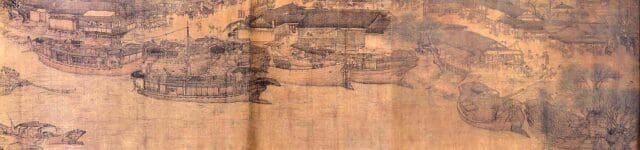
A detail of the famous Song painting of the Qingming Festival, showing river boats on the Grand Canal (Public Domain)
I’m not sure that anyone has estimated the economic gain that Tang and Song China enjoyed as a result of the trade carried along the Grand Canal system, but it must have been very significant. When one looks at Chinese history as a whole, one gets a strong impression of a transition from one economic level to another in the centuries around 1000 CE. This steady upsurge in the Chinese economy was reflected in expanding Townsend cities, deepening trade networks, the appearance of such innovations as printing and new agricultural techniques, and their spread around the country, the spread of paper money, the growth of urban commercial classes, and Chinese merchants becoming much more involved in maritime overseas trade (referred to in my post on the invention of the compass). China at this time undoubtedly had the largest economy in the world, by a stretch; and its influence was felt far and wide. Chinese ceramics became popular as far afield as Persia, and these did not come via the overland Silk Road but by the sea-route across the Indian Ocean.
Actually, there is plenty of evidence of a general increase in trade and urban growth right across the lands bordering the Indian Ocean, and indeed the Mediterranean. I wonder how much of this was due to the stimulus created by increased demand from an expanding Chinese economy.
Given all this, it is hardly surprising that the Grand Canal was by far the busiest inland transport system in the world at this time.
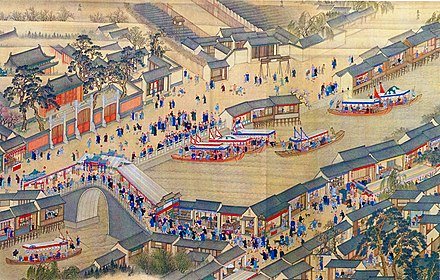
The Kangxi emperor on a tour of southern China, travelling along the Grand Canal (Public Domain)
Enduring bounty
During the later dynasties of imperial China, the Yuan (1279 to 1368), Ming (1368 to 1644) and Qing (1644 to 1911), the Grand Canal continued to expand. The Mongol Yuan dynasty extended the system to the north, to supply their new capital, Beijing, with grain and other goods. At times of disorder, when dynasties were weak, such as in the later years of dynasties, poor maintenance meant that the waterways had a tendency to silt up, even get washed away in huge floods. This of course badly disrupted trade. But when dynasties were strong and maintenance was carried out regularly and diligently, the canal fulfilled its immensely important economic function of unifying China. It was only in the nineteenth and early twentieth century, when the Qing dynasty was in long decline – but also when railways were beginning to siphon off trade from the inland waterways of China – that the Grand Canal gave up its crucial role as the beating heart of the Chinese economy.It is however still very much in use today.
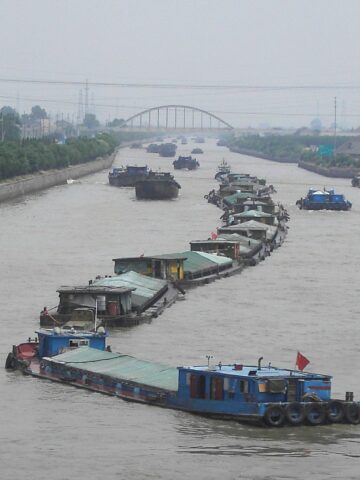
The Jaingnan sector of the Grand Canal (Creative Commons)
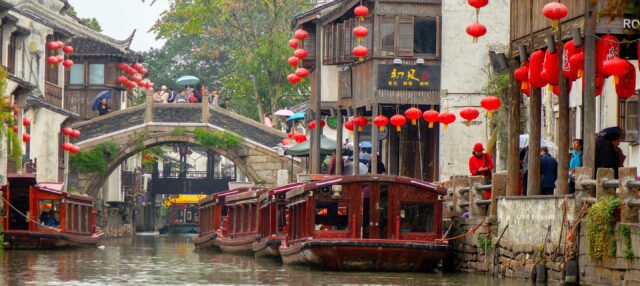
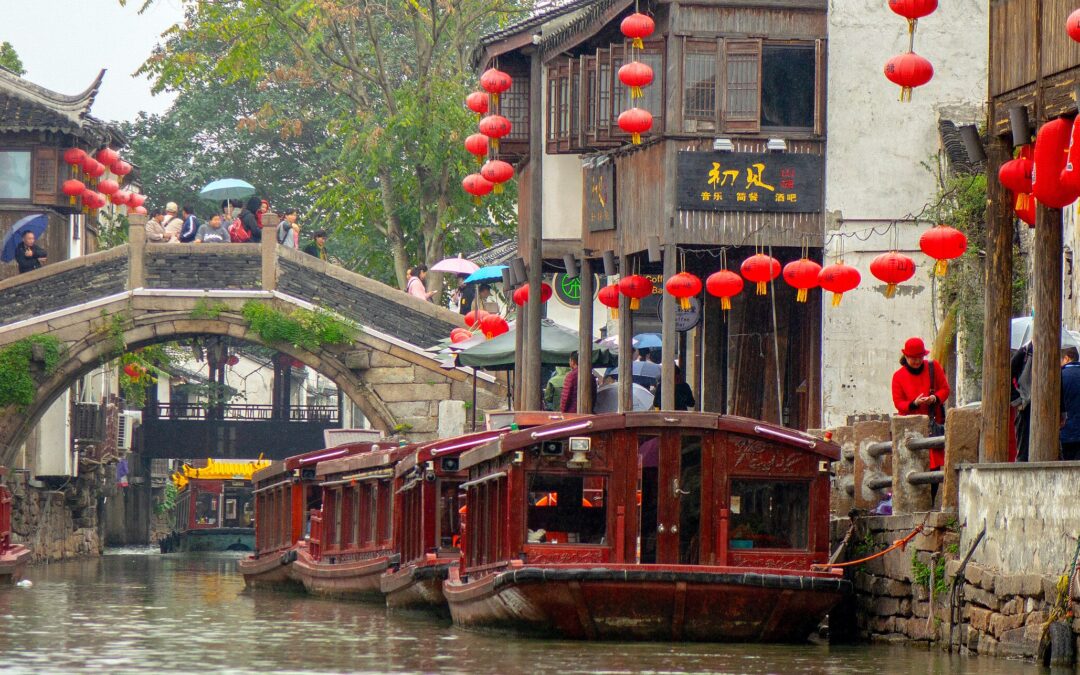
The Grand Canal passing through the city of Suzhou, in southern China (Creative Commons Licence)
So, yes – the Chinese Grand canal was indeed more consequential than its Venetian namesake. And yes, it did indeed bring huge benefits to China.