
Didn’t Jesus and his disciples speak Hebrew, and therefore write in Hebrew?
Well, not Jesus personally, nothing from him actually survives in writing, and there’s no actual evidence that he wrote anything down himself.
And, come to think of it, probably not his disciples, either. Most theologians today don’t think that any of the twelve apostles actually wrote any gospels themselves, even the ones (Matthew and John) which are named after them.
However, many theologians think that the disciples’ followers did write down, if not the gospels themselves, then the documents that became the basis for the Gospels.
And in any case, even while the disciples were still alive and active, St Paul and maybe others were at work, writing letters which would later form an important part of the New Testament.
So, anyway, to get back to my original point – why weren’t the Gospels written in Hebrew, since obviously the people who wrote them spoke Hebrew?
So, if not Hebrew, what?
Well, not quite true. Jesus and many (if not all) of his disciples almost certainly did speak Hebrew. They will have used it in their worship, especially when they went to the temple in Jerusalem. Also, the Hebrew Bible (the Christian’s Old Testament) was an important part – sorry, I’ll rephrase that: was THE MOST important part – of their culture. And not only did Jesus speak Hebrew, he is recorded as reading the Bible in the synagogue (Luke 4,16).
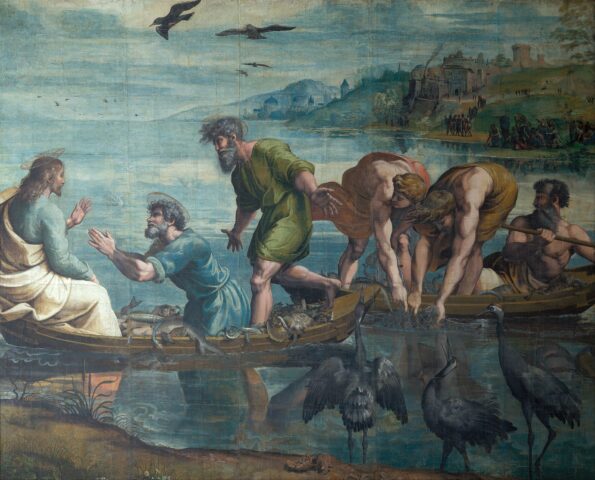
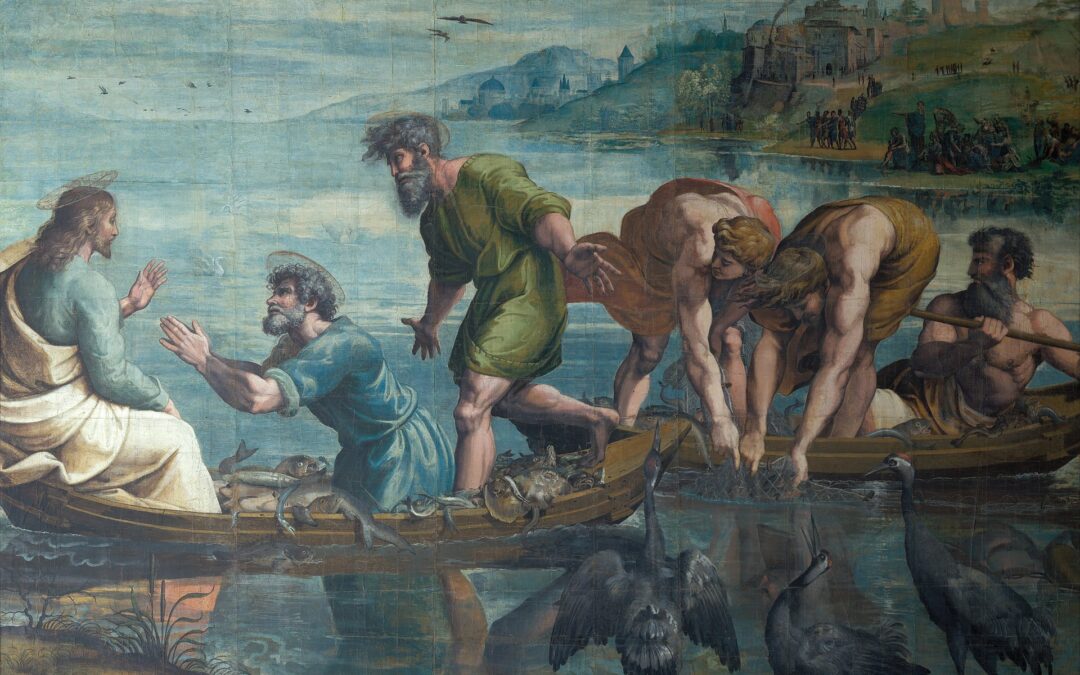
Painting by the Renaissance artist Raphael of Jesus calling his disciples from their work as fishermen on the Sea of Galilee (Public Domain)
Nevertheless, he and his disciples would not have used Hebrew in everyday speech. This would have been Aramaic. They would have both spoken it and written in it.
Why Aramaic?
So where did Aramaic come from and why did they speak it?
Aramaic is a language closely related to Hebrew, Canaanite and other languages belonging to a branch of the Semitic stock of languages known as Northwest Semitic.
It was originally the language of the Aramaens, a group of nomadic tribes who had lived in the Syrian desert (which located in eastern Syria). In the late second millennium and early first millennium BCE, they had expanded outwards from their homeland and conquered several small kingdoms in today’s central Syria and northwest Iraq. The best-known of these was Damascus (the modern capital of Syria).
In the 9th and 8th centuries these Aramaean kingdoms were all conquered by the Assyrian Empire (or as some modern scholars would have it, the “Neo-Assysian” Empire, to distinguish it from earlier powerful kingdoms in the same area) early on in its expansion. As anyone who is familiar with the Old Testament will know, this aggressive state practiced a policy of uprooting conquered populations and resetting them far from their original homelands. So a lot of Aramaic-speakers were forcibly resettled in Assyria and other places scattered around the Assyrian domains.
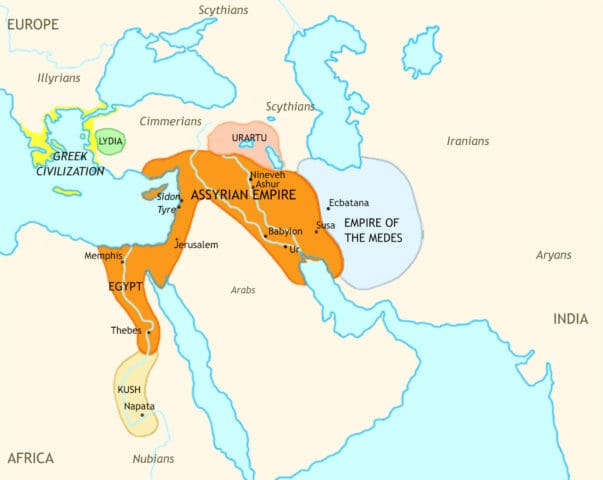
Ancient Middle East 664 BCE, showing the Assyrian empire at its height (Timemaps Atlas of World History)
This policy had the effect which the Assyrians were looking for – it destroyed local kingdoms, cultures, languages and loyalties. But it also had another result, presumably totally unlocked for by the Assyrian imperialists. As local populations lost their own languages, they picked up a new one, Aramaic. Even the Assyrian themselves soon came too be speaking Aramaic in everyday life, not their original tongue, Akkadian.
So this is how Aramaic came to be spread right around the Middle East (you can read more about this and its effects in our article on the Ancient Middle East).
Anyhow, to rephrase my original point – since Jesus and his disciples used Aramaic everyday, surely the New Testament was written in this language?
And if not Aramaic, what?
Nope. Because by the time Jesus, another language had become the lingua franca of the Middle East. Or at least, one of the lingua francas (though shouldn’t that be lingua francae?).
This other one was Greek, and this was the tongue spoken by the upper classes of the region, and in fact of of all the lands bordering the eastern Mediterranean Sea.
Why was this? The answers lies three hundred years before. In the 320s and late 330s BCE, Alexander the Great conquered the whole of the Middle East – Asia Minor, Syria, Judaea, Egypt, Mesopotamia…the lot.
Why Greek?
Alexander was the king of Macedonia, a state just to the north of Greece. Here, the local language was a dialect of Greek, barely intelligible to the inhabitants of the Greek city-states to the south. Indeed, whereas the Macedonians thought of themselves as Greeks (sort of), the Greeks of Athens, Sparta, Corinth and all the other city states tended to look down on them as half barbarian.

The entry of Alexander the Great into Babylon, by the painter Charles le Brun (Public Domain)
Be that as it may, Macedonia had become a powerful state, and under Alexander’s father, Philip, came to dominate the rest of Greece. So, when Alexander set out to conquer the Middle East, in the early 330s BCE, his army was as much Greek as Macedonian, and was entirely Greek-speaking.
Alexander himself was steeped in Greek culture (he had been tutored by the greatest Greek philosopher of the day, Aristotle) and pursued a conscious policy of planting Greek colonies wherever his army went. Many of these thrived, and several – notably Alexandria in Egypt, Antioch in Syria, Seleucia in Iraq (this one founded by one of Alexander’s successors, Seleucus) – became the leading cities of their day.
These and other Greek colonies became nodes from which Greek culture spread outwards to the upper classes of the local populations. By Jesus’ day, this was a process that had been going on for more then three hundred years, and anyone who was anyone – and a lot of people who were no one – spoke Greek and were members of a half-Greek, half-Asiatic culture to which modern scholars attach the label “Hellenistic”.
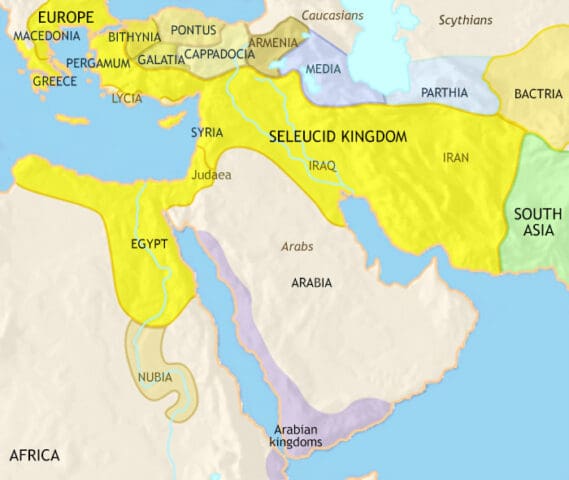
Map of the Middle East in 200 BCE, after Alexander the Great’s conquests (Timemaps Atlas of the World)
Indeed, Jesus seems to have been able to at least understand some Greek. To his disciple Simon he gave the name “Peter”, i.e. “Petros” in Greek, meaning “rock”. Another disciple, Thomas, was called “Didymus”, which means “the twin” (although, this being a direct translation of the Aramaic word for “twin”, this may have been the name be which he was later known once his missionary work outside his homeland had begun).
Jesus also seems to have been able to converse quite naturally with non-Jews like a Phoenician woman and a Roman centurion, who would both have been Greek speakers. And of course, the Roman governor, Pontius Pilate, would, like all educated Romans, have been able to speak Greek fluently (and not so educated Romans as well; it is reckoned that if you wandered through the city of Rome at around this time you would have heard Greek spoken more than Latin).
A multilingual population
So in Galilee and Judaea, at least three languages, Hebrew, Aramaic and Greek, were all spoken, with Aramaic being the most common. Each of these came to the region at a different point in history, and as the result of seismic historical events. The linguistic situation here was a bit like a layered cake, reflecting the development over time pf the region. In some parts of the Middle East, the linguistic story was even more complicated – in southern Iraq, for instance, the people spoke first Sumerian (by Jesus’ time a long dead language), Akkadian (which was still used, but mostly by temple priesthoods in ceremonial situations), Aramaic, Greek and Iranian (Iraq was ruled at the time by an Iranian people called the Parthians).
Koine Greek
Anyhow, to return once again to the question posed in the title of this post, the answer is that, by the time the New Testament was being written, Greek had spread right around the Middle East and through all the lands of the eastern Mediterranean. By this time it wasn’t only the elites who spoke Greek; many ordinary people did too. In fact a “common” Greek dialect – Koine Greek – was spoken very widely, particularly in the cities of Asia Minor. It was amongst these that Christianity began to take root in the generation after Jesus’ disciples, thanks largely to the preaching of St Paul. It was natural that the language used by the writers of the New Testament was the international language of the day.
No doubt some of you will by now be asking, so what about Latin? This was the language of the Romans, the rulers of the huge empire of which Galilee and Judaea (the places where Jesus and his disciples lived) were just a small part. If Aramaic had been spread by one imperial power, the Assyrians; and Greek had been spread by another imperial power, Alexander and his successors, had the Romans not spread their own language around?
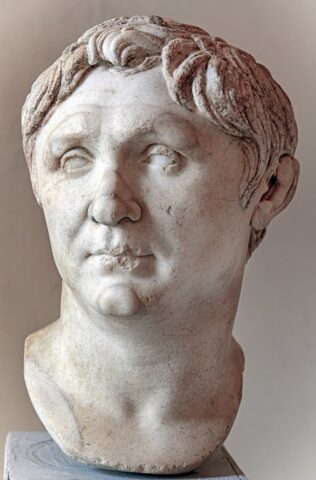
Bust of Pompey the Great, the Roman general who conquered Palestine (Museo Archeologico Nazionale, Venice – Public Domain)
The answer is yes, very much so – but only in the lands bordering the western Mediterranean did it take root. In the eastern Mediterranean, Greek persisted as the language of the elites, and to a large extent of government. The Romans adapted themselves to this situation instead of the local populations adapting themselves to the Romans. This happened because, by the time the Romans came to these lands, they were already deeply in thrall too Greek language and culture.
Please click here for more on the history of Palestine in the Ancient World,