
Do any other historians think about the future, I wonder – and look to the past for clues as to what might unfold?
I confess to doing that now and again. I definitely do NOT try to predict the future. As some wag said, “You can predict everything, except the future”. There are so many variables in play that it’s a bit like predicting what the pattern of the waves on the sea will be like at a certain beech tomorrow at noon.
Nevertheless, I want to take you on a thought experiment which might help draw you to one aspect of “future-on-the-basis-of the-past” speculation which I find quite interesting.
A thought experiment
Let’s imagine that there will be as much progress in the next 1000 years as there has been in the past 1000 years.Speaking as an English person, that takes us back to the last decades of Anglo-Saxon England.
At that time, the vast majority of England was very rural. Wild forests covered much of the landscape, but every now and again there would be a small settlement of rickety cottages. There might be a wooden hall where a local lord lived with is family and retainers.
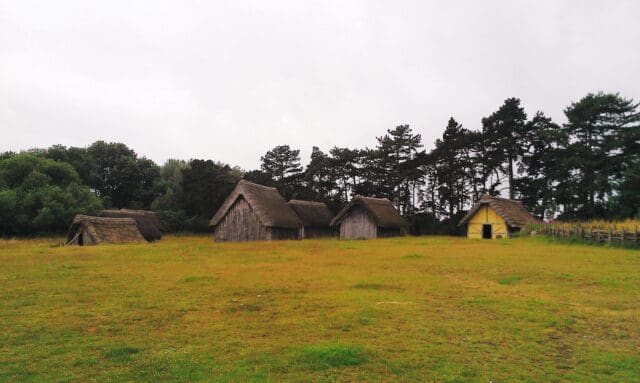
The reconstructed Anglo-Saxon village at West Stow, England (Creative Commons Licence)
Most people lived in a style not very different from their Iron Age ancestors, a thousand years before. If we could be transported back there, we would be shocked at the level of poverty, but the inhabitants would take that as the norm. Beggars would be a common site, and most people over the age of thirty would look like old people. Many would have unsightly deformities from untreated injuries they had accumulated throughout their hard lives.
Most laboured in the fields surrounding their settlement. The roads between the villages would be dirt (or on rainy days, mud) tracks. Most villages would have been at east a days’ travel from the nearest proper town. This would have looked to us more like a shanty town of shacks and lean-tos, with narrow dirt lanes between the dwellings. And the stench from the waste (including human waste) strewn around on streets and public spaces would have been hard for its to stomach.
If a settlement had more than a thousand people in it would have been regarded as a large town, even a city. The third largest city in the whole of England, Lincoln, had 5,000 people – the size of the village I live in now. London, by far the largest, had ten thousand.
The vast majority of people we met would have been completely illiterate – the ruling class almost as much as everyone else. In fact, we would probably look at the aristocrats and warriors, who dominated English society at that time, as little more than thugs.
Only a few clergyman received what would have looked to us as having had anything like a proper education (and most village clergy would have been as uneducated as their flock).
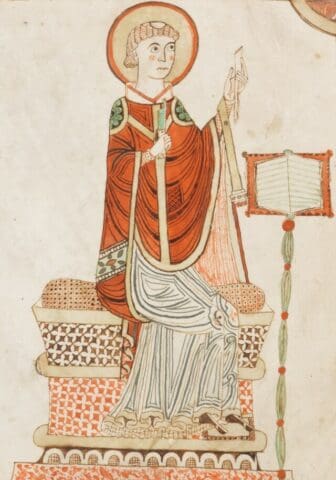
Oddly enough, one of the very few Anglo-Saxons who were literate was one of the greatest writers in English history – the Venerable Bede (Public Domain)
We moderns would have been traumatised by the levels of disorderliness we would witness, in both towns and villages. Justice was rough and ready – this was the age of the “hew and cry”: if a person was seen stealing something, a cry would go up and a crowd would quickly form to chase them and beat them to pulp. More formal justice was sought by means of the “trial by ordeal “ – for example, throwing someone into a river and if they floated they were guilty (yes, you work that one out, I can’t!).
Well, that gives something of the flavour of England a thousand years ago. I’m sure many of you are as familiar with this as I am. It cannot be emphasised enough how almost unimaginably different it was from the England of today.
Which, in the thought experiment I am indulging in, means that, if there’s as much change in the next thousand years as there has been in the past, life in that future will be almost unimaginable to you and I.
Not all thousand year gaps are the same!
There is a big “but” here, though. If, for example, we had gone back to China instead of England, we would have been confronted by a society that looked far more like our own.
In many places we would have encountered a densely populated landscape, filled with farms, villages and towns. And these would be towns surprisingly like those were are familiar with. By the year 1000 China had several cities of over a million inhabitants (a hundred times the size of London at that time). All Chinese towns would have had busy shopping streets, banks where paper money was issued, public parks, spacious avenues, imposing mansions, well-constructed government buildings and beautiful temples. Its upper and middle classes, who made up a sizeable portion of the population, were highly educated (even by our standards). Printing presses turned out masses of books on a huge range of subjects. The country was governed by public officials who were selected by a series of tough exams, and promoted on merit.
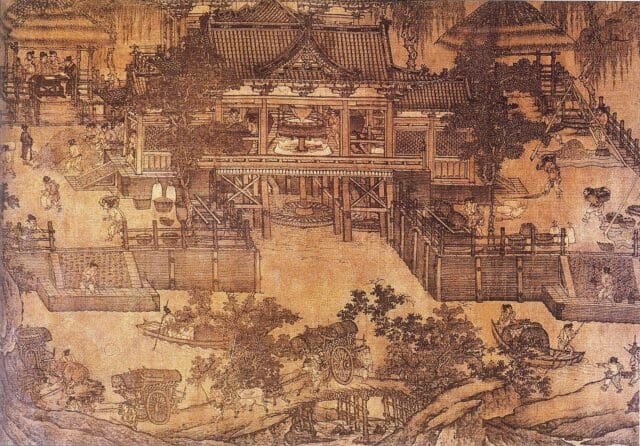
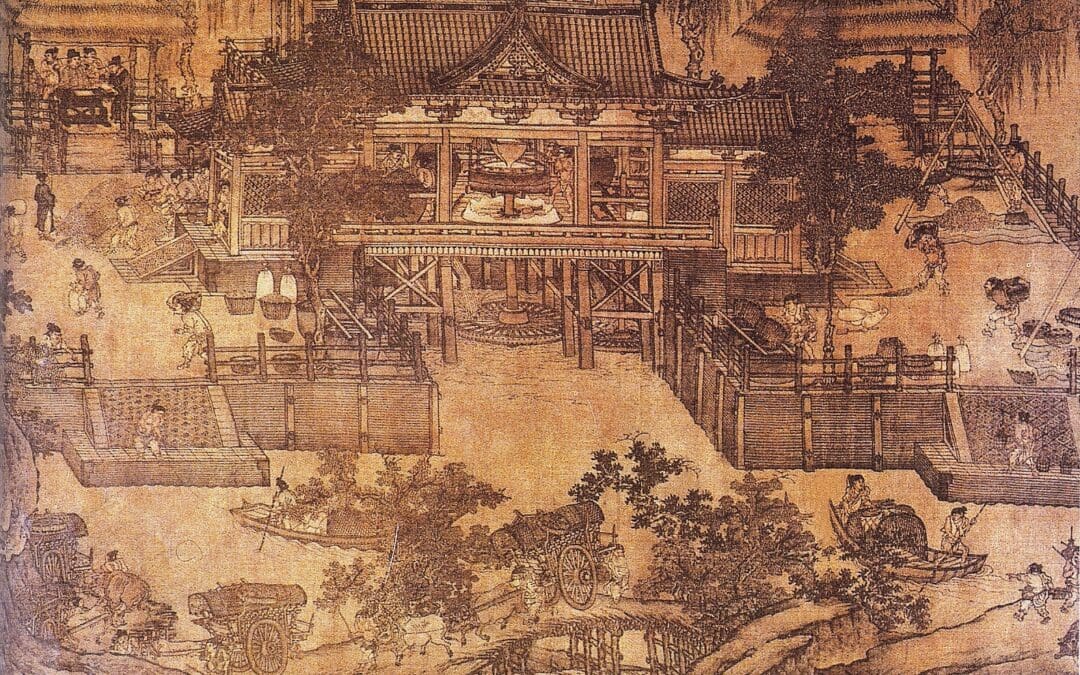
A town scene from Song Dynasty China (the Song ruled in China from 979 to 1279 CE) (Public Domain)
If, a thousand years ago, someone had been whisked instantaneously from England to China, they really would have felt as of they had been transported to a different age. We, on the other hand, would have found plenty for us to recognize. China of 1,000 years ago was more like the England of 150 years ago than the England of Anglo-Saxon times – and in 21st century England a lot of buildings date back 150 years to the Victorian era.
So, if our vision the future assumes that there will be as much change in the next 1000 years as the past 1000 years, the question is, where’s our starting point – England 1000 years ago, or China 1000 years ago?
Our answer makes a lot of difference to what we think the future will look like. Would we find a society as unrecognizable to us as an Anglo-Saxon would find our society? Or would we find plenty of things that were familiar to us, in amongst the the amazing gizmos our 31st century descent will take for granted?
Questions for historians
As a historian, though, I think the most interesting thing about this thought experiment is that it helps us understand how advanced China was at that time compared to most other parts of the world.
And this raises two questions: The first is, Why was this? What were the historical forces causing the Chinese to become so sophisticated, so civilized? And the second question is, What were the historical forces that would lead, several hundred years later, to the Industrial Revolution beginning in Britain, and not China?
This is one of the biggest debates in history, and something for another post.