
Along with the Aztec Empire and the Inca empire, Maya civilization is probably one of the three civilizations which most people have heard of from Pre-Columbian America. Of all of them, indeed, it was the Maya who are widely recognized as reaching the highest levels of achievement in many fields, such as math, astronomy, literature, architecture and sculpture.
The collapse of Maya civilization is one of the great unresolved debates in archaeology. What gives it its particular frisson is that, unlike, say, the fall of the Roman Empire, almost the entire population disappeared along with the cities and monuments..
Actually, what we are talking about here is something archaeologists call the “Classic May Collapse”. The decline and fall of Maya civilization occurred in two stages, and the Classic Maya Collapse is the first – and most dramatic – of these.
Charting the collapse
Modern archaeological techniques have been applied to the Copan Valley, one of the best-known of the Classic Maya sites, and this has allowed researchers to estimate population sizes over time. In the early 5th century CE, the population stood at about 28,000. From around 750 CE it began a steady decline, falling to about 15,000 by 900 CE. Two hundred years later it had collapsed to less than 1000.
This process is reflected in the construction of large monuments. By around 750, forty significant monuments were being built each year. Fifty years later this number had dwindled to ten. A hundred years after that (900 CE) none were being built.
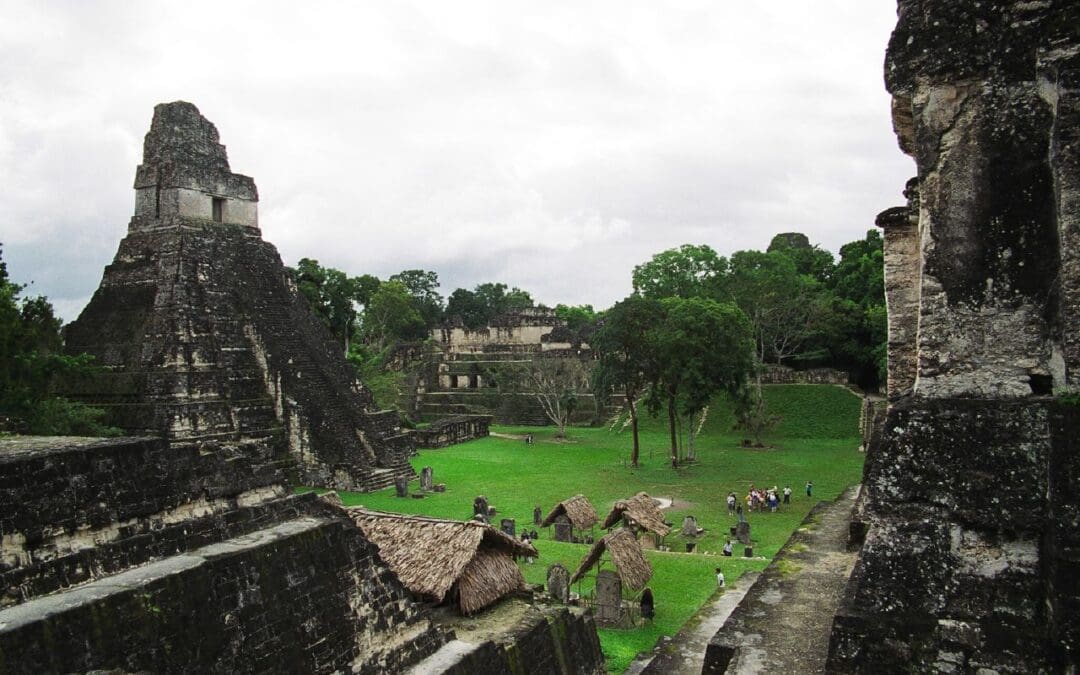
The impressive ruins of Tikal, a powerful Classical Maya city (Creative Commons Licence)
These and other pieces of evidence paint a very clear picture. The Maya cities in the southern lowlands of the Yucatan Peninsula, which had for centuries been the heartland of Maya civlization, went into decline in the 8th and 9th centuries, and soon after were almost completely abandoned.
Cities elsewhere the Yucatan peninsula continued the flourish, however. In fact, they increased in size, and new cities even arose in the northern highlands. It was not until the coming of the Spanish that their end came, and even then it took more than 150 years before the last Maya city fell (in 1697). The Maya people still live in the region, and still nurture their distinctive language and culture.
Causes of Collapse
Why did this 8th-9th centuries collapse occur? Scholars have debated this question for decades, and have put forward many theories. The leading contenders are as follows:
1. Overpopulation and Environmental degradation
This theory proposes that, as the cities flourished and expanded in the Maya heartlands, they had to practice an increasingly intensive form of agriculture to keep their growing population fed. This led to more and more deforestation and soil depletion as pressure on the land mounted. Crops would have suffered, and this would have led to a decline in population through starvation.
What likely made this situation worse was a decades-long drought, for which there is some evidence form the period of the collapse. This would have reduced the availability of water resources, which would have made matters much worse.
The Maya heartlands were probably more dependent of rainfall than other areas, which, being in or at least near to the highlands, would have access to more abundant water sources.
2. Warfare
The Maya civilization was made up a a multitude of city-states. These were often at war with one another. For some reason the wars may have increased in number and intensity as time went by. Some scholars think this many have been linked to internal strife.
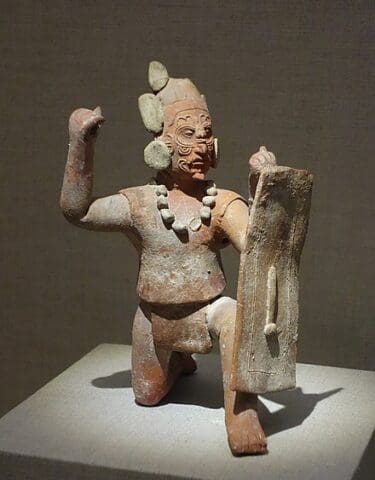
A Maya warrior (Creative Commons Licence)
A variant of this theory is that that there was an invasion – or perhaps several invasions – of the Maya heartland from peoples outside the region. The main suspect in this scenario is the large state centred on the city of Teotihuacan, to the north of the Maya.
3. Shifting trade routes
The Maya civilization was traversed by many trade routes, along which porters or canoes carried trade goods such as jade, obsidian, and cacao. Disruptions to these trade routes may have weakened the economy and contributed to the collapse.
4. Epidemic diseases
An epidemic could account for at least part of the depopulation which took place so suddenly. The heartland of Maya civilization is located within the tropical zone of central America, which is notorious for the infectious diseases it carries. These could have spread widely through the Maya and killed a significant portion of the population. It could also have left many of the survivors with ongoing health problems, which would have rendered them more vulnerable to other diseases.
5. Social, political and cultural factors
Some researchers think that there may have been a shift in religious beliefs, leading to an undermining of the divine status of the rulers. This could have had a large impact on the entire legitimacy of the power structures in the Maya cities, leading to social strife, and, if unchecked, the abandonment of cities.
So what DID happen?
Objections have been raised to all these theories. The evidence is ambivalent for some of them, leaving room for doubt about their severity or timing. For example, much of the evidence for a long drought comes from the very areas in which Maya civilization endured.
Also, one can easily think of examples of other pre-modern societies which experienced all these factors without their settlements being completely abandoned. Overpopulation and environmental degradation have frequently occurred throughout history (notably 14th century Europe and 19th century China); all societies have been afflicted by warfare (the Greek city-states fought each other fiercely at the very time that their culture reached its peak); trade routes have shifted (most notably when the sea route round Africa was discovered and diverted trade from the Mediterranean lands); massive pandemics have afflicted large areas of the world (most famously, the Black Death); and probably no society had escaped social upheaval at some moments in their history.
All this points to an underlying cause for the Maya Collapse of the 9th and 10th centuries. This is that the Classical Maya cities arose in a very fragile environment, were the availability of water was (and is) highly variable. Through extraordinary exertions and innovative techniques, the Maya created a productive agricultural system upon which a brilliant civilization could be built. However, water-management technologies (even in modern times) can only go so far. In these circumstances, a long period of drought could have kicked off all sorts of problems. The result would probably have been exactly what the archaeological record shows: many years of increasing stress, ending in a sudden and catastrophic collapse.
The real question probably is, not so much why this civilization came to an end, as how it had come into came into being in the first place.