
In 1453 the Christian city of Constantinople fell to the forces of the Ottoman sultan, Mehmet II.
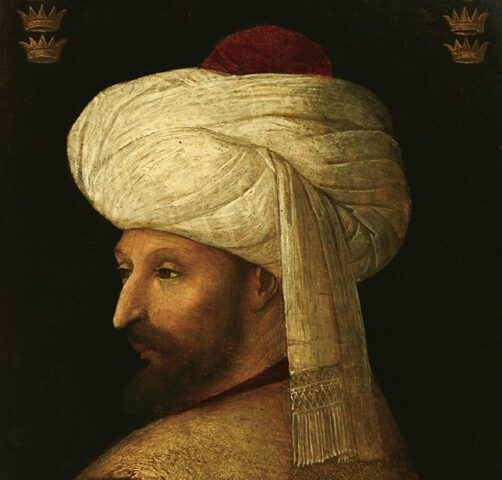
Sultan Mehmed II
This event sent a shockwave throughout Europe.
For hundreds of years, Constantinople had been the capital of what modern scholars call the “Byzantine Empire”. The people of contemporary Europe, though, knew it by a different name: the “Roman Empire”.
Yes, THAT empire.
The people of Constantinople had no doubt about their identity as Romans, and other Europeans also saw them as such (although when they wanted to disparage them they also referred to them as “Greeks”, with its connotations of effeminacy and low cunning).
What’s in a date?
We are accustomed to thinking of the Roman Empire as coming to an end in the fifth century CE. The city of Rome itself was famously sacked by the Visigoths in 410 CE, and again by the Vandals in 455 CE. Meanwhile German tribes had swarmed across vast swathes of the empire, occupying territory from Gaul to North Africa. In 476 CE the last of the Roman emperors, Romulus Augustulus, was forced into abdication by the barbarian general, Odoacar.
Or, actually, not the last of the Roman emperors. Ever since 395 CE the empire had been divided into two parts, with one emperor ruling the western half and the other the eastern half. It was the western half of the empire that had now vanished; the eastern half remained intact, and very much a going concern.
The inhabitants of the Eastern Roman Empire saw themselves as Romans: note, not “heirs” of the Romans, but actual Romans. Ever since 211 CE all the millions of the free inhabitants of the Roman Empire had been Roman citizens. By the end of the Fourth century, whether you lived in Gaul, Spain, Greece, Asia Minor or any other land within the empire, you had come to think of yourself as a Roman.
This Eastern Roman Empire endured for another 1000 years, until the event we are looking at now, the fall of Constantinople in 1453. By this time, the empire was a tiny shadow of its former self. It comprised only the city of Constantinople, with a small area around about, and pockets of territory in southern Greece.
But its significance to Europeans at the time was still huge. It had, after all, been the capital of the great Roman Empire for a millennium, and in its heyday was one of the greatest cities in the world. For centuries it had guarded the rest of Christian Europe from the onward march of Islamic forces from the Middle East. And to the end it housed a sophisticated civilization which other Europeans revered and envied.
What’s in a name?
So, why had the “Roman Empire” come to be called the “Byzantine Empire”? Well, to re-iterate, throughout its existence it was regarded as the Roman Empire by its inhabitants and by others. Indeed, when a Muslim state was established on former Byzantine territory it was called the “Sultanate of Rum” (i.e. Rome). Soon after the fall of Constantinople and the final disappearance of its empire, scholars began referring to it as the “Byzantine” empire, to distinguish it from the earlier “Roman” empire. By the 19th century this designation had become almost universal.
There were several reasons for this. Firstly, the city of Rome never actually lay within the Byzantine Empire’s core territory. It did come under Byzantine rule in the Sixth century, but not for long and only as part of the frontier war zone (Italy being a theatre of war between the Byzantines and Goths throughout that time).
Secondly, the Byzantine empire was, throughout its history, a Christian state, so that the “Byzantine” label served to differentiate it from the pagan ancient Romans.
Thirdly, the language of the Romans, Latin, had ceased to be spoken, even for official purposes, by the Byzantines. By the early seventh century CE., when Greek replaced Latin as the official language of there Byzantine Empire, it was barely understood. It was this fact that led to growing friction – and ultimately Schism (in 1054) – between the Latin-speaking Church of western Europe and the Greek-speaking church of eastern Europe.
Fourthly, the city of Constantinople had been founded in 330 CE by the emperor Constantine the Great – the first Christian ruler of the Roman Empire – on the site of an existing Greek city, called Byzantium. For many, it continued to be known by that name even though its official designation was the “City of Constantine” (or “Constantinople” in its Anglicised Greek form).
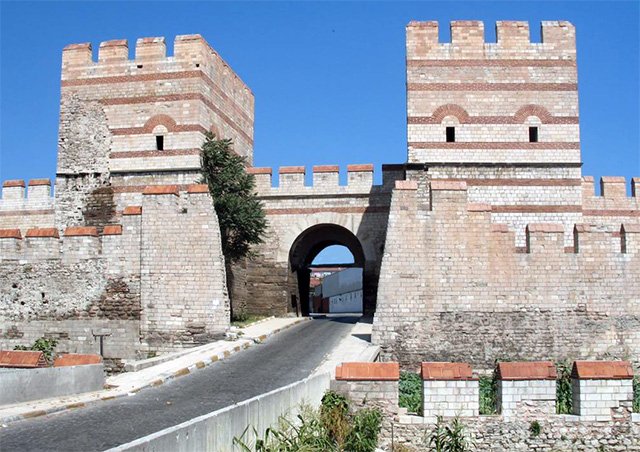
Part of the walls of Constantinople
For all these reasons scholars have regarded the Roman Empire as evolving into a different entity after the loss of its western half in the fifth century. But tell that to the inhabitants of Constantinople in the thousand years that followed!
Links: