
Rise and Fall 395 CE



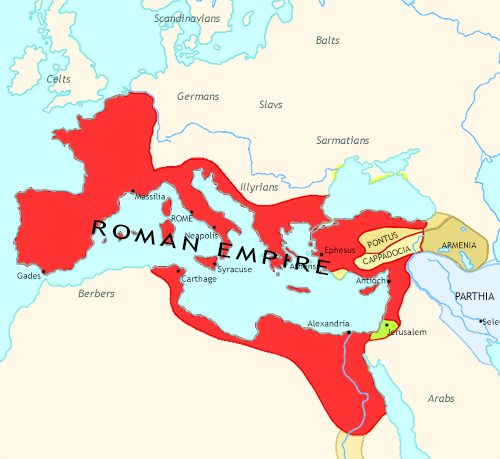
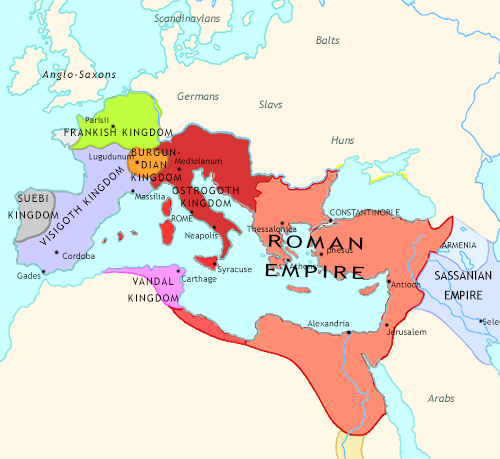
What is happening in Rise and Fall in 395CE
Decline set in at the end of the Second Century CE, as political instability and barbarian invasion ended the peace and prosperity of the earlier empire.
Crisis and change
In the late Second Century CE a plague swept through the Roman Empire. This reduced its population, and its wealth, and its ability to defend itself.
In 180 CE the emperor Marcus Aurelius died. He was the last of a series of good emperors, and the empire was never to know the same level of stability it had known in the second century.
The end of peace and stability
Up to now, the Romans had by and large kept the “barbarian” tribes on their European frontiers at bay. The Parthian Empire, to the east, had also caused little trouble for the Romans. As the Third Century wore on, this all changed. Germans and other tribal groups swarmed over the frontiers in Europe. At the same time new Persian rulers in the east invaded Rome’s eastern frontiers.
These invasions triggered half a century of crisis. One emperor was killed in battle against the invaders, another was captured. In these dangerous times emperors failed to gain the loyalty of the troops, and many rebellions broke out against them. Most emperors lasted no more than a few years on the throne. By the mid-Third century the empire looked as if it was breaking up.
Soldier emperors
The empire survived thanks to a succession of very capable emperors. They were not drawn from the aristocracy, as previous emperors had been. Instead, they had long experience as professional soldiers. They repulsed the invasions, overcame rebellions and reunited the empire.
Finally, the emperor Diocletian, who reigned at the end of the Third Century, carried out many changes to try and ensure that the empire could defend itself properly. He enlarged the army, and admitted many barbarians into it. He expanded the government to make it more effective, and greatly increased taxes to pay for all this.
Four emperors share power
Most famously, Diocletian realized that the empire was too large to be ruled from just one place. For example, it took too long for news of a new invasion to get to the emperor. By the time he was able to lead an army to deal with it the invaders had already caused huge damage.
Diocletian therefore appointed three colleagues to share the burden with him, each with their own capital in different parts of the empire. All of these were near the frontiers, as that was where the main danger now came from. None of these capitals was Rome – it would never again be the center of government for the empire.
Constantinople
A little later, the emperor Constantine the Great reigned in the early Fourth Century. He founded a new capital, Constantinople, at the point where Europe meets Asia. From then, the emperor of the eastern Roman Empire would always be based there.
Diocletian’s scheme of four emperors was not followed by his successors. After the time of Constantine, however, the Roman Empire was usually ruled by two or more emperors at the same time.
Theodosius, however, was sole emperor when he died in 395. On his death he divided the empire between his two young sons. One was assigned the west, the other the east. The empire would never be reunited again, until the western half vanished altogether, less than a century later.
After that, there would only be a single capital again, but this would be Constantinople, not Rome.
Religions, old and new
Most famously, however, Constantine converted to Christianity. He proclaimed that everyone should be free to follow any religion they chose. This was a major turning point for Christianity, as that religion had been suffering from more and more persecutions. Some emperors in the Third Century had blamed that religion for the empire’s misfortunes, and ordered their officials all around the empire to imprison and kill those who did not give up their faith.
Constantine stopped any further persecution of the Christians. From this time on, with only one exception, all Roman emperors were Christians. Following the emperors’ example, more and more people began to join the Christian church.
The Christian Church becomes powerful and wealthy
Many Christians, rich and poor, began leaving their property to the church on their deaths, and the church started gaining in wealth. Bishops became the leaders of their communities, and the Church soon became the wealthiest institution within the empire.
Not all Christians were pleased with this development. An increasing number joined communities in isolated locations to practice their faith in a simple way, free from “worldly” concerns. These communities were the first Christian monasteries. These would become more and more numerous, and have a major influence in Medieval Europe.
Christianity becomes the official religion of the Roman Empire
In 381, the emperor Theodosius decreed Christianity to be the official religion of the empire. Furthermore, only “orthodox” Christianity (i.e. that version of Christianity agreed to by the emperor) would count as the official state religion.
The Huns
The German tribes were increasingly being disturbed by a new factor – the coming of the Huns.
The Huns were a people from central Asia. Their warlike reputation struck fear even into other “barbarians”, like the German tribes who had troubled the Romans for so long.
One of these, the Goths, stood in the Huns’ path. In 378 CE, desperate to escape the Huns, the Goths tried to cross into the empire. The Roman officials on the spot treated the Goths badly, and the Goths massacred them. They then headed south, deep into Roman lands. At the battle of Adrianople they destroyed a Roman army – and a Roman emperor – which came to deal with them.
A new emperor, Theodosius, settled the Goths within the empire, where they lived peacefully for more than 20 years.
What is happening in Rise and Fall in 500BCE
[Teachers: please click here for teaching notes and additional teaching resources for this topic]
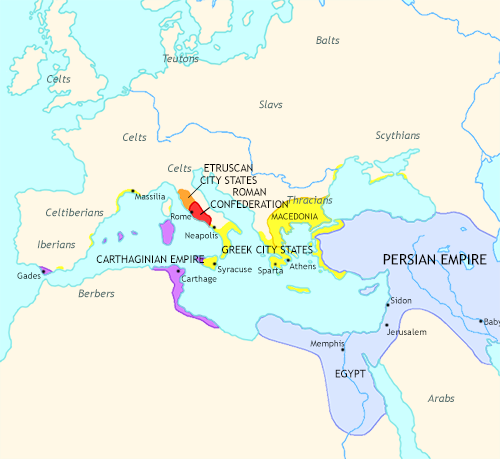
Early Rome appeared in Italy, probably about 800 BCE. By in 500 BCE it had become a city-state and was governed as a republic.
Italy in 500 BCE
In the 500s BCE, many different peoples lived in Italy. Some of these were hill-tribes, who inhabited the mountain regions stretching down the center of Italy. They lived simple lives as farmers and herdsmen, and were tough warriors who often took to raiding the lands of their neighbors.
The peoples who lived near the coast, however, had taken to living in towns and cities. These formed the centers of independent “city-states”, much like those of the Greeks (see our unit on Greece and Persia).
Greek influences
In fact, by 500 BCE several Greek city-states had been established in southern Italy for more than a century. They had brought their city-based way of life to Italy. Along with this had come literacy (based on the alphabet) and Greek-style art and architecture. These were all spreading through Italy.
The Greeks also introduced a new kind of government – the republic. Most Greek city-states had by got rid of their kings. They governed themselves through elected magistrates, advised by councils. This kind of government is now spreading in Italy.
The Etruscans
Apart from the Greeks, the most civilized people in Italy lived in central Italy. They were the Etruscans. They had taken to living in city-states, had adapted the Greek alphabet for their own language, built fine temples and produced beautiful works of art.
In 500 BCE the Etruscans were at the height of their power. Their league of city-states controlled much of central and northern Italy.
The Latins and early Rome
The influence of Etruscan civilization was felt by neighboring peoples. The Latins were one example. They also lived in central Italy, just to the south of the Etruscans. They had taken to living in city-states, and adapted the Etruscan alphabet to their own use (modern English uses the Latin alphabet, only slightly changed).
The small Latin city of Rome was located in the borderland between Latium (the Latins’ homeland) and Etruria (the land of the Etruscans). It also lay between Latium and the warlike hill tribes of central Italy. It therefore had a mixed population, and was regarded with suspicion by all of the surrounding peoples.
From monarchy to republic
A series of Etruscan kings had ruled Rome until recently. They had turned Rome from a collection of villages to a city-state. They had also become tyrannical in their rule, however. According to tradition, the last king was expelled from Rome in 509 BCE. The monarchy was then replaced by a republic.
Early Roman society
Most Romans were farmers, cultivating their own small farms. A small number of the most wealthy families owned larger estates (large farms), which they worked with the help of slaves.
Only a small proportion of Romans work as traders or artisans. Most of early Rome’s sea-going trade, such as it was, was probably in the hands of foreigners such as Etruscans and Greeks.
[Follow this link for Premium teaching resources on the Roman Empire]
What is happening in Rise and Fall in 338BCE
In the period between 500 BCE and 338 BCE the early Roman Republic faced major challenges. These came from both outside and within its borders.
The Sack of Rome and after
The period between 500 BCE and 338 BCE saw the early Roman Republic experience major challenges, even to the point of its very survival. Most dramatically, in about 390 BCE a band of Gauls (whose homeland lay far to the north, in what is now modern France), raided down into Italy. They got as far as Rome, and sacked the city. The Romans paid them a huge amount of gold to get them to return home.
Rome’s neighbors took advantage of this situation to attack. It was only with great difficulty that the Romans were able to defeat them. By 338 BCE, however, they were in firm control of central Italy.
The Conflict of the Orders
These threats from outside the city were accompanied by turmoil within Rome.
When the republic was formed, it was under the control of a small group of families called the Patricians. The rest of the Roman people (the Plebeians) soon came to resent this control. A long period of tension followed, which modern scholars call the “Conflict of the Orders”. These struggles would only end when the Plebeians gaining complete legal equality with the Patricians.
Balanced government
Out of these struggles emerged a system of government in which different parts (or branches) had different roles.
Annually elected officials
First, a growing number of officials, all elected for one year only, acted as army commanders, judges, state treasures and managers of Rome’s water supply, roads, festivals and so on. The most important of these officials were the consuls, two of whom were elected each year, so that neither could become too powerful.
The Senate
Second, a council of the leading men in Rome advised the officials. This council was called the Senate. Most of its members were ex-officials themselves, so that their advice was backed up by great practical experience.
The plebeian assembly and tribunes
Third, the Plebeians had their own assembly. This was under the leadership of their own officials, called tribunes of the people. These had the power to veto laws made by officials which went against the interests of the common people.
Checks and balances
There was often tension between these different branches of government. However, by balancing each other, none of them were able to gain too much political power. The liberty of the Roman people was protected by the checks and balances between the different branches. Only when there was an especially dangerous crisis was this balance suspended, when a dictator would be elected with absolute power – but only for six months.
The beginnings of Roman Law
Another thing to emerge from the Conflict of the Orders was the famous Roman legal system. According to Roman tradition, this began to be written down in the 450s BCE, and was first inscribed on twelve bronze tablets. These “Twelve Tables”, as they were called, were on public display in the main square (forum) in Rome.
In its early form it was frighteningly strict by modern standards. It was also highly patriarchal – early Roman laws emphasized the life and death power a father had over his family. However, it gave all Roman citizens basic legal rights before the law; for example, no one could be punished for a crime without a trial.
Over the centuries, Roman law became more and more complex as new laws were added. It also became less harsh.
Today, Roman law underpins the legal systems of many countries throughout the world.
What is happening in Rise and Fall in 270BCE
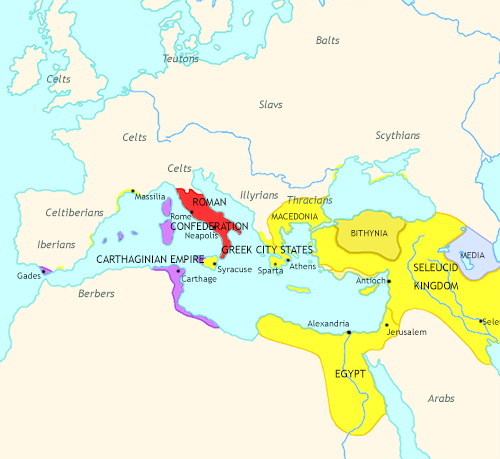
After much hard fighting, the Romans gained control of almost the whole of Italy. They achieved this by wise diplomacy as well as success in war.
The Roman system of Alliances
After the defeat of their enemies in central Italy, the Romans had created a system of alliances which cemented her leadership over them. The Romans left their allies to run their own affairs, free from interference. The one thing they did require from them, however, was that they contribute troops.
Rome was therefore able to call on a much larger pool of manpower for her armies. This enabled her to defeat peoples further afield. Once defeated, these also were brought into the Roman Alliance (or Federation, as some modern scholars have called it).
Military reforms
Within fifty years, Rome had conquered all of Italy except the far north. Even with an ever-expanding pool of manpower to draw on, this had not been easy to achieve. The Romans were up against tough warrior peoples. Roman armies were sometimes heavily defeated.
In the end, however, they were successful. This success was not only down to greater manpower. It was also due to changes in the way the Romans organized their armies. These changes made these armies the most effective in the Mediterranean world at that time.
The Legions
The most important of these changes was the development of the famous Roman legion.
A legions consisted of about 5000 soldiers. However, unlike Greek formations, they were not just one large mass of men. They were divided into units of 100 men each, called centuries. This meant that they were much more flexible than their enemies’ forces. Centuries could fight independently of one another, as well as a part of a whole legion.
The Senate
A key part of the Roman system of government was the Senate, as we have seen. This was the council of wealthy and powerful men that advised the city’s officials.
The Senate consisted of 300 members, who held office for life. In earlier times, they had came from the small number of Patrician families. This had changed as a result of the “Conflict of the Orders”. Plebeians were now elected to public office, and could even become consuls. As the Senate was mostly made up of ex-magistrates, this meant that it was increasingly filled with plebeian senators.
Wealthy Plebeians
It should not be thought that all Plebeians were poor. Probably even in its earliest days, Rome had a few rich Plebeians. Those who were successful traders, for example, probably matched the wealth of many Patricians. As Rome’s power expanded throughout Italy, so did her trade. This meant that there were more and more wealthy merchants.
Also, the ruling families of Italian allied cities and tribes were soon intermarrying with the leading Roman families. They thus entered the upper rungs of Roman society.
A new ruling class
These new groups of wealthy plebeian families were soon producing men who were being elected to public office and becoming Roman senators. The distinctions between Patricians and Plebeians began to disappear. A new ruling class was emerging at Rome, made up of members of both groups.
The end of the Conflict of the Orders
The new plebeian senators continued to have strong links with the Plebeian Assembly, and the tribunes were increasingly drawn from this group. Indeed, the office of tribune became a normal part of most plebeian senator’s politIcal careers. In these circumstances, the Conflict of the Orders became a thing of the past.
Greek influence
By the early Third Century BCE, a number of Greek city-states in southern Italy had come under Roman control. This brought the Romans into much closer contact with Greek civilization. Wealthier Romans began to acquire a taste for Greek art, architecture and literature. This was much to the disgust of conservative Romans, who regarded such influences as alien and “softening”.
What is happening in Rise and Fall in 200BCE
Two long, hard wars with the wealthy trading city of Carthage ended with Rome being the leading power in the western Mediterranean.
The First Punic War
The year 264 BCE saw the start of series of long wars between Rome and the city of Carthage, located in North Africa. The Romans called them the Punic Wars, because Carthage had originally been founded by Phoenician colonists, and the Latin for “Phoenician” is Punicus. These wars took Roman forces overseas for the first time.
Carthage was a wealthy trading city. She was also a strong military power. Her navy dominated the western Mediterranean, and she used her wealth to pay for a large mercenary army.
Alarmed by the rise of Roman power in Italy, the Carthaginians sent armies to the island of Sicily to shore up their power there. Some Greek cities in Sicily appealed to Rome for help, and the Romans sent an army there as well. The First Punic War began soon after.
Building a navy
To defeat one of the leading naval powers of the Ancient World, the Romans had to build a powerful navy from scratch. After nearly twenty years of hard fighting, and some dreadful losses (mostly in fleets destroyed by storms), the Romans were able to gain control of the seas around Italy and Sicily. In 241 the war came to an end in a Roman victory.
In the peace treaty that followed, the Carthaginians agreed that they would not rebuild their navy.
The Second Punic War
The Carthaginians did not take their defeat lying down. Over the next 20 years they carefully built up their power-base in Spain. By 220 BCE the person in charge in Spain was a young man called Hannibal. He would become recognized as one of the greatest generals in world history.
Hannibal crosses the Alps
In 218, Hannibal led a large army out of Spain, into southern Gaul, and from there across the Alps and down into northern Italy. This took the Romans completely by surprise. His army was then joined by thousands of Gallic warriors in northern Italy, who saw the Romans as a growing threat to their independence.
The greatest Roman defeat
Hannibal then invaded south into Roman territory. Over the next three years the Romans sent three large armies against him. Hannibal destroyed them all. The last of these victories was at Cannae (216 BCE), in southern Italy. The Romans came to regard this as the worst defeat they ever suffered in their history.
Hannibal then demanded Rome’s surrender – but the Romans, led by the Senate, refused. Hannibal then encouraged Rome’s allies to join him against her. Only a few cities went over to him. The majority remained loyal.
For the next 10 years Hannibal marched his army up and down Italy to little effect. He was unable to receive support from his home city, as the Roman navy controlled the seas in between Italy and North Africa.
Roman victory
During this time, the Romans carefully nursed their strength, and when they were ready, went over to the attack. While still avoiding battles in Italy, Roman armies drove the Carthaginians out of Spain and Sicily. They then invaded the Carthaginian home territory in North Africa.
The Carthaginians quickly recalled Hannibal to lead the defense of their city, but the Romans won a great victory at the battle of Zama, in 202 BCE. This ended the Second Punic War.
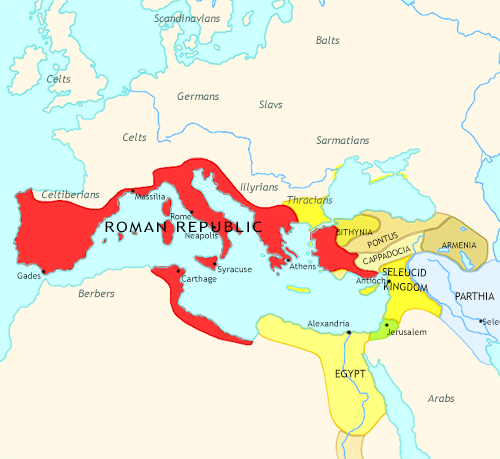
Victory against Carthage left Rome in control of territories in Sicily, Sardinia, Corsica and Spain. She possessed the beginnings of an overseas empire.
During the war, it was the Senate that assumed most of the responsibility for directing the war. Its success in this enormous task gave it great prestige, and it now dominated Roman politics.
What is happening in Rise and Fall in 100BCE
After Rome’s victory in the Second Punic War her power continued to expand. This, however, brought deep changes to Roman society. Her political system was designed for a small city-state, however, and found it hard to adapt to these changes.
Further expansion
The end of the Second Punic War found Rome as the leading power in the western Mediterranean. Very soon, her forces were heavily involved in the eastern Mediterranean as well. A series of wars ended in the conquest of the kingdom of Macedonia and the city-states of Greece (in 146 BCE – we have studied these in the unit on Greece and Persia)).
The end of Carthage
Meanwhile, Carthage had been recovering its strength. This led the Romans to deal with their great enemy once and for all. In the Third Punic War (149-146 BCE), therefore, the Romans destroyed Carthage, killed many of its people and sold the rest off into slavery. They added Carthage’s territory in North Africa to their growing empire.
In the following decades they annexed western Asia Minor, conquered more of Spain, and occupied a strip of southern Gaul (France).
A less equal society
The expansion of Roman power brought great changes to Rome.
The rich become richer
Early Rome was a society of small independent farmers. Now, huge amounts of war booty and tribute flowed into Rome from her overseas conquests. This made many Romans vastly rich. Senatorial generals and governors made fortunes out of the provinces. So did a growing class of wealthy businessmen.
The poor become poorer
The many wars also flooded the Roman slave markets with captives. Thousands were put to work on the estates of wealthy Romans. These estates were able to produce grain and other farm produce much more cheaply than smaller farms. The small independent farmers found themselves squeezed.
Many of them sold up to their richer neighbors. They moved to the city of Rome, where they swelled the numbers of landless poor. They lived in the overcrowded slums of the rapidly growing city. The Italian countryside meanwhile lost many of its small farms as large slave-run estates covered more and more land.
The Gracchi
The Latin word “Gracchi” is the plural of “Gracchus”. That was the name of two brothers who tried to bring about change, but were killed for their efforts.
Tiberius Gracchus was elected one of the tribunes for the year 133 BCE. He proposed carving up large estates and creating small farms for landless Roman families. This idea was naturally very popular with the poor, and very unpopular with the rich. Tensions led to riots. Tiberius was killed in one of these.
Ten years later, Tiberius’ younger brother, Gaius Gracchus, tried again to allocate land to the landless poor. Again violence flared, and Gaius was killed.
These events marked the onset of violence in Roman politics.
Professional armies
Up to now, the troops in Rome’s armies were mostly owners of small farms. The early Romans thought that those with some land would feel that they had a stake in Rome’s fortunes. They would be more loyal and fight more stoutly.
As we have seen, however, this class was now being squeezed. At the same time, Rome’s wars were now being fought overseas, not in Italy. Farmer-soldiers were having to serve for several years at a time. This made military service very difficult for them and their families. It added to their problems.
By the late 100s BCE, therefore, Roman armies were running short of recruits. In 107 BCE, a consul named Marius opened army service to those without any land. From now on, Roman armies would increasingly be made up of professional, long-service soldiers.
What is happening in Rise and Fall in 50BCE
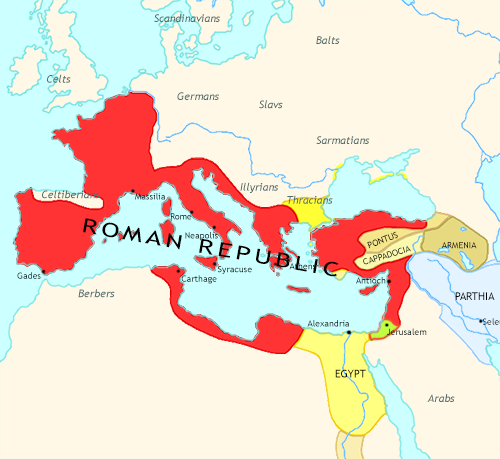
During the first half of the First Century BCE, the expansion of Roman power continued, with dramatic conquests in the east and in Gaul. Meanwhile, however, Rome’s political and social troubles got worse and worse.
The rebellion of the Italian Allies
The relationship between Rome and her Italian Allies had been breaking down for some time. There was a growing feeling that the Roman leaders increasingly ignored the interests of their allies.
In 90 BCE, many of Rome’s Italian allies rebelled, leading to a bitter war (90-88 BCE). This was only brought to an end when the Senate granted full Roman citizenship to all Italians.
This war is known to history as the “Social War”. This confusing name is due to the fact that the Latin the word for “allies” is socii (from which we get such English words as “society” and “associates”).
The first civil wars
These years also saw the outbreak of the first civil war in Rome’s history . This grew out of bitter political competition between two leading Romans, Marius and Sulla.
What turned political rivalry into open war was the fact that Roman armies were now made up of a new kind of soldier. In place of the short-service farmer-soldiers of the old days were full-time, long-service professionals. These were largely recruited from the landless poor. When they were discharged, they looked to their commanders to have grants of land made to them. Given Rome’s poisonous political climate, a commander’s bid for land for his veterans was almost sure to be blocked by political rivals. His soldiers were therefore prepared to back his efforts with violence in order to achieve their aims.
It was these conditions which led to the fighting. Both Marius and Sulla were successful generals with many loyal but desperate soldiers at their back.
Eventually Sulla triumphed, and had himself appointed dictator (82 BCE – he resigned the next year, though not before trying to eliminate his political enemies). He set an example to later generations of over-ambitious leaders as the first “strong man” in Roman history.
Disorder on the increase
After Sulla’s time, the political climate in Rome continued to worsen. Widespread corruption and bitter factionalism increased. Leading politicians even allied themselves with violent crime gangs to attack rivals.
The checks and balances had once given Roman government great strength. They now stood in the way of finding solutions to Rome’s problems.
A few men tried to hold the tide back by proposing reforms. The best known of these was the famous orator, Cicero. Their efforts were in vain as politicians blocked any measures to bring about change.
Slave revolts and piracy
The paralysis in Roman government made it harder to meet dangerous threats. A major slave revolt in southern Italy, led by a gladiator called Spartacus, was only put down with great difficulty. A little later an alarming rise in piracy across the eastern Mediterranean took place. Only a huge effort by Roman sea and land forces, under the command of a general called Pompey, was able to bring this under control.
Over-mighty generals
An even greater threat to the Roman Republic was the continuing rise of over-mighty generals, such as Pompey and Julius Caesar. These increasingly viewed their troops almost as private armies.
The First Triumvirate
In 60 BCE, three leading figures in Rome made a pact. Their aim was to dominate the government of Rome. The first was Pompey, the leading general of the day. He had defeated the pirates and brought all the lands of the eastern Mediterranean (except Egypt) under Roman rule. The second was Crassus. Although not a famous general, he was a leading politician and known as the wealthiest Roman of all. The third was Julius Caesar, a military genius who had scored brilliant successes in Spain. He was ambitious for more glory.
Modern scholars call this pact the “First Triumvirate”.
Julius Caesar conquers Gaul
Julius Caesar spent the next ten years conquering the whole of Gaul, and even invading the semi-legendary islands of Britain, in 55 and 54 BC. During these years he wrote about his campaigns in detail, sending his reports back to Rome. Here they were read widely, and made him very popular with the common people.
Crassus’ death in battle in 53 BCE dealt a fatal blow to the triumvirate. By this date, many senators had become alarmed at Caesar’s growing success. They asked Pompey to lead a powerful anti-Caesar faction.
What is happening in Rise and Fall in 1CE
The Roman Republic fell apart and the Roman world was wracked by civil war after civil war. The Senate had completely lost control of government. Finally, in 31 BCE, one man became master of the Roman world, and became the first of the Roman emperors.
Caesar marches on Rome
In 49 BCE, knowing that his enemies in the Senate intended to bring about his downfall, Caesar crossed the river Rubicon, which marked the boundary between Italy and Gaul, and led his army on Rome.
Pompey and his allies fled to Greece, where Caesar followed them and defeated them at the battle of Pharsalus (48 BCE). Pompey himself escaped to Egypt, but was killed there on the orders of the king.
Caesar then spent some years dealing with other enemies, and returned to Rome in 45 BCE. He made himself dictator for life. However, on the 15th March, 44 BCE (the famous “Ides” of March, according to the Roman calendar), he was assassinated by some of his enemies.
Two new leaders: Mark Antony and Octavian
Two men emerged to avenge Caesar’s death. These were Mark Antony (his full name was Marcus Antonius), Caesar’s former chief lieutenant, and a young man who was Julius Caesar’s adopted son and heir, named Octavian (full name: Gaius Julius Caesar Octavianus). A third, Lepidus, joined them to form the Second Triumvirate, a pact between the three leaders to take control of the Roman government. Lepidus, however, was soon sidelined by the other two.
Antony and Octavian led an army to Greece, where the assassins had fled to. There they defeated the assassins’ at the battle of Philippi (42 BCE).
The triumph of Octavian
Octavian then returned to Rome, while Antony went to the eastern Mediterranean to deal with Rome’s enemies there. He soon fell in love with Cleopatra, the queen of Egypt, and made Egypt his base. Because of this, Octavian was able to turn the Romans against Antony by accusing Antony of betraying his country.
Yet another civil war inevitably followed. Octavian led a fleet to attack Antony and Cleopatra’s fleet in Greece, and there defeated them at the battle of Actium (31 BCE). Antony and Cleopatra both escaped back to Egypt, where they committed suicide. Octavian followed them there and annexed Egypt to the Roman empire. He was now the sole master of the Roman world. He returned to Rome and set about bringing peace and order to it.
The first Roman emperor
Octavian knew that the Roman people were deeply attached to their republican form of government. They had no wish to be ruled by a king, nor by a dictator (at least, not for more than a short period of time). He understood very clearly, however, that the old Republic, and particularly the Senate, was completely unable to control the powerful generals and governors that the empire now needed.
The Restorer of the Republic…or maybe not
Octavian was therefore very careful, to show respect to the Senate and other institutions of the Republic. In fact, he claimed to be the “Restorer of the Republic”. At the same time, however, he reorganized it so that he, not the Senate, dominated the government of Rome.
The chief thing he did was to get the Senate to give him control over most of the legions. This meant that he had so much military power that no other general could challenge him.
New imperial titles
To emphasis his wide military power he took the title of Imperator, or “Supreme Commander”. It is from this word that we get the English word “Emperor”. In 27 BCE he also had the Senate give him a new title,“Augustus”. This loosely translates as “Revered One”. All his successors as emperor used the same title.
Stability and peace
By ending the cycle of civil wars which plagued the Roman world, Augustus brought peace to the Roman world. This “Pax Romana” (or Roman Peace) would last for more than two hundred years.
The changes that Octavian (or Augustus as he was now called) made were very important in Roman history. In fact Modern Scholars divide Roman history into two main parts. Apart from in its very early days, up to Augustus’ time Rome was governed as a Republic, with elected officials, a Senate and assemblies of the people. By concentrating power in his own hands, Augustus turned Rome into a Monarchy (which means the rule of one man).
The traditional institutions of the Republic continued to exist – the Senate, the consuls and other public officials. But their power was now overshadowed by that of Augustus and his successors.
What is happening in Rise and Fall in 500CE
In the Fifth Century, invasions by German tribes destroyed the western half of the Roman Empire. The eastern half, however, continued to another thousand years.
The invasions of the west
After 395 CE, the two halves of the empire operated more or less as separate states. Most importantly, the taxes collected by each half’s government was spent within its own sphere. This put the west at a disadvantage. The western provinces were poorer than those of the east. The western government therefore had less to spend on defending a much longer and more dangerous border.
The sack of Rome
In the early Fifth Century the Goths marched into Italy. The Roman government unwisely refused their demands for payment. The Goths therefore sacked Rome, in 410 CE.
The sack did little damage to Rome, but it sent a shockwave around the Roman world. It had not been the capital of the empire for more than a century, but it stood as the heart and soul of the Roman people.
German tribes invade the western provinces
Meanwhile, in 406, large groups of Germans had crossed the northern frontier, into Gaul. Modern historians think that. like the Goths before them, they too were fleeing before the fearsome Huns.
Whatever their motives, they caused devastation wherever they went. Villas were destroyed, towns burned and people fled. Some of these marched long distances, across Gaul and on into Spain, and even North Africa.
These German tribes all soon set up kingdoms of their own. Even though some paid lip-service to the Roman emperor as their superior, in fact they were all independent.
The end of Roman Britain
In 410 the Roman army in Britain was ordered across into Gaul, to help deal with the troubles there. It never returned. The Britons were forced to organize their own defenses.
From now on, Britain was no longer part of the Roman Empire. From the mid-fifth century German peoples, above all the Anglo-Saxons, began to settle in Britain in large numbers. Most traces of Roman civilization there quickly vanished – city-life, literacy, Christianity and much more.
The Huns
In the mid-Fifth Century, the Huns marched westward into Gaul under their leader, Attila. Such an invasion had been a major fear for both Romans and Germans, but in the event the Huns were defeated by a joint Roman-Visigoth army.
The power of the Huns vanished soon after, when Attila died.
The end of the western Roman Empire
In North Africa, a German tribe called the Vandals had built a large fleet. They used this to raid the Mediterranean coasts. In 455 CE they sacked Rome. This did not have the same traumatic effect that the first one had done, but the damage to the city was much more extensive. The word “Vandal” came to mean someone who destroys things just for the sake of it.
The end of Roman rule in the west
In the rest of the western Roman Empire, the German kingdoms expanded until there was no Roman territory left under Roman rule. Finally, in 476 CE, the German leader who dominated Italy took the title of king of Italy. At the same time he arranged for the abdication of the last of the western Roman emperors. This was a young boy names Romulus Augustulus.
The end of Roman civilization in the west
The decline of Roman power in the west had gone hand-in-hand with the decline of Roman civilization there. The great Roman towns were shrinking, the beautiful villas had mostly gone, and the well-built roads were falling into disrepair. The Latin language had begun to morph into French, Italian, Spanish, Portuguese, Catalonian and Provencal. Roman-style education declined and most people were now illiterate.
Roman influences were far from dead, however. To help them in governing their new kingdoms, the German rulers used Roman officials. Most of their populations still lived under a form of Roman law. Christian monks preserved as much Roman writing as they could.
The Eastern Roman Empire continues
In the eastern Roman empire, life continued very much as before. The eastern provinces had always been wealthier than the western ones. Since the division of the empire in 395, the emperors in Constantinople had been able to maintain a large army. This had been able to defend the eastern provinces properly.
Despite many ups and downs, the Eastern Roman Empire would endure for almost another thousand years. Modern scholars call it the Byzantine Empire, to emphasize the differences between it and the old Roman Empire. The Byzantines were Greek in language and culture, not Latin. They continued to think of themselves as Romans, however. Finally, the end of their empire came in 1453, when Constantinople fell to the Turks. This was just a generation before Columbus discovered America.

Subscribe for more great content – and remove ads